Advertisements
Advertisements
प्रश्न
How does G. N. Devy bring out the importance of the oral literary tradition?
Advertisements
उत्तर
G. N. Devy brings out the importance of the oral literary tradition by referring to the richness of the works of the tribals that have been handed down from one generation to the other orally. He tries to bring home the point that though the literary compositions have been transmitted orally yet thematically and ornamentally they are very rich. The stories and songs that have come down to the tribals through oral tradition are unique. These compositions present the exclusive world view of the tribals. He points out that the wealth and variety of these works is very enormous. In order to show the importance of the oral literary tradition, Devy throws light on the various characteristics of the tribal arts. He shows that one of the main characteristics of tribal arts is their distinct manner of constructing space and imagery, which might be described as hallucinatory. Playfulness is another dimension of this tradition. Devy advocates that proper recognition should be given to the oral literary tradition in view of its variety and richness.
APPEARS IN
संबंधित प्रश्न
What were Helen’s memories of Radcliffe?
Answer any three of the following in 30-40 words each:
(a) Why has the poet’s mother been compared to the ‘late winter’s moon’?
(b) The poet says, ‘And yet, for these Children, these windows, not this map, their world.’ Which world do these children belong to? Which world is inaccessible to them?
(c) What was the plea of the folk who had put up the roadside stand?
(d) What will happen to Aunt Jennifer’s tigers when she is dead?
Complete the flow-chart :

Answer the following in 200-250 words :
Describe the relationship between Anne and Margot?
Give reasons for the following statement.
The author thought that his positive thinking strategy worked well after all.
|
The energy stored in coal and petroleum originally came to the earth from the sun. The bulk of the present-day supplies was laid down some 200 to 600 million years ago, when tropical conditions were widespread. Lush, swampy forests produced huge trees; warm coastal seas swarmed with microscopic forms of life. When these organisms died, much of their tissue was recycled as it is today — through scavenging and decay. But a significant amount of dead plant and animal material was covered with mud, which prevented complete decomposition. With the passage of time, layer upon layer of the fine sediment was deposited over the once-living material; the sheer weight turned the sediments to rock. Sandwiched between the layers, both coal and petroleum were produced and preserved under pressure. Coal was formed mostly of giant fern-like plants that have only small counterparts today. Coal may still be forming here and there on earth, but conditions are not right for the production of significant quantities. |
Underline the important words and phrases.
Tick the statement if its true.
Rajendra Deshpande was a historian.
We 'draw up a deed'. Complete the following phrase with an appropriate word.
________one's will
How is colour highlighted in the poem and why? List all the words in the poem that suggest colour.
Find from the poem, positive qualities to fill up the web.
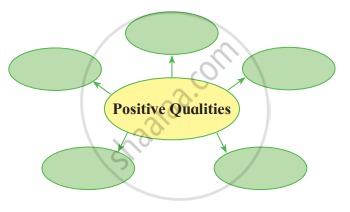
Say why the speaker of the poem wishes to be a -
watchman
complete the following sentence.
Ajoy reported about ________________.
‘The city now, doth, like garment wear’. The poet imagines that the city is wearing a beautiful garment. Hence, the figure of speech is personification. Find out more examples of personification from the poem.
Justify the verdict delivered in the poem.
I can support my answer with the help of the following suitable arguments:
- _______________________
- _______________________
- _______________________
Go through the poem and state whether the following statement is true or false.
The newly planned city looks modern and amazingly beautiful.
Pick out the statements which aptly depict the theme of the poem.
- In the poem, the speaker memorises the past.
- In ‘The Planners’ the poet describes the unstoppable force of modernisation.
- The poet talks about the replacement of natural environment by the concrete jungle.
- The poet proposes to stop modernisation.
- The poet laments helplessly.
Wash your handkerchief clean. Hang it with a peg to dry in the wind. Watch how it flutters.
Read the story and write about the following in short.
Kojo
Hold a mock trial for the following offence. There should be a complainant, a defendant, and lawyers to argue the case on behalf of them. The whole class can vote to pass the judgment. On what occasions will you plead for justice? What punishment will you suggest? When will you plead for mercy?
A poor man stole some ornaments from a rich girl.
Read the following sentence aloud. Write who said it and to whom.
“What! ... how ! ... That’s impossible! ”
Prepare similar word chains using the following ideas.
size - small _______________.
Complete the following sentence with reference to the passage.
They may be composed and sung or recited for many years before __________________.
There were no human settlements on the moon.
What did the husband want to buy?
List and say whether the following statement agrees with the passage or not.
You should look at the person you are talking to.
What did the important-looking man tell Gulliver?
The poem has rhyming words at the end of the lines. Find and write the pairs of rhyming words in each stanza.
List the rhyming words in the (On the water) poem.
Do you agree with the poet’s thoughts? Why?
Which event in the story tells us that the lion was brave?
Read the following and say whether the statement tells you about a fact or whether it is imaginary.
There is a man in the Moon.
What is ‘e-mail’ or electronic mail?
Find out the difference between the fingerspelling method, sign language and Braille.
Give two reasons why Miranda was so concerned about Ferdinand.
What made the reporter gaze at the author?
Read the incident again and answer the following question.
When did the writer remember the fact that he had to buy something for Mr. Gilson?
Hamid’s granny scolded him for buying iron tongs. Then she understood that Hamid had bought it ______.
The wind hurried and passed through the ______
What kind of learning brings joy to you?
Why did the train stop in the middle of the forest?
Why was Sir Francis angry?
What did Mr. Fogg mean by, ‘it was foreseen’?
It is a problem for sea turtles to come ashore because ______.
Read the comic strip again. Make groups of four and frame some questions on what you have read. Each group should ask a question in turns. You cannot repeat the same question. The team which asks more questions is the winner.
e.g:
- Which are the foreign vegetables mentioned?
- What was sad for Columbus?
Narrate the story based on the story map
Gulliver was the captain of the ship.
We get water by burning _______.
Where is Jaswantgarh located?
What did you learn from this lesson?
What was the message on the chit?
What party is that?
What was the reason behind Nandhini’s dullness?
Where do the crocodiles save?
A Shepherd had a _______.
The grandmother had kept the plate in memory of her ______.
The Delhi government did not allow blind children to study Science after ____________.
Why is your nose important for you?
Write the related words as shown in the example:
Read the following passage and answer the questions that follow:
The Stationmaster’s Supreme Sacrifice by Sanchari Pal (Adapted)
- Thirty-three years ago, on the night of December 2, 1984, Bhopal was hit by a catastrophe that had no parallel in the world’s industrial history. An accident at the Union Carbide pesticide plant in Bhopal had released almost 30 tons of a highly toxic gas called methyl isocyanate, turning the city into a vast gas chamber. The result was a nightmare; more than 600,000 people were exposed to the deadly gas cloud that left thousands dead and many more breathless, blind and in agonizing pain. Few people know that during the Bhopal gas tragedy a heroic stationmaster risked his own life to save others.
- On the evening of December 3, 1984, Ghulam Dastagir was settling down in his office to complete some pending paperwork. This work kept him in his office till 1am in the night, when he emerged to check the arrival of the Gorakhpur Mumbai Express. As he stepped on to the platform, the deputy stationmaster felt his eyes burn and a queer itching sensation in his throat. He did not know that poisonous fumes leaking from Union Carbide’s pesticide factory were stealthily enveloping the railway station.
- Beginning to choke, Dastagir did not know then that twenty-three of his railway colleagues, including his boss, station superintendent Harish Dhurve, had already died. It was later reported that Dhurve had heard about the deadly gas and had immediately tried stopping the movement of trains passing through Bhopal before collapsing in his office chamber. His suddenly worsening health and years of experience told Dastagir that something was very wrong. Though he did not fully comprehend what was happening, he decided to act immediately when he did not get any response from the station master. He alerted the senior staff at nearby stations, like Vidisha and Itarsi, to suspend all train traffic to Bhopal.
- However, the jam-packed GorakhpurKanpur Express was already standing at the platform and its departure time was 20 minutes away. Listening to his gut instinct, Dastagir summoned his staff and told them to immediately clear the train for departure. When they asked if they should wait until the order to do so came from the head office, Dastagir replied that he would take complete responsibility for the train’s early departure. He wanted to ensure that the train left immediately, without any delay. His colleagues later recalled that Dastagir could barely stand and breathe as he spoke to them. Breaking all rules and without taking permission from anyone, he and his brave staff personally flagged off the train.
- But Dastagir’s work was not done. The railway station was filling up with people, desperate to flee the fumes. Some were gasping, others were vomiting, and most were weeping. Dastagir chose to remain on duty, running from one platform to another, attending, helping and consoling victims. He also sent an SOS to all the nearby railway offices, asking for immediate medical help. As a result, four ambulances with paramedics and railway doctors arrived at the station. It was winter and the gas was staying low to the ground, a thick haze poisoning everything in its path. Besieged by hordes of suffering people, the station soon resembled the emergency room of a large hospital. Dastagir stayed at the station, steadfastly doing his duty, knowing that his family was out there in the ill-fated city. That day all he had for his protection was a wet handkerchief on his mouth.
- Ghulam Dastagir’s devotion to duty saved the lives of hundreds of people. However, the catastrophe didn’t leave him unscathed. One of his sons died on the night of the tragedy and another developed a lifelong skin infection. Dastagir himself spent his last 19 years shuttling in and out of hospitals; he developed a painful growth in the throat due to prolonged exposure to toxic fumes. When he passed away in 2003, his death certificate mentioned that he was suffering from diseases caused as a direct result of exposure to MIC (Methyl Isocyanate) gas. A memorial has been built at platform No.1 to pay tribute to those who sacrificed their lives in the line of duty on the fateful night of December 3, 1984. However, Ghulam Dastagir, who died later, is not one of them. A forgotten hero whose sense of duty and commitment saved countless lives, Dastagir’s story deserves to be recognized and remembered by our fellow countrymen.
- Why was the accident at Union Carbide unparalleled in the world’s industrial history?
- How was Dastagir affected by the poisonous gas?
- What was the action taken by the station superintendent?
- How did Dastagir and his staff break rules?
- What was the cause of Dastagir’s death?
- Find words from the passage which mean the opposite of the following.
- safeguard (para 1)
- common or familiar (para 2)
- prompt (para 4)
- cause (para 6)
Read the passage below:
| 1. | Our history makes it evident that the Indian Plastics Industry made a vigorous beginning in 1957 but it took more than 30 years for it to pervade Indian lifestyles. In 1979, "the market for plastics' was just being seeded by the state-owned Indian Petro-Chemicals and it was only in 1994 that plastic soft drink bottles became a visible source of annoyance. |
| 2. | In the same year, people in other cities were concerned about the state of public sanitation and also urged regulatory bodies to ban the production, distribution and use of plastic bags. However, the challenge was greater than it appeared at first. |
| 3. |
The massive generation of plastic waste in India is due to rapid urbanisation, spread of retail chains, plastic packaging from grocery to food and vegetable products, to consumer items and cosmetics. The projected high growth rates of GDP and continuing rapid urbanisation suggest that India's trajectory of plastic consumption and plastic waste is likely to increase.
|
| 4. | According to the United Nations Environment Programme (UNEP) report of 2018, India stands among few other countries like France, Mongolia and several African countries that have initiated total or partial nationallevel bans on plastics in their jurisdictions. On World Environment Day in 2018, India vowed to phase out single-use plastics by 2022, which gave a much needed impetus to bring this change |
| 5. | In this context, thereafter ten states (Andhra Pradesh, Chhattisgarh, Gujarat, Himachal Pradesh, Karnataka, Madhya Pradesh, Meghalaya, Odisha, Rajasthan and Tamil Nadu) are currently sending their collected waste to cement plants for co-processing, twelve other states/UTs are using plastic waste for polymer bitumen road construction and still four other states are using the plastic waste for waste-to-energy plants and oil production. A world of greater possibilities has now opened up to initiate appropriate and concrete actions to build up the necessary institutions and systems before oceans turn, irreversibly into a thin soup of plastic. |
| 6. | However there is no one single masterstroke to counter the challenges witnessed by the staggering plastic waste management in the country. The time is now to formulate robust and inclusive National Action Plans and while doing so, the country will establish greater transparency to combat the plastic jeopardy in a more sustainable and holistic way. |

Based on your understanding of the passage answer any six out of the seven questions given below:
- What does the writer mean by 'visible source of annoyance'?
- Why did people demand a ban on plastics?
- What created a demand for plastics in India?
- With reference to the graph write one conclusion that can be drawn about the production of plastics in 2019 (approximately).
- What does the upward trend of the graph indicate?
- What does the line, oceans turning 'irreversibly into a thin soup of plastic', suggest?
- What step must be taken to combat the challenges of plastic waste management? What will be its impact?
