Advertisements
Advertisements
Question
How does G. N. Devy bring out the importance of the oral literary tradition?
Advertisements
Solution
G. N. Devy brings out the importance of the oral literary tradition by referring to the richness of the works of the tribals that have been handed down from one generation to the other orally. He tries to bring home the point that though the literary compositions have been transmitted orally yet thematically and ornamentally they are very rich. The stories and songs that have come down to the tribals through oral tradition are unique. These compositions present the exclusive world view of the tribals. He points out that the wealth and variety of these works is very enormous. In order to show the importance of the oral literary tradition, Devy throws light on the various characteristics of the tribal arts. He shows that one of the main characteristics of tribal arts is their distinct manner of constructing space and imagery, which might be described as hallucinatory. Playfulness is another dimension of this tradition. Devy advocates that proper recognition should be given to the oral literary tradition in view of its variety and richness.
APPEARS IN
RELATED QUESTIONS
When and how did the people of Iping grow suspicious of the invisible man ?
Notice these expression in the text. Infer their meaning from the context.
careered down
Read the text below and summarise it.
The Great Desert Where Hippos Once Wallowed
The Sahara sets a standard for dry land. It’s the world’s largest desert. Relative humidity can drop into the low single digits. There are places where it rains only about once a century. There are people who reach the end of their lives without ever seeing water come from the sky.
Yet beneath the Sahara are vast aquifers of fresh water, enough liquid to fill a small sea. It is fossil water, a treasure laid down in prehistoric times, some of it possibly a million years old. Just 6,000 years ago, the Sahara was a much different place.
It was green. Prehistoric rock art in the Sahara shows something surprising: hippopotamuses, which need year-round water.
“We don’t have much evidence of a tropical paradise out there, but we had something perfectly liveable,” says Jennifer Smith, a geologist at Washington University in St Louis.
The green Sahara was the product of the migration of the paleo-monsoon. In the same way that ice ages come and go, so too do monsoons migrate north and south. The dynamics of earth’s motion are responsible. The tilt of the earth’s axis varies in a regular cycle — sometimes the planet is more tilted towards the sun, sometimes less so. The axis also wobbles like a spinning top. The date of the earth’s perihelion — its closest approach to the sun — varies in cycle as well.
At times when the Northern Hemisphere tilts sharply towards the sun and the planet makes its closest approach, the increased blast of sunlight during the north’s summer months can cause the African monsoon (which currently occurs between the Equator and roughly 17°N latitude) to shift to the north as it did 10,000 years ago, inundating North Africa.
Around 5,000 years ago the monsoon shifted dramatically southward again. The prehistoric inhabitants of the Sahara discovered that their relatively green surroundings were undergoing something worse than a drought (and perhaps they migrated towards the Nile Valley, where Egyptian culture began to flourish at around the same time).
“We’re learning, and only in recent years, that some climate changes in the past have been as rapid as anything underway today,” says Robert Giegengack, a University of Pennsylvania geologist.
As the land dried out and vegetation decreased, the soil lost its ability to hold water when it did rain. Fewer clouds formed from evaporation. When it rained, the water washed away and evaporated quickly. There was a kind of runaway drying effect. By 4,000 years ago the Sahara had become what it is today.
No one knows how human-driven climate change may alter the Sahara in the future. It’s something scientists can ponder while sipping bottled fossil water pumped from underground.
“It’s the best water in Egypt,” Giegengack said — clean, refreshing mineral water. If you want to drink something good, try the ancient buried treasure of the Sahara.
Staff Writer, Washington Post
In which language do you think Bhausahebanchi Bakhar was written?
Did the boys return the horse because they were conscience-stricken or because they were afraid?
Identify instances in the story that show the business acumen of Ramanand.
Suggest a few instances in the poem which highlight humour and irony.
Notice this word in the poem and guess its meaning from the context.
turquoise
Comment on the lines that make you visualise the colourful image of the peacock.
Discuss in pairs or in small groups
What does a novel do?
Which two sayings about God are conveyed through the poem 'The Plate of Gold'?
- God helps those, who help themselves.
- God loves those, who love their fellow beings.
- God loves those, who give away their wealth, to please Him.
- Service to mankind is service to God.
Kite - flying in Gujarat, is a competitive sport - cum - festival.
Read the lesson and name the following.
The First surgeon to perform operations ______
With the help of the internet and other sources, obtain more information about the critically endangered birds and animals in India. Find the names of their sanctuaries.
Write a short autobiography of any bird or animal of your choice.
Discuss in groups and think about it.
List a few occasions on which you had become angry. What do you do when you are angry?
Enlist a few reasons for watching a drama live on the stage.
Explain the following statement with reference to the context.
From now on The Herald shall be my artillery.
Write a recipe for the stone soup.
What were the three things that Sushruta discovered?
Write a few lines about each character.
Visit a library:
Find and read stories and poems written by Edith Nesbit.
Can you think of a similarity between a raven and a writing desk? Write at least five differences between the two.
Visit a library:
Read the stories of King Arthur and his Knights of the Round Table.
Write an imaginary telephone conversation in which you invite your friend to the above function.
Read the following:
- Charging along like troops in a battle.
- Fly as thick as driving rain.
Using your imagination, write one or two comparisons each with -
- like ______
- as ______ as
Write in your own words.
What does the poet miss?
Gather more information about cold winters in Russia.
Who said the following, to whom, and when?
“As you desire, Huzoor.”
Who said the following, to whom, and when?
"Ah no, to thee I sing: he sings to God.”
Imagine the following and write about it in your own words:
What the world looks like to a fish.
What are the complaints of the animals?
What examples of plentiful things does the poet give?
Which event in the story tells us that the lion was brave?
Do you long to be something else? Write about your longing.
What is meant by being ‘offline’?
Why did Shepherd-Barron reduce the PIN number from six digits to four?
Read the data below and answer the following question.
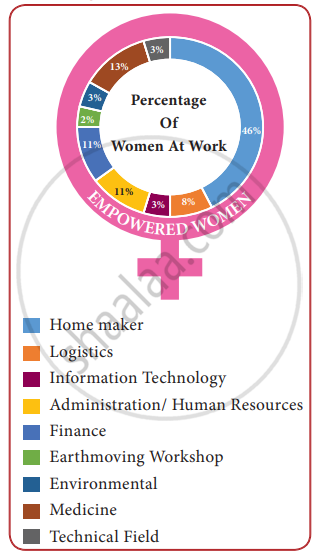
Choose the correct answer.
What is the data about?
Identify the speaker/character.
A man fell into the sea. Please save him.
Sea turtles come to the shore to ______.
The boy was so inspired by Mithali that he was happy for his sister to play cricket.
Why did Muthu say that he could walk along its side?
Describe the beauty of the blue mountain.
What does the phrase ‘presence of mind’ mean? Explain the phrase using Muthu’s action.
Did she give up the fight?
Recite the poem 'Treasure Trove' with the correct intonation.
Choose and write the adverbs to complete the sentence.

My dog barks ______.
Why did Meena call the official 'Appa'? Do you think we need to be a family to care for others?
Kani took Teddy out for a ____.
Does the poet want diversity? why?
Leafcutter ants grow fungus.
Whose word are these? Name the character.
“I am not rich enough to buy this plate. This is a gold plate.”
What did his mother say in his dream?
What incident made Mugund make a wooden drum?
Write the word with same meaning.

Sink
Write about the places where the poet wants us to run.
What did he learn about the birds?
The passage given below is on Kabbadi. Read the passage and complete the activities that follow.
Kabbadi (கபடி - in Tamil) is a contact team sport that originated in Tamil Nadu, India. It is the national sport of Bangladesh. It is also popular in South Asia and is the state game of the Indian states of Tamil Nadu, Kerala, Andhra Pradesh, Bihar, Haryana, Karnataka, Maharashtra, Punjab, and Telangana.

Kabbadi is played between two teams of seven players: the objective of the game is for a single player on offence referred to as a 'raider', to run in to the opposing teams half of a court, tag out as many of their defenders as possible, and return to their own half of the court–all without being tackled by the defenders. Points are scored for each player tagged by the raider, while the opposing team earns a point for stopping the raider. Players are taken out of the game if they are tagged or tackled, but can be 'revived' for each point scored by their team from a tag or tackle. The raider should hold his breath and utter the words like 'kabbadi kabbadi, hututu hututu, chadu kudu' etc. while the opponents try to catch him. If he stops uttering these words, he is considered out.
The game is known by its regional names in different parts of the subcontinent, such as Kabbadi or Chedugudu in Andhra Pradesh, Kabbadi in Kerala and Telangana, Hadudu in Bangladesh, Bhavatik in Maldives, Kauddi or Kabbadi in the Punjab Region, Hu-Tu-Tu in Western India and Hu-Do-Do in Eastern India and Chadakudu in South India. The highest governing body of Kabbadi is the International Kabbadi Federation.
Given below is the visual presentation of the first paragraph.
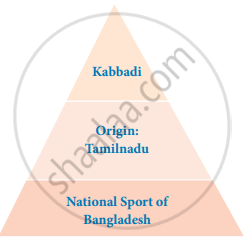
i) Represent the other paragraphs in a visual form of your choice(flow chart, mind-map, pie-chart, etc.).
ii) Choose the correct option.
1. A contact sport usually involves a ______contact between players.
- violent
- gentle
- physical
2. Kabbadi is a game played between ______.
- seven teams of two players
- two teams of seven players
- four teams of seven players
3. A single ______.
- player on offence is referred to as a raider
- offence is referred to as a raider
- raider is an offence by the player
iii) Answer the following.
- How does a raider score points for his team?
- When does a raider concede a point to the opponent team?
- Can a player be revived when he/she is out of the game? Explain your answer.
- Kabbadi is called by different names in different parts of India. Do you know how Pallankuzhi is called in Karnataka, Andhra Pradesh and Kerala?
Complete the dialogue.
| Anil: | Which is your favourite book? |
| Sunil: | ________________________ |
| Anil: | What type of book is it? |
| Sunil: | ________________________ |
