Advertisements
Advertisements
Question
Who according to Gandhi, can fight against evil and how?
Advertisements
Solution
One can fight against evil with the help of good. Such a fight is led by heroes like Gandhi himself.
APPEARS IN
RELATED QUESTIONS
A1. True or False
State whether the following statements are true or false:
(1) The author's new house was situated at Bangalore.
(2) The writer was delighted because their new house, was the biggest they ever lived.
One of the advantages of growing up in an Army household was the frequency with which we moved. 'Postings' came with predictable regularity every three years. What was unpredictable and therefore exciting was the suspense. Where would we go this time? Ambala, Pune, Dehradun, Allahabad, Tejpur, Bangalore, Yo! ............ In my short span of thirteen years we had moved lock. stock and barrel eleven times!
Every move meant change. New journeys, new places, new schools, my new books, new uniforms, new friends and new houses. We lived in tents, bashas, Nissen huts, flats and bungalows. No matter what the shape and size of the dwelling, mother soon put her own special stamp on it and transformed it into a familiar place - our home - complete with bright yellow-curtains, coffee-brown carpet, assorted pictures, hanging ferns and potted palms - providing a comforting sense of continuity in our essentially nomadic life.
I was thirteen, the year we moved to the Cantonment at Allahabad. In stark contrast to the razzle-dazzle of the city's commercial areas like Katra and Chowk, the Cantonment was a quiet, orderly place with broad tree-lined roads that still carried the names of long-dead Britishers. Our bungalow was on a sleepy by-lane called MacPherson Road. When we first saw it, my brothers and I were delighted. It was by far the biggest house we had ever lived in. The task of furnishing those huge, echoing rooms daunted Mother.
A2. Complete
a. The broad tree-lined roads were named after.............................
b. Katra and Chowk are .............................
c. Mother was daunted with the task of................................. .
d. The suspense was exciting because the posting was.........................
A3. Personal response
What do you think are the problems faced by those who change households frequently.
Attempt in 120‒150 words a character sketch of Miss Sullivan.
Answer any four of the following questions in 30-40 words each:
(a) How could the peddler enter the forge without being noticed by the blacksmith?
(b) At Champaran what did the British landlords want from the sharecroppers?
(c) How does the poet show the futility of Aunt Jennifer's efforts?
(d) Stephen Spender in his poem, 'An elementary School Classroom in a Slum' paints a dismal picture of poverty. Comment.
(e) How did Evans have the last laugh at the Governor?
(f) How did the General plan to get rid of the American POW?
Attempt a character sketch of Margot Frank as shown in ‘The Diary of a Young Girl’.
Talk to your partner about the following.
Would you agree that the author’s grandmother was a person strong in character? If yes, give instances that show this.
What do you understand of Einstein’s nature from his conversations with his history teacher, his mathematics teacher and the head teacher?
Examine the communication channels in the story between Paul and his mother.
Examine the communication channels in the story between Paul's mother and his uncle.
Make groups and discuss the following:
What inspired them to spend the best part of their lives to research and share their findings?
The kite - Bazar in Ahmedabad, is open day and night for a week.
Answer the following question in short.
Why did Pundit Shahane visit Vijaynagar?
What do fairy-tale witches do?
List the four elements of drama.
Write the following:
The sights mentioned in the third stanza.
Write about the sights you may see from a bus or an airplane. You may write it in the form of a short poem.
Make a list of your favourite fruits and vegetables and note down the time of the year when they are available in plenty.
Imagine you are one of the three brothers. Write in short what you did with the rice.
What does a farmer need most for his fields?
Read the following line from the poem and answer the question that follow.
In the dim past, nor holding back in fear From what the future veils; but with a whole And happy heart, that pays its toll To Youth and Age, and travels on with cheer.
- What does the poet mean by the phrase ‘in the dim past’?
- Is the poet afraid of future?
- How can one travel on with cheer?
Read the poem and fill in the blanks with the correct option.
It is better far to rule by ______, than ______.
- soft
- vain
- fear
- joy
- love
- heard
- toiled
- mild
- good
- sand
- life
- harsh
Identify the character/speaker.
You may stay if you answer my riddle.
Work in pair, find answer for the question and share in the class.
When is it autumn in India? Why does the poet say this? Is there an autumn season in India?
How do the wheels go?
Choose the correct option from the given homophones.
What did you ______ at the store?
Identify the character/speaker.
"Grow the fish at home, Anbu."
Write the rhyming word.
gale
______are the real wealth.
The merchants sold things made of______.
Recite the poem Never give up with correct intonation.
Read the poem.
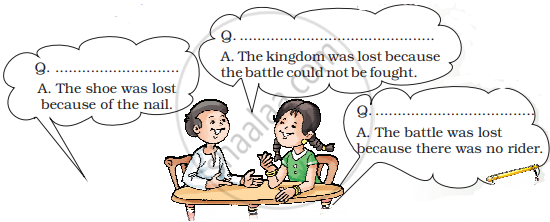
For Want of a Nail
For want of a nail, the shoe was lost,
For want of a shoe the horse was lost,
For want of a horse, the rider was lost,
For want of a rider, the battle was lost,
For want of a battle, the kingdom was lost,
And all for the want of a horseshoe nail!
[traditional rhyme]
Now form questions for the answers given in the speech bubbles.