Advertisements
Advertisements
Question
Comment on the graphic detail with which the various passengers who took Iona's cab are described.
Advertisements
Solution
The story of Iona Potapov is one of suffering. The setting described in the beginning sets the mood of the reader, the atmosphere is full of gloom and darkness as it is a day covered with snow. The author has tried to evoke melancholy in the reader's heart through the environment he describes so that the reader is set in tune with the mood of the protagonist. The author describes the positions and appearance of Iona. He appears like a phantom who is lost as if he is not interested in the world anymore, unaware of his surroundings and the snow that covered his eyelashes and even on his horse's back. This all sets the mood perfectly for a story that is to uncover the protagonist's loss at which he laments.
APPEARS IN
RELATED QUESTIONS
Read the passage given below :
(ii) he added a lot of grandeur to Mewar.
(iii) of his valour, sacrifice and patriotism.
(iv) both (ii) and (iii)
(b) Difficulties in the way of Mewar were :
(ii) ancient traditions of the kingdom.
(iii) its small area and small population.
(iv) the poverty of the subjects.
(ii) the flag of Mewar was hoisted high.
(iii) the people of Mewar showed gallantry.
(iv) most of the rulers heaved a sigh of relief.
(d) Mewar was lucky because :
(ii) most of its people were competent.
(iii) most of its rulers were competent.
(iv) only a few of its people were incompetent.
Answer the following questions briefly:
(h) How could art and literature flourish in Mewar?
(i) How did the rulers show that they cared for their subjects?
(j) What does the erection of Vijaya Stambha and Kirti Stambha in the same fort signify?
(k) Find words from the passage which mean the same as each of the following:
(ii) evidence (para 4)
We know that chimps are intelligent because
To what end have humans used their superior intelligence ?
Notice these expression in the text. Infer their meaning from the context.
cairn of rocks
Put down the images that come to your mind immediately when you see the words in the box.
| Cat cupboard wall pond bird |
The school system often curbs individual talents. Discuss.
What do you think are the reasons for the references made to the English people and the British monarchy?
Locate expressions in the text reflect the Indian idiom, for example, the pride of the generations of his ancestors.
The poem is a satire against the present political class. How effectively does it convey the anger and anguish of the common man trapped in the system?
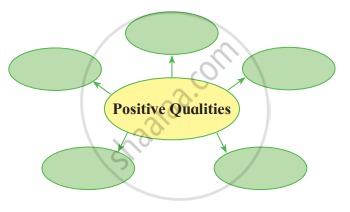
Find from the poem, positive qualities to fill up the web.
Using a dictionary/internet note down the main difference between farm and granary.
The mother was working, when the Swallow brought the yellow jewel.
Make a list of words related to agriculture.
Pick out a word from the poem to complete the sentence meaningfully.
Everyone stood ______ (horrified) when the terrible accident took place.
Discuss in your class.
Are robots truly useful to human beings? Why? Why not?
Human beings can learn from honey bees ______.
Visit a library:
Read the biographies of other Indian Saints. Share at least one story from their life with your friends. What message does it contain?
Hold a mock trial for the following offence. There should be a complainant, a defendant, and lawyers to argue the case on behalf of them. The whole class can vote to pass the judgment. On what occasions will you plead for justice? What punishment will you suggest? When will you plead for mercy?
A very poor and honest servant has broken a vase while cleaning it. The vase was valuable and the employer liked it very much.
Make a chart to show the important points to remember while making a graphic presentation.
In the novel, the Lethargarians give a whole day’s time table of their activities. Can you guess what it would be like?
Use your own ideas and prepare their time table.
Form groups. Discuss the first two paragraphs. Try to present their content in the form of a series of conversations among the volunteers and the villagers.
There were no old cities left on the earth.
Explain the use of the following property in the development of the play.
An envelope containing the letter
Find one example of the following given below from the poem: Simile.
Complete the following diagram.
Pick out the line that means:
Sing in such a manner:
Form a group of four to six. As a group activity, write a conversation in which a person/a group of person thanks to someone.
Imagine the following and write about it in your own words:
What the world looks like to a baby.
Read the word. Write the words that combine to make it.
footprint
Write other meaningful words that begin/end with stepmother.
Discuss the following in group.
Do people admit that they have bad habits?
Draw a diagram to explain the idea of Internet.
How did Helen Keller help other blind people?
What are the three rules given by the bird?
Look at the following situations the writer was in. He could have avoided the situation and saved himself. Glance through the write up again and comment on what the writer should have done in the following situations.
- Gilson asked the writer to bring a tie.
- On the day of arrival, the writer had no time to think about the tie.
- The writer remembered about the tie when the bus was leaving for the airport.
- The writer walked down in search of the shop.
- The writer rushed out with the tie in a paper bag.
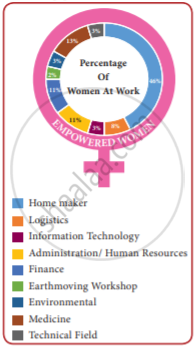
Read the data below and answer the following question.
Choose the correct answer.
Percentage of women working in finance is the same as ______.
With their treasure, the boys would buy ______ in Eidgah.
They may have______ in______.
- soft
- vain
- fear
- joy
- love
- heard
- toiled
- mild
- good
- sand
- life
- harsh
Look at the number pattern. Fill the blank in the middle of the series or end of the series.
CMM, EOO, GQQ, ______, KUU
Read Section – III (para 1 and 4) and answer the following questions.
Paragraph 1
1. Who listened to the chipping sound of the chisel? ______
2. Who was working with the hammer and chisel? ______
Paragraph 4
1. Who was staring? ______
2. Who was the young stone carver? ______
3. What was he working on? ______
What are the characteristics of a courageous man?
Write a paragraph about 50 words describing the scenes that the poet passed by.
When did the richest farmer get upset? Why?
What should we do to save the Earth?
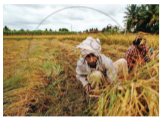
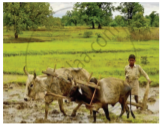
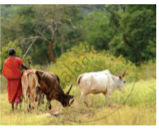
| Mr. Murugan is a farmer. He has a small piece of land and two bulls. He takes good care of his bulls as they help him in farming. Every morning, he takes the bulls for grazing. When it rains he ploughs the land with the bulls. As he has no one to help he starts sowing the seed before sunrise. He irrigates the crop till it grows. He reaps and binds the crop then takes it to thrash the paddy. Finally, with the help of the bulls, he takes the paddy to his house. |
Name the actions of Murugan.
 |
|
 |
|
 |
What happened to Dr. Karmugilan in the story?
What was the epidemic that broke out in the story?
Whose hospitality is described in the poem?
The pigeon flew away for dry twigs.
The hen-pigeon returned home when it started to _______.
Recite the poem 'A Voyage' with correct intonation.
The official's family visited the rehabilitation centre for ______ years.
Sparrow tied the elephant and the crocodile with a ______.
Read the advertisement and answer the question given below.

What is free, for LED TV?
Why was the tree called 'The Mother Tree'?
Kamali gave her savings to______.
Name the things that good merchant offered for the plate
The fir tree was not happy with the gold leaves ______.
Read the passage below:
| 1. | Our history makes it evident that the Indian Plastics Industry made a vigorous beginning in 1957 but it took more than 30 years for it to pervade Indian lifestyles. In 1979, "the market for plastics' was just being seeded by the state-owned Indian Petro-Chemicals and it was only in 1994 that plastic soft drink bottles became a visible source of annoyance. |
| 2. | In the same year, people in other cities were concerned about the state of public sanitation and also urged regulatory bodies to ban the production, distribution and use of plastic bags. However, the challenge was greater than it appeared at first. |
| 3. |
The massive generation of plastic waste in India is due to rapid urbanisation, spread of retail chains, plastic packaging from grocery to food and vegetable products, to consumer items and cosmetics. The projected high growth rates of GDP and continuing rapid urbanisation suggest that India's trajectory of plastic consumption and plastic waste is likely to increase.
|
| 4. | According to the United Nations Environment Programme (UNEP) report of 2018, India stands among few other countries like France, Mongolia and several African countries that have initiated total or partial nationallevel bans on plastics in their jurisdictions. On World Environment Day in 2018, India vowed to phase out single-use plastics by 2022, which gave a much needed impetus to bring this change |
| 5. | In this context, thereafter ten states (Andhra Pradesh, Chhattisgarh, Gujarat, Himachal Pradesh, Karnataka, Madhya Pradesh, Meghalaya, Odisha, Rajasthan and Tamil Nadu) are currently sending their collected waste to cement plants for co-processing, twelve other states/UTs are using plastic waste for polymer bitumen road construction and still four other states are using the plastic waste for waste-to-energy plants and oil production. A world of greater possibilities has now opened up to initiate appropriate and concrete actions to build up the necessary institutions and systems before oceans turn, irreversibly into a thin soup of plastic. |
| 6. | However there is no one single masterstroke to counter the challenges witnessed by the staggering plastic waste management in the country. The time is now to formulate robust and inclusive National Action Plans and while doing so, the country will establish greater transparency to combat the plastic jeopardy in a more sustainable and holistic way. |

Based on your understanding of the passage answer any six out of the seven questions given below:
- What does the writer mean by 'visible source of annoyance'?
- Why did people demand a ban on plastics?
- What created a demand for plastics in India?
- With reference to the graph write one conclusion that can be drawn about the production of plastics in 2019 (approximately).
- What does the upward trend of the graph indicate?
- What does the line, oceans turning 'irreversibly into a thin soup of plastic', suggest?
- What step must be taken to combat the challenges of plastic waste management? What will be its impact?
