Advertisements
Advertisements
Question
Form groups. Discuss the first two paragraphs. Try to present their content in the form of a series of conversations among the volunteers and the villagers.
Advertisements
Solution
| Villager 1: | Why have you brought us here? |
| Volunteer A: | We wanted to ask you about these egg shells. What are they? |
| Villager 2: | These are turtle egg shells, sir. |
| Volunteer B: | We have never seen them before, in all our walks along the Konkan coast. |
| Villager 3: | Well, sir, this beach has been sealed to the public since the past month to prevent smuggling activities. |
| Volunteer C: | Turtle eggs? But turtles are a protected species. |
(Students may continue the conversation of your own.)
APPEARS IN
RELATED QUESTIONS
Read the following extract and then do all the activities that follow :
I rain into a stranger as he passed by
“Oh, excuse me please” was my reply.
He said, “please excuse me too; wasn't even watching for you.”
We were very polite, this stranger and I.
We went on out way and we said good-bye.
But at home a different story is told.
How we treat out loved ones, young and old.
Later that day, cooking the evening meal,
My daughter stood beside me very still.
When I turned, I nearly knoked her down.
“Move out of the way,” I said with a frown.
She walked away, her little heart broken.
I didn't realize how harshly I'd spoken.
While I lay awake in bed,
God's still small voice came to me and said,
“While Dealing with a stranger, common courtesy you use,
But children you love, you seem to abuse.”
A1. Order-
The incidents narrated in the extract are arranged in a jumbled manner here, Rearrange them in a proper order as they occur in the extract:
(i) The poet and the stranger went on their way saying good-bye.
(ii) Seeking excuse politely from the stranger, she went her way.
(iii) The poet ran into a stranger on the road.
(iv) The poet yelled at her daughter.
A2. Poetic device:
Make a list of rhyming pairs from the second stanza and note down the rhyme scheme of the same stanza.
A3. Personal Response:
Understanding and politeness are the essentials of out everyday life. Explain your views in brief.
A4. Creativity -
Frame two poetic lines on the following situation using a rhyming pattern with the help of clues given:
“While introducing great personalities, we praise them highly and talk about their qualities, but while speaking
about our friends we may not follow the same trend.”
While introducing great personalities, — a
------------------------------------ — a
But while speaking about our friends, — b
------------------------------------ — b
The following common word is used in a different sense in the poem. Guess what it means.
What is described in the poem?
Discuss what a friendly and good-natured peacock would say to a crane. Write his speech. (5-8 lines.)
How early did the preparations for the Science Fair begin?
Observe the picture and the labels carefully. Then match the words and the meanings given in the following table.
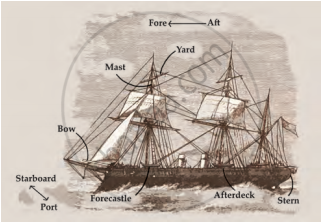
| Words | Meaning |
| 1. yard | (a) a floor, flat area built on a ship |
| 2. mast | (b) the forward part of the main body of a ship |
| 3. bow | (c) the forward part of a deck |
| 4. deck | (d) tall, upright pole on a ship |
| 5. forecastle | (e) a pole slung across a ship’s mast. A sail hangs from a yard. |
| 6. starboard | (f) the rearmost (back) part of a ship |
| 7. stern | (g) the part which is always at the front while the ship is sailing. |
| 8. afterdeck | (h) the right-hand side of a ship as one faces forward |
| 9. fore | (i) an open deck near the back |
Identify the speaker/character.
A man fell into the sea. Please save him.
A day in Mars is called ______.
Where is the poet going in the dream?
Bala's home doesn't have ______.
