Advertisements
Advertisements
Question
What do you think are the reasons for the references made to the English people and the British monarchy?
Advertisements
Solution
Indian society, unfortunately, is the one that takes pride in the language and culture of their rulers and not in their own rich and vibrant history. The nabobs and babus that were in British Raj are still looked up and are respected. Though the truth is that these are the people that ensured English Queen's authority on our land. The reference in the story of Mulk Raj Anand makes it clear. He cites an example of how the nabobs and generals in the English army are to wear the prestigious lion mustache, which is worn by resplendent rajas and maharajas of our land. This makes clear how we Indians take pride in being slaves of Britishers.
APPEARS IN
RELATED QUESTIONS
A1. True or False
State whether the following statements are true or false:
(1) The author's new house was situated at Bangalore.
(2) The writer was delighted because their new house, was the biggest they ever lived.
One of the advantages of growing up in an Army household was the frequency with which we moved. 'Postings' came with predictable regularity every three years. What was unpredictable and therefore exciting was the suspense. Where would we go this time? Ambala, Pune, Dehradun, Allahabad, Tejpur, Bangalore, Yo! ............ In my short span of thirteen years we had moved lock. stock and barrel eleven times!
Every move meant change. New journeys, new places, new schools, my new books, new uniforms, new friends and new houses. We lived in tents, bashas, Nissen huts, flats and bungalows. No matter what the shape and size of the dwelling, mother soon put her own special stamp on it and transformed it into a familiar place - our home - complete with bright yellow-curtains, coffee-brown carpet, assorted pictures, hanging ferns and potted palms - providing a comforting sense of continuity in our essentially nomadic life.
I was thirteen, the year we moved to the Cantonment at Allahabad. In stark contrast to the razzle-dazzle of the city's commercial areas like Katra and Chowk, the Cantonment was a quiet, orderly place with broad tree-lined roads that still carried the names of long-dead Britishers. Our bungalow was on a sleepy by-lane called MacPherson Road. When we first saw it, my brothers and I were delighted. It was by far the biggest house we had ever lived in. The task of furnishing those huge, echoing rooms daunted Mother.
A2. Complete
a. The broad tree-lined roads were named after.............................
b. Katra and Chowk are .............................
c. Mother was daunted with the task of................................. .
d. The suspense was exciting because the posting was.........................
A3. Personal response
What do you think are the problems faced by those who change households frequently.
The story is divided into pre-war and post-war times. What hardships do you think the girl underwent during these times?
The lecture was delivered in 1864. What are the shifts in style and diction that make the language different from the way it is used today?
Certain words in the poem are in capital letters — why?
What would you say are 'the finer growths' that the story supports in a novel?
What do the references to the birds and animals made in the poem suggest?
Read the following statement and mark those that apply to you.
I wish to be friends with someone but my friendship is rejected.
Read the following statement and mark those that apply to you.
I have a small group of close friends and have no wish to interact with anyone else.
Fill in the blank.
Moru Dada wanted to spray __________ on the moong crop.
Make groups and discuss the following:
Name a few scientists/explorers/social reformers/inventors/discoverers, who spent most of their lives to find solutions to some major problems/setbacks, that mankind faced.
Answer in your own words.
How did the plants respond when Revathi played her favourite tune?
Add the appropriate Prefix to make the following word opposite in meaning.
continue
Discuss in groups, reasons/ consequences/ effects:
The life of the cherry tree was threatened.
Divide the story into parts. Make 4 groups in your class. Each group should take one of the 4 parts to convert the story into a play and enact your part.
Compare and contrast the two opposing human feelings as expressed by the poet.
Correct the following statement.
Johnsy was eager to recover from her illness.
Pick out three lines that create an image in your mind of bees busy at work.
Read the passage and answer the following question:
Who designed the PVC medal?
Describe the following with the help of the story.
The fabric is woven by Thiruvalluvar
Explain the following statement with reference to the context.
Because your father can't do without my help.
Form groups and hold debates on the following topic. Make bulleted lists of points in favour of the topic (pros) and those against it (cons). (3-6 points each).
Boys cannot cook or do any housework.
Name the white and bright things mentioned in the poem.
Visit a library:
Find and read stories and poems written by Edith Nesbit.
Write a review of your favorite book. Use the following points:
- Title of the book
- Author/Authors
- The central idea or story
- The important characters
- Some special features of the book
- Why it is your favourite book.
Prepare a short note on sea turtles with the help of the information given in the passage.
Read the following:
- Charging along like troops in a battle.
- Fly as thick as driving rain.
Using your imagination, write one or two comparisons each with -
- like ______
- as ______ as
Pick out three examples of interrogation (rhetorical questions) from the poem.
Explain in your own words the point that each one makes.
| Interrogation | Explanation |
| (1) | |
| (2) | |
| (3) |
Present Mr. Wilson’s story as it would be shown in a comic strip. Write what picture you will show in each frame along with the dialogues. Write the dialogue with the help of the story. Examples:
 |
 |
 |
Describe the following in one or two lines.
The nest.
Name the following.
Captain of the Indian Team.
Read the poem aloud using proper intonation.
List and say whether the following statement agrees with the passage or not.
When you want to make a speech, there’s no need to think about it in advance.
Look at the photographs on textbook pages 19-20 carefully and imagine the following:
- The colours, shape, size, actions, etc. of what you see in the picture.
- The sound/sounds you may hear at the scene of the photograph.
- How the different things, birds, animals, etc. in the picture feel to the touch.
- The smell / smells you may smell at the scene of the picture.
- The taste of what you see in the pictures.
In short, let your imagination include oil your five senses.
Now, write short descriptions of any 8-10 of your choice.
Remember to make use of your senses (one or more!) when you describe a photograph. You will find the following words and phrases useful. You may also use other words you know.
Read the following and say whether the statement tells you about a fact or whether it is imaginary.
There is a man in the Moon.
Where was the well situated?
Guess the meaning of weary.
Helen Keller’s life is the story of ______.
What happened to the young seagull when it landed on the green sea?
Share a memorable trip from your life
Why did Shepherd-Barron reduce the PIN number from six digits to four?
Read the comic strip and answer the following question.
Do you think that all the information online can be used without any permission?
Let no ______ tone be______.
- soft
- vain
- fear
- joy
- love
- heard
- toiled
- mild
- good
- sand
- life
- harsh
Imagine you are a marketing executive for a company in a specific industry (toothpaste, soup, hair care products, automobiles, etc) and are developing a product with a brand name that refers to a character from the story.
For example: You want to sell bandages that have little pictures of Don Quixote on them. Your company’s name is Kure-All and you decide to call them “Kure-All Quixote Bandages”.
The slogan might be: “Had a tough day with windmills? When you take a fall, use Kure-All.”
You can use exciting words, a catchy new slogan and a jingle among other things to promote sales of your item.
Give a picturesque view through which the train travels.
Who inhabited the jungles that the train passed through?
Identify the speaker/character.
Stop ship. Drop anchor. Quick!
Raj did not buy______.
Women should not be compared with men in cricket, says Mithali.
Women/Men can achieve anything, provided they put their heart and soul into it. Discuss in the class. Do you think being a man or a woman makes a difference?
Match the planet with its feature.
| 1. | Mars | blue ice giant |
| 2. | Saturn | red storm |
| 3. | Jupiter | red planet |
| 4. | Neptune | ring and moons |
How does Patna differ from Delhi?
Rearrange the story in order.
- Jaswant stayed back in his post.
- He killed 300 chinese soldiers in the battle.
- He fired weapons from separate points.
- Sela and Nura helped him in the battle.
- Jaswant shot himself to death.
- Chinese soldiers caught the man who supplied food.
- He was awarded the Mahavir Chakra.
Try your own.
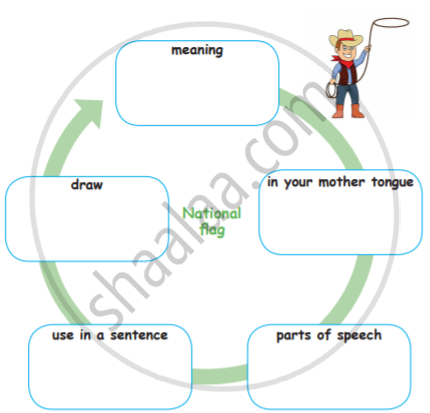
Robinson named the boy______.
How are we divided in real world?
What will you do if you have a gold plate?
Write the word with same meaning.

Flat
Draw me some hair, quickly, I look like a ______.
Write the correct word.
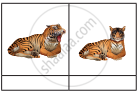
| rooster, king, hen, tiger, queen, tigress. |
Being a bachelor, the stranger had no patience with children.
