Advertisements
Advertisements
Question
Examine the communication channels in the story between Paul and his uncle.
Advertisements
Solution
Paul and uncle Oscar became partners soon after uncle discovers that Paul has an uncanny knowledge that makes him predict the winning horse. However, there is more to it, he realises that the whole betting thing was making Paul nervous and was hampering his health. However, Oscar Creswell asks Paul on how to win by betting, to which the child innocently replies that he just knows who is going to win once he “gets there
APPEARS IN
RELATED QUESTIONS
A1. Order
Arrange the following sentences in the chronological order as they appear in the passage:
(i) On celebrations, parents can invest Rs. 200 and plant a sapling of a tree representing the child’s birth star.
(ii) He wants to create Brihat Panchvati.
(iii) He has been able to increase the areas of the Pavitra VanaVana.
(iv) Plans are afoot to create a Saptaswara forest.
Today, Reddy is one of the most well - known environment specialists in India. With his influence, he has been able to increase the areas of the Pavitra Vana and has plans to bring about awareness of Puranic trees and flowers for the knowledge of the Indian citizen.
He wants to create near the Pavitra Vana, a Brihat Panchavati so that parents can show their children the forest where Shakuntala lived or Sita spent her final days. There will also be a hillock where people can meditate. Plans are also afoot create a Saptaswara forest, pertaining to different ragas in music. Scientists have found that certain plants react in a particular way to different ragas. So in such a forest, when a musician performs certain ragas, the plants will reach in such a manner that it will benefit the audience, the musician and the whole environment. The other idea is an ecopark for children. On celebrations, like birthdays, parents can invest Rs. 200 and plant a sapling of a tree representing the child's birth star. The plant will also carry the child's name. The Pavitra Vana also houses a garden of Prophet Mohammed, which has some plants mentioned in the Holy Quran. There is the date plant - sacred to Islam - and the Mimosops elengi, the latter a highly fragrant variety. There is also the garden of Eden for housing plants sacred to Christianity, but the Pavitra Vana authorities have to procure most of them in the new sections.
A2. Find specialities
Write down the specialities of the following:
(i) Brihat Panchavati: ........................ ..... . .
(ii) Saptaswara Forest: ..................... ..... .............. . .
(iii) Eco-park: ..................................... . .
(iv) A garden of Prophet Mohammed:
A3. Antonyms Find antonyms for the following words from the passage:
(i) same
(ii) decrease
(iii) destroy
(iv) lost
A4. Language study
(i) He wants to create near the Pavitra Vana, a Brihat Panchavati. [Pick out an infinitive from the given line and use it in your own sentence]
(ii) Reddy is one of the most well-known environment specialists in India. [Begin with: Very few ………]
A5. Personal Response
Do you think one person alone can create an awareness towards environment conservation ? Support, your answer with appropriate reasons.
B1. Select
Fill in the blanks choosing the correct alternatives from those given in the bracket:
(i) The author was inspired and motivated to read ............................................ by the time she was eleven.
[Shakespeare, Chaucer, G.B. Shaw]
(ii) Every lesson .......................... ......... took was spiced with half a dozen or more anecdotes.
[Mrs. Rowlands, Sister Monica, Mr. A.N. Patil]
(iii) The teachers helped the narrator to become ..................................... . .
[confident, happy, independent]
(iv) Mrs. Cynthia Nesamani and Sister Monica gave .......................................... to the narrator.
[freedom to do what he wanted, advice to do something, instructions to produce better results]
In a way, one of the greatest gifts any teacher can give a student, I think, is to inculcate a curiosity to learn.
I've been incredibly lucky to have at least one such teacher at every stage in my life. The first was Mrs. Rowlands who taught me in primary school. She taught me to read without ever pushing me. She made me want to read more by giving 'me some of the most interesting children's books available. And although I still love to go back to those books from time to time, it was only because of her that I was able to read Shakespeare by the time I was ten, and Chaucer a year later.
In later years, it was Mr. A.N. Patil, my Marathi and Hindi Teacher who made a huge impression on me. Every lesson he took, was spiced with half a dozen or more anecdotes from a wide variety of subjects: among them history, politics, religion and sociology. I was, and still am in awe of his knowledge, which despite rather desperate attempts, I doubt I'll ever be able to match.
There have also been other teachers who helped me to try to become independent: to think and act for myself using my own judgement, which to my mind has been just as, if not more important, than actually learning anything.
After all, it's much too easy to become a completely useless repository of facts and little else.
Two teachers whom I remember in particular are Mrs. Cynthia Nesamani and Sister Monica, both taught me in school. The former, by and large, gave me a free rein to do what I wanted to do. I, being one of those people who dislike instructions, she helped me to produce much better results than I'd have otherwise done.
B2.Complete
Read the extract and complete the following:
The teacher can
(i) .............
(ii) ..............
(iii )..............
(iv).................
B3. Similar word
Look at the following sentences arid pick the word having similar meaning to the given word and rewrite:
(i) Spiced His conversation is always with a lot of humour. (made interesting, garnished, flavoured)
(ii) Repository
The library should not merely be a ................ of books. (store-house, reservoir, tank)
(iii) Inculcate
It is the responsibility of the parents and teachers to .......values in the child's formative years. (imbibe, give, show)
(iv) Incredibly
I have been .. lucky to have at least one such teacher at every stage in my life. (importantly, unbelievably, beautifully)
B4. Language study
(i) There have also been other teachers. They have helped me to try to become
independent. (Combine using 'who')
(ii) It was only because of her that I was able-to read Shakespeare.
(Rewrite beginning with: If it was not for her, ).
B.5 Out motivators
Look at the following table and complete it by presenting your own views
| Personalities | Influence on your life |
| (i) Teachers | |
| (ii) Parents | |
| (iii) Relatives | |
| (iv) Friends |
Write a character sketch of Mr. Barrymore in about 125 words
Discuss in groups plays or films with a strong message of social reform that you have watched.
What was the importance of the watch to the author?
What are the cues that signal the presence of the peacock in the vicinity?
What causes the element of surprise when the child comes on the scene of 'adult reconciling'?
Comment on the subtlety with which the poet captures the general pattern of communication within a family.
Comment on the capitalisation of all the words in the line:
'Children Must be Disciplined'.
Read the poem and fill in the table.
| Time of the day | Location | Poet’s Activity | Hawker’s Activities | Gardener’s Activities | Watchman’s Activities |
| Morning | __________ | __________ | __________ | __________ | __________ |
| Afternoon | __________ | __________ | __________ | __________ | __________ |
| Night | __________ | __________ | __________ | __________ | __________ |
Think and answer in your own words.
Why is the street light compared to a one-red-eyed-giant?
Answer in your own words.
In what ways is Ashangbi different from other women of her community?
Think and answer in your own words in your notebook.
‘Live and let live’ is a famous proverb. Which lines from the poem support this proverb?
Say where . . . . . . .
______ do squirrels store their food?
Write 3 to 4 lines about the following in your own words.
First Cardiac Surgery
Expand the idea inherent in the following proverb :
One should eat to live, not live to eat - Franklin.
Have you ever given up on something good? Share your story with your friend.
Suggest what you would do in the following situation:
Your very close friend has been using a fake social media account to play pranks on others and is not ready to stop in spite of several attempts by you.
Write short note on the following:
The 1883 eruption
If you saw someone abusing an animal, what would you do? Write about it in 5 lines.
Draw word webs for the following. Begin with the given word and go on writing as many other words associated with it, as you can. Use these words to write other related words to form a word web.

Write all the instances of the mischief done by Mr. Nobody.
In the novel, the Lethargarians give a whole day’s time table of their activities. Can you guess what it would be like?
Use your own ideas and prepare their time table.
What do the following events/actions tell us about the characters? Discuss.
Sir Ector kneeled before Arthur.
The Emperor says he had realised earlier that Abdul has great talent. Does this tally with his actions? Give your opinion.
Form groups of 5-8. This passage tells us only what the compère says. Try to visualize and write what the other people on the dais must have said in their speeches (Write only the main points.)
- The School Principal
- The Chief Guest
- The Art teacher who offered a vote of thanks
What is direct and indirect.
Write in your own words.
What message does the poem convey?
Tell any one of the stories orally imagining you are Gulliver.
Have you ever seen or used a computer?
Read the following line from the poem and answer the question that follow.
In the dim past, nor holding back in fear From what the future veils; but with a whole And happy heart, that pays its toll To Youth and Age, and travels on with cheer.
Identify the rhyming words of the given lines.
Complete the given tabular column with the suitable plural forms.
| chair | - | |
| box | - | |
| Eskimo | - | |
| lady | - | |
| radius | - | |
| formula | - | |
| child | - | |
| deer | - | |
| loaf | - | |
| hero | - |
Identify the speaker/character.
‘ The one that spits deadly poison straight into its opponent’s eyes.’
What commotion did the boomerang cause in the neighborhood?
Why did Anne want to exchange the book ‘Camera Obscura’?
Tom lay thinking. Presently it occurred to him that he wished he was sick; then he could stay home from school. He examined himself. He found no symptoms or sickness, and he investigated again. This time he felt he had a stomach ache, but it soon grew feeble, and presently died wholly away. He reflected further.
What was the result of Tom’s self-examination?
How does Alice feel after all these changes?
Fill in the table given below.
| S. No | Problems faced by the hatchlings | Effect | Solution |
| 1. | Pollution | Survival of sea turtles becomes difficult. | Reduce the usage of plastics. |
| 2. | Predators | ||
| 3. | Human Activities |
Grandmother had wanted the peepul tree cut down because______.
Work in groups of five. Tell the story in ten sentences.
You can begin the story like this:
The author’s Grandfather served in the Indian Forest Service.
After his retirement he built ______ Now continue the story. Each one should say one sentence.
Recall Merlin’s memories and complete the story map.
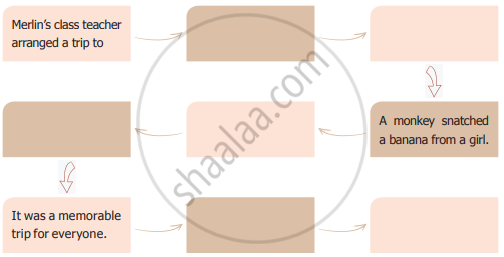
They went out through the broken windows.
Match the rhyming words.
| filth | farmer |
| cook | harm |
| charm | wealth |
| armour | look |
What did you learn from this lesson?
Name the character or speaker.
"Play me a pleasant song."
Raju loves______.
A man in ______ clothes stopped near him.
Pick out the rhyming words from the poem and write.
| Mars | |
| time | |
| be |
Who disguised himself as an old man?
Match the rhyming words.
| 1. | flow | know |
| 2. | grow | week |
| 3. | seek | blow |
Fill in the blank
He has bat ______ ball.
Does the poet want diversity? why?
Do you tell the truth always? Why?
Whose word are these? Name the character.
“Utensils made of brass and tin for sale!”
Choose the correct one.
Elephant

What do you think birds say to each other in the morning?
Does the child in the poem like her nose? Why do you think so?
What sort of a boy is described in the poem?
How did the tree help the boy earn money?
