Advertisements
Advertisements
Question
List the distinctive features of the tribal arts.
Advertisements
Solution
According to the essayist G. N. Devy, the tribal arts display many distinctive features.
One of the distinctive features of tribal arts is their distinct manner of constructing space and imagery, which might be described as 'hallucinatory'. In both oral and visual forms of representation, tribal artists seem to interpret verbal or pictorial space as demarcated by an extremely flexible 'frame'. The boundaries between art and non art become almost invisible. In a tribal Ramayana, an episode from the Mahabharata makes a sudden and surprising appearance; tribal paintings contain a curious mixture of traditional and modern imagery.
The tribal arts follow strict convention. Every tribal performance and creation has, at its back, another such performance or creation belonging to a previous occasion. The creativity of the tribal artist lies in adhering to the past while, at the same time, slightly subverting it.
Playfulness is the soul of tribal arts. The tribal arts rarely assume a serious or pretentious tone. The tribal arts are relaxed and never tense.
The tribal oral stories and songs employ bilingualism in a complex manner.
APPEARS IN
RELATED QUESTIONS
B1. What does the poet want us to do in the following situation?
(a) While struggling ………..
(b) While making money ………
(c) While dreaming ………………
(d) While losing …………..
It's doing your job the best you can,
And being just to your fellow man;
It's making money-but holding friends,
And being true to your aims and ends.
It's figuring how and learning why,
And looking forward and thinking high;
And dreaming a little and doing much,
It's keeping always in closest touch.
With what is finest in word and deed,
It's being through, yet making speed;
It's daring blithely the field of chance,
While making labour a brave romance.
It’s going onward despite defeat
And fighting staunchly, but keeping sweet;
It's struggling on with the will to win,
But taking loss with a cheerful grin.
B2. Achieving Success
Hints given by the poet to become successful are
(a) Doing your job the best
(b)
(c)
(d)
(e)
B3. Poetic Device
Select the appropriate rhyme scheme for the 3rd stanza.
(1) abab
(2) aabb
(3) aaba
Attempt a character sketch of Mr Gilman as a teacher.
How does a black kite spread wildfire ?
Describe the shifts in the narration of the events as indicated in the three sections of the text. Give a subtitle to each section.
Tick the item that is closest in meaning to the following phrase.
to stand on one's feet
This play, written in the 1950s, is a humorous and satirical depiction of the status of the mother in the family.
Do you think it caricatures these issues or do you think that the problems it raises are genuine? How does the play resolve the issues? Do you agree with the resolution?
Suggest a few instances in the poem which highlight humour and irony.
How have the three passions contributed to the quality of Russell's life?
Discuss the following in pairs or in small groups.
“Discipline and a questioning spirit can coexist in an individual.”
“I can see clear bridges between my life experiences and my work in dance.” How does Kumudini Lakhia weave episodes from the two realms in her account?
Find from the poem, positive qualities to fill up the web.
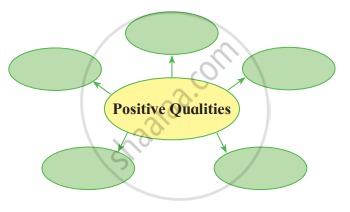
A small thought, put in action, led to a great achievement. Pick out the lines from the beginning and end of the poem and explain their significance.
Fibreglass kites led to creating power - driven aeroplanes.
In Gujarat, the kite - festival is celebrated to welcome the Spring.
Read the story and choose the appropriate meaning.
Masterpiece ____________.
How do we help animals and birds?
Fill in the gaps in the table of Degrees of Comparison.
| Positive | Comparative | Superlative | |
| (1) | ____________ | ____________ | oldest |
| (2) | ____________ | healthier | ____________ |
| (3) | near | ____________ | ____________ |
| (4) | ____________ | finer | ____________ |
| (5) | ____________ | ____________ | earliest |
| (6) | small | ____________ | ____________ |
| (7) | ____________ | faster | ____________ |
| (8) | high | ____________ | ____________ |
Honey-bees live an organized life like human beings. Discuss what work the following honey-bees do, as per the poem. Write it down in your own words, in your notebook.
- King/Emperor bee
- Magistrate bees
- Merchant bees
- Soldier bees
- Mason bees
- Civilian bees
- Porter bees
- Judge bee
Discuss and write 1-2 lines about the following,
Why Bushi told Yonamine not to travel at night.
Form pairs. Complete the following table through discussions.
| Occupation | Necessary Qualities | Reasons |
| Student | ||
| Teacher | ||
| Housewife | ||
| Sportsman | ||
| Artist | ||
| Singer | ||
| Author | ||
| Umpire | ||
| Actor | ||
| Scientist |
Portia had many brothers and sisters.
Read the following.
- I mean what I say. I say what I mean.
- I see what I eat. I eat what I see.
Use your imagination to write a funny sentence on this pattern.
Find one example of the following given below from the poem: Simile.
Answer the following question and write in short, why the parody sounds funny.
Why does the crocodile work?
Complete the following diagram.

The table-tennis set was gifted by ______.
Read the following words aloud and copy them in your notebook.
- idle
- enough
- exclaimed
- commotion
- astounded
- antics
- wander
- wielding
Name the following.
Ruler of Germany.
Imagine that you are in a land of tiny people like Lilliput. Write about some of the interesting things you might see there, including animals, houses, plants, vehicles, etc. Find an interesting name for this land.
What are the common Rangoli designs or motifs?
What made the reporter gaze at the author?
Why do you think Mrs. Bodwell wanted to sell the house?
Read the story again and write how these character reacted in these situation:
You are an absolute treasure…………. Dr.Krishnan………………..
Zigzag………………………..
Write the name of the toys against each picture.

What did Hamid buy at the fair? And for whom?
Which of these statements do you find in the speech?
- Inclusion is essential for us to do well in life.
- We should neglect others.
- Communicate politely with the less privileged.
- Teachers teach us to communicate well.
- Effective Communication is inessential to excel in life.
What are the skills/values a teacher should teach their students to live in this competitive world?
Underline the words or phrases that tell you what the wind does to the village.
What kind of joy is unfurled during the festival of sacrifice?
Tackling the Issues
Ask the class to discuss solutions to an issue that plagues contemporary society at large or just your community—for example, homelessness, violence, environmental degradation, hunger.
Half the class should mention idealistic solutions to the chosen issue; the other half should mention only realistic approaches to solving the problem.
See if, in listening to both sides, someone can come up with a proposal that is both realistic and unconventional—an idea that hasn't been tried yet.
Look at the number pattern. Fill the blank in the middle of the series or end of the series.
QPO, NML, KJI, ______, EDC
A ________ dies for the nation.
What was the epidemic that broke out in the story?
| Our national emblem is taken from Ashoka’s pillar at Sarnath. It is found on all government documents, coins, currency notes, postcards, and envelopes. It consists of four lions standing back to back but, we can see only three lions at a time. There is a Dharma chakra in the centre of the base plate, with the figure of a bull in the right and that of a horse in the left. The entire structure is sitting on a lotus. The words ‘Sathyameva Jayate’ is written under it in Devanagari script. These words mean, ‘Truth alone Triumphs’. |
- Where is our national emblem taken from?
- Where is our national emblem found?
- What does ‘Sathyameva Jayate’ mean?
- What are the animals found in the emblem?
Name the character or speaker.
"Play me a pleasant song."
Match the following.
| 1. | garden | very small |
| 2. | trash can | hungry and tired |
| 3. | old man | well maintained |
| 4. | hut | earthen pot |
| 5. | gruel | wasted food |
When do we land on Mars?
Pick out the rhyming words from the poem and write.
| Mars | |
| time | |
| be |
Who was Akilan’s inspiration?
______hem the border.
Write the rhyming word.
away
Where does the scene take place?
Choose and write the adverbs to complete the sentence.

The lion fought _____.
What should we vow for?
Speak and win.
Join in any group. Support or oppose using 4 to 5 sentences to win.
| I support Divya. | I oppose Divya. |
Why should a fisher wait?
The pretty little fir tree was happy with gold leaves but______.
List three questions that the little boy asks.
- ______
- ______
- ______
Pick out word which mean the same as
keep a check on (para 3)
