Advertisements
Advertisements
Question
What are the cues that signal the presence of the peacock in the vicinity?
Advertisements
Solution
There are many cues in the poem that signal the presence of the peacock in the vicinity.
-
At the beginning of the poem, the poet tells says that one can make out that there is a peacock around on hearing its loud sharp call, which seems to come from nowhere.
-
Then there is a flash of turquoise in the peepal tree, which is another indication that a peacock is present.
-
The impression of its slender arched neck as he descends, and a glimpse of the very end of its tail as he swiftly darts away.
-
As one reads a book with a great concentration out in the veranda, a blue shadow falls over. The wind then changes the direction, the steady hum of bees in the bushes nearby will stop, all suggesting the presence of the peacock.
APPEARS IN
RELATED QUESTIONS
Answer any four of the following in 30-40 words each:
(a) Why was the peddler amused at the idea of the world being a rattrap?
(b) Why did Gandhiji agree to a settlement of mere 25 percent?
(c) Aunt Jennifer's efforts to get rid of her fear proved to be futile. Comment.
(d) What does Stephen Spender want to be done for the children of the school in a slum?
(e) How did the ten-day-old baby (the future Tiger King) react to the prediction about his future made by the astrologers?
(f) Why was Dr. Sadao not sent abroad along with the troops?
Complete the following table :
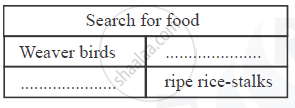
Big male elephants throw logs at electric fences because
Mention three reasons why the author’s grandmother was disturbed when he started going to the city school.
Talk to your partner about the following.
The author’s grandmother was a religious person. What are the different ways in which we come to know this?
Tick the item that is closest in meaning to the following phrase.
to stand on one's feet
What was the reason for young Paul's restlessness at the beginning of the story? How did it find expression?
Discuss in pairs
Ruskin's insistence on looking intensely at words, and assuring oneself of meaning, syllable by syllable – nay, letter by letter.
What are the unpleasant aspects of the human condition that the poet wants to escape from?
Think and answer in your own words in your notebook.
Why do you think God created worms? What is their ecological importance?
The kite - Bazar in Ahmedabad, is open day and night for a week.
Doctors who do special advanced study of specific parts of the body have special terms.
In your group try to match the specialist doctors with who / what they treat.
| Specialists | Who/What they treat | ||
| 1. | Dentist | a. | bone |
| 2. | Cardiologist | b. | brain/with spine |
| 3. | Ophthalmologist | c. | small kids |
| 4. | Orthopedic | d. | teeth |
| 5. | Pediatrician | e. | animals/birds |
| 6. | Neurologist | f. | eye |
| 7. | Veterinarian | g. | heart |
Fill in the gap, choosing a word from the bracket to make an appropriate comparison.
(tall / quiet / humble / merry / busy / slippery / fast / sly / slow / big)
as ______ as a giraffe
Read the passage and answer the following question:
What is seen on the obverse and reverse of the PVC medal?
Now, talk to your friends or elders; refer to books and read about all the objects on which wheels are used. List them. (How many did you miss out on in your first list? Why?)
Does the traveller really have a magic stone?
Form a pair. Write at least one short dialogue for the following expression.
I agree.
Write the following in short:
The events at the court.
Read the passage and answer the following:
When was the book written?
Complete the following table.
| No. | Utterance | Who said it | To whom | When |
| (a) | I touched it in the hall at the ministry. | ___________ | ___________ | ___________ |
| (b) | It will give us time to look some more. | ___________ | ___________ | ___________ |
| (c) | I might have needed it. | ___________ | ___________ | ___________ |
| (d) | You must have made a mistake. | ___________ | ___________ | ___________ |
| (e) | Well, I lost it. | ___________ | ___________ | ___________ |
| (f) | Mine was an imitation. | ___________ | ___________ | ___________ |
You want to start human settlement somewhere else other than the earth, in the universe. Will you select a star or a planet? Why? What features supporting life will you look for? Try to find answers to such questions and make a presentation using scientific information and your imagination.
Use the following outline to develop a story as a group activity. Then write the story individually.
Family returns home late at night ______ hear converstation between thieves from inside the locked house ______ family gets ready to counter ______ attack ______ father opens the door ______ all enter ______ no one is seen ______ but TV is on detective serial midway.
Pick out Archaic words from the poem and give their modern equivalents.
| Archaic Words | Modern Equivalents | |
| (a) | ||
| (b) | ||
| (c) | ||
| (d) | ||
| (e) |
Form groups. Discuss how one can be a 'good reader'. Use the points in the above passage in your discussion. Write down the points that show what makes a 'good reader'.
Find out how the following game is played.
Badminton
Based on your understanding of the poem, complete the following passage by the using the phrases given in the box.
| youth to old age | up or down the hill | to hurry nor move away | |
| high adventure | joyful | mourn | looking ahead |
The poet wants to live his life __________, willing to do something. He neither wants __________from his goal. He does not want to _______ the things he has lost, not hold back for fear of the future. He instead prefers to live his life with a whole and happy heart which cheerfully travels from __________. Therefore, it does not matter to him whether the path goes __________, rough or smooth, the journey will be __________. He will continue to seek what he wanted as a boy - new friendship, __________ and a crown (prize). His heart will remain courageous and pursue his desires. He hopes that every turn in his life's journey will be the best.
Answer the question in a paragraph of about 100 – 150 word.
Write a detailed character sketch of Prospero.
The author was going to New York.
Read the following line from the poem and answer the question given below.
Nothing goes right with the folks you meet
Down on that gloomy Complaining Street.
- What is the opinion about the folks you meet down the street?
- What does the word ‘gloomy’ mean here?
Read the following line from the poem and answer the question given below.
| And so it were wisest to keep our feet From wandering into Complaining Street; |
- What is the wisest thing that the poet suggests?
- What does the phrase ‘to keep our feet from wandering’ refer to?
Identify the speaker/character.
‘ It’s Somu’s thoughtless ways that reduce me to tears’
Based on your reading, rearrange the following sentences in the correct sequence.
- Since all her methods failed, finally she gave him a pain-killer.
- He told his aunt that Peter had no aunt, so he gave him the medicine.
- The pain-killer triggered adverse reactions on Peter.
- It jumped out of the open window.
- Tom was dull and depressed.
- This incident upset Aunt Polly and she questioned him.
- But, Tom gave that painkiller to the cat Peter.
- So, Aunt Polly tried different types of remedies on him.
Write the name of the toys against each picture.

‘My tongs are like a tiger among toys.’ It means ______
Read Section – III (para 1 and 4) and answer the following questions.
Paragraph 1
1. Who listened to the chipping sound of the chisel? ______
2. Who was working with the hammer and chisel? ______
Paragraph 4
1. Who was staring? ______
2. Who was the young stone carver? ______
3. What was he working on? ______
Neerja had a sour marriage due to______.
Read the questions related to the three sports stars you have read about and tick the appropriate boxes.
 |
 |
 |
|
| 1. Who won the Olympic 2016 silver medal in badminton? | |||
| 2. Who is the role model for her siblings? | |||
| 3. Whose mother tongue is Tamil? | |||
| 4. Whose attitude is 'never-say-die spirit'? | |||
| 5. Which player works in the Police Department? | |||
| 6. Which player holds the record for the highest individual score in cricket? |
The little bird broadened the hole with her______.
We get water by burning _______.
Match the following.
| cuckoo | blows |
| breeze | sings |
| river | swims |
| fish | flows |
How do we see the earthworm often?
Jaswant was helped by __________ tribal girls.
Why did the old man disguise himself as a beggar?
What would we do when we are happy or sad?
Identify the character or the speaker.
“Do not feel sad dear.”
Why do we ask questions?
Who helped Tenzin in learning English words?
Where do the crocodiles save?
The king looked for a______.
Choose the word with same meaning.
Kingdom- ______
______ had made Math easy for Bala.
Why did Bala go to Chennai with his father?
Write the word with same meaning.

queue- ______
Mugund made______using the dry woods.
Mugund loved wild animals.
Why was his father unable to sleep?
The brush ______ to her will.
Choose the right word.
Chintha Chettu is a tamarind ______.
Did the girl buy a picture book?
Bertha was very good but very proud too.
