Advertisements
Advertisements
Question
Discuss the following in pairs or in small groups.
“Discipline and a questioning spirit can coexist in an individual.”
Advertisements
Solution
Discipline and a questioning spirit can go together. There is no inherent conflict between the two. If somebody is disciplined then one will have questioning spirit in a disciplined manner. Every discipline is with an objective. Discipline is not for discipline's sake. So, if one seeks to understand the fundamentals of a discipline there is no harm.
Another perspective
Discipline and questioning spirit cannot coexist. One cannot stick to any discipline if one does not take for granted the basic assumptions of a discipline. For example, one cannot follow and apply the principles of an art form if one keeps on questioning. Both cannot go together. Some sort of surrendering of the questioning spirit is required to be disciplined.
APPEARS IN
RELATED QUESTIONS
Answer any four of the following question in 30 – 40 words each:
(a) ''What a thunderclap these words were to me!'' (Franz). What were those words and what was their effect of Franz?
(b) Why did Douglas fail to come to the surface of the pool as he hoped to?
(c) What was Kamala Das's childhood fear?
(d) How is the Earth a source of life when all seems dead on it? Keeping Quiet)
(e) How does Mr. Lamb react when Derry enters his garden?
(f) Which problem did the Maharaja face when he had killed seventy tigers? How did he solve it?
Complete the flow-chart :

We know that chimps are intelligent because
Read the following passage and do the activities:
B1 Match:
Match the areas given in Column ‘A’ with the description of Mehendi design given in Column ‘B’:
| 'A' | 'B" | ||
| (i) | North African | (a) | A mix of Indo-Pakistani and Arabic design |
| (ii) | Indian | (b) | Delicate loops and curves, paisleys, teardrops |
| (iii) | Arabic | (c) | Geometrical images |
| (iv) | South Asian | (d) | Local textiles, paintings, and architecture |
Henna comes from the leaves of the plant Lawsonia inertias. The plant grows in hot and dry climes and is native to North Africa, the Indian subcontinent and the Middle East. The leaves of the plant are dried and crushed to powder. Various additives such as coffee decoction, tea, lime juice, Mehendi and eucalyptus oil are mixed with the henna powder to increase the potency of the dry, this also helps to bind the powder to a paste-like consistency. The mixture is applied through cones in intricate patterns depending on the region of use.
Album of Patterns
Four major styles can be found in the vast dictionary of Mehendi designs. Earlier the application was restricted to hand and feet, but the adoption of Mehendi by different cultures throughout the world has seen experimentation on different body parts including the neck naval and back.
North African patterns rely on geometrical images to trace the shape of hands and feet, Arabic designs borrow heavily from local textiles, paintings, and architecture. These are more spaced out, to allow the design to stand out boldly from the skin parts left untouched by henna. The Indian style comprises of delicate loops and curves, paisleys, teardrops and flowers that give a dainty filigreed glow-like effect. Though intricate patterning is the name of the game today, this trend took off in India only during the 20th century. The patterns preferred by the South Asian countries are mixed with Indo-Pakistani and Arabic design schemes. Chinese and Celtic symbols now find a place in the vast repertoire of Mehendi designs as well.
B2 Complete:
Complete the following and write:
(i) The procedure before applying henna _______
(ii) The reasons for using additives _______
(iii) The suitable climatic conditions for the henna plant _______
(iv) Mehendi is used on _______
B3 Find words:
Look at the following description and find out proper words from the passage and write:
(i) Existing naturally in the place : - n _______
(ii) Consist of something: - c _______
(iii) Delicate decoration made from gold, silver and copper wire: - f _______
(iv) Substance that is added in small quantity : - a _______
B4 Language study:
Fill in the blanks with suitable subordinators given in the box:
| as well as, so that, however, which |
(i) The mixture is applied through cones in intricate patterns _______ depend on the region of use.
(ii) The intricate pattern is the name of the game of today _______, this trend took off in India, recently.
(iii) North African pattern relies on geometrical images ______ they can trace the shape of hands and feet.
(iv) The patterns preferred by the South Asian countries are mixed with Indo-Pakistani _______ Arabic design schemes.
B5 Personal Response:
Which Mehendi design do you like? Why?
The three stanzas depict three different phases. What are they?
Briefly comment on:
“As a Buddhist, he told me, he knew that it didn’t really matter if I passed away, but he thought it would be bad for business.”
Discuss in groups of four.
The accounts of exotic places in legends and the reality.
The episode has been narrated in a light vein. What social mores does the author seem to ridicule?
What do you think is the message that the author seems to convey through the story?
We 'draw up a deed'. Complete the following phrase with an appropriate word.
________a deaf ear to
What does the line 'I never writ, nor no man ever loved' imply?
Discuss in pairs
Choice of diction is very crucial to the communication of meaning.
Discuss in pairs or in small groups
What does a novel do?
The poem is a satire against the present political class. How effectively does it convey the anger and anguish of the common man trapped in the system?
Think and answer in your own words in your notebook.
Why does the poet appeal to us, to respect the life of a worm?
Using a dictionary/internet note down the main difference between self-reliant and self-assured.
Answer the given question in your own words.
Why was the Prince sad?
Read the story and choose the appropriate meaning.
Wielded the brush ____________.
Complete the web with the help of adjectives used to describe eyes and nose in all respects. Two are done for you.
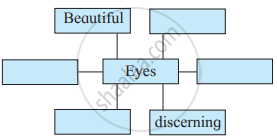

Discuss in your class.
Do you like to study science?
Read the lesson and name the following.
The world’s most advanced surgical robot ______
Expand the idea inherent in the following proverb :
Fools rush in where angels fear to tread - Alexander Pope.
Guess the meaning of the following words and phrases:
untold wealth, closest to the Emperor’s heart, grave offence, banish.
Imagine you are the Crane. What actions and words of the Peacock would you not like? Write about it in short.
Read the passage and find the verbs used with the following nouns and phrases:
- volcano
- molten rock
- volcanic mountain
- dust
- 165 village and towns
- the wind and the sea
- seeds
- bird
What is implied in the following phrases or lines?
- A silver house in the lovely sky
- It takes two weeks to build it up
- And two to pull it down.
Present the information in the box ‘My Teacher says’. Translate the box ‘My Teacher says’ into your mother tongue.
Form groups and hold debates on the following topics. Make bulleted lists of points in favour of the topic (pros) and those against it (cons). (3-6 points each)
You should admit your mistakes.
Explain the meaning of the following phrase:
An eagle’s eye
Read the following sentence aloud. Write who said it and to whom.
“Look, here’s something for you.”
Rohan had finished ______ rounds of the tree before Mrs. Groover discovered him.
An announcement can be made in every class, orally. Or, it can be put up on the school notice-board. Discuss and decide what method should be used for the announcement given here.
Oral aanouncement
Find out how the following game is played.
Football
List the characters in the play.
Birds and animals
Write some more expressions like ‘hundreds of’. Expand each expression.
Example, ‘Hundreds of children in the school.’
Find out what 'Braille' is.
Share a memorable trip from your life
Identify the character or speaker
He repented and implored his brother’s forgiveness.
What did the Bodwells think when they heard the mother shout.
What did the bird suggest Chulong, in exchange for its freedom?
What made John Shepherd-Barron to come up with the idea of ATM?
What is the difference between this toy train and a normal train?
What does ‘charges along like troops in a battle’ mean?
Complete the sentence given below with word/phrase.
The rains came and poured______.
Nilavan unknowingly started the space shuttle.
The robot did not obey his master.
Write the rhyming word.
Bird - ______.
Identify the character or the speaker.
“I will camp here for the night.”
Name the character or speaker.
“How did I win the competition with a single stroke?”
How did the girl seem?
Uthaman was skilled in _____.
Choose the correct answer.

Who showed love and care to the children?
Every year the children visit the______.
Many may lie and______.
Why did Bala go to Chennai with his father?
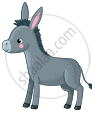
Match the animals with their sounds.
 |
bray |
 |
croak |
 |
bark |
 |
hum |
 |
neigh |
 |
mew |
Why is the play called ‘The Giving Tree’?
Read the passage and write a summary of it. Suggest a suitable title for the summary.
|
A sparrow is a small bird which is found throughout the world. There are many different species of sparrows. Sparrows are only about four to six inches in length. Many people appreciate their beautiful songs. Sparrows prefer to build their nests in low places-usually on the ground clumps of grass low trees and low bushes. In cities, they build their nests in building nooks or holes. They rarely build their nests in high places. They build their nests out of twigs grasses and plant fibers. Their nests are usually small and well-built structures. Female sparrows lay four to six eggs at a time. The eggs are white with reddish-brown spots. They hatch within eleven to fourteen days. Both the male and female parents care for the young. Insects are fed to the young after hatching. The large feet of the sparrows are used for scratching seeds. Adult sparrows mainly eat seeds. Sparrows can be found almost everywhere where there are humans. Many people throughout the world enjoy these delightful birds. The sparrows are some of the few birds that engage in dust bathing. Sparrows will first scratch a hole in the ground with their feet then lie in it and fling dirt or sand over their bodies with flicks of their wings. They will also bathe in water or in dry or melting snow. Water bathing is similar to dust bathing with the sparrow standing in shallow water and flicking water over its back with its wings also ducking its head under the water. Both activities are social with up to a hundred birds participating at once and are followed by preening and sometimes group singing. |
