Advertisements
Advertisements
Question
Many sentences and paragraphs in the excerpt begin with the word ‘And’. To what extent does this contribute to the rhetorical style of the lecture?
Advertisements
Solution
John Ruskin gave ‘What is a Good Book’ as a public lecture in the nineteenth century. His style of speaking is more fluid and conversational as compared to an essay. His repetitive use of ‘And’ or ‘but’ helps in explaining an idea even further. It is more spontaneous like an interaction rather than written and rewritten like an essay.
APPEARS IN
RELATED QUESTIONS
Answer any three of the following in 30-40 words each:
(a) Why has the poet’s mother been compared to the ‘late winter’s moon’?
(b) The poet says, ‘And yet, for these Children, these windows, not this map, their world.’ Which world do these children belong to? Which world is inaccessible to them?
(c) What was the plea of the folk who had put up the roadside stand?
(d) What will happen to Aunt Jennifer’s tigers when she is dead?
List the steps taken by the captain
(i) to protect the ship when rough weather began.
(ii) to check the flooding of the water in the ship.
Briefly explain the following statement from the text.
“The lack of determinism in quantum theory!”
Tick the item that is closest in meaning to the following phrase.
to give vent to
Identify instances in the story that show the business acumen of Ramanand.
We 'draw up a deed'. Complete the following phrase with an appropriate word.
________a deaf ear to
Explain the phrase.
his bending sickle's compass
Answer in your own words.
How did the plants react to the fast rhythmic music?
Using a dictionary/internet note down the main difference between self-reliant and self-assured.
Find evidence from the lesson and write in your own words.
We Indians are obsessed with foreign things.
Read the story and choose the appropriate meaning.
Struggling artists ____________
Given below are various professions in column A and in column B, the nature of work in respective professions. Match the columns.
| A | B |
| (i) Anaesthetist | (a) Specialist in the treatment of problems concerning the position of teeth and jaws. |
| (ii) Pharmacist | (b) A person who designs buildings and supervises the process of constructing them. |
| (iii) Orthodentist | (c) A person who is in charge of a newspaper or of a part of a newspaper. |
| (iv) Dermitologist | (d) The medical study of the skin and its diseases. |
| (v) Architect | (e) A person who has been trained to prepare medicines and sell them to the public. |
| (vi) Chartered Accountant | (f) A person whose job is to give drugs which makes the person not feel pain especially in preparation for a medical operation. |
| (vii) Editor | (g) A person who is engaged in the profession of accounting and examining the statements and records of accounts. |
Write a sentence each about three of your friends. Each time you should say what your friend cannot do, and yet, pay a compliment to your friend.
Visit a library: Find the stories of
- Mulla Nasiruddin
- Gopal Bhand and
- Tenali Raman. Share them in the class.
Visit a library:
This story is a fable. Find two more fables. Share them with your friends.
What do restive horses do?
Describe the following with the help of the story.
The rich young man
Answer the following question in one sentence.
What does the title of the poem say?
Find what Hirabai tells the traveller by reading her words from right to left.
Write a short note on the following:
Care of animals in the regime of Emperor Ashoka
Shylock demanded a pound of Antonio’s flesh.
What is your favourite time of the day? Describe it in detail.
Read the passage and answer the following:
Who is the main character in the story?
Prepare similar word chains using the following ideas.
sunshine - warm ________________.
Think of a play/skit which you have seen enacted on the stage and which has impressed you. Write the following details about it.
| Name of the play/skit: | ______________ |
| Important characters: | ______________ |
| Any famous actors/actresses: | ______________ |
| Theme: | ______________ |
| Climax: | ______________ |
| Ending: | ______________ |
| Use of lights and special effects if any: | ______________ |
| Use of background music and sound effects if any: | ______________ |
| Use of sets: | ______________ |
| The costumes, make up, etc. of the characters: | ______________ |
| How well the actors present the play and behave on the stage: | ______________ |
| Your own opinion about the play: | ______________ |
How long does the whole event described in this passage take? Work it out by reading the passage.
Choose the appropriate phrase to insert in the gap, to make the sentence meaningful. Use the appropriate form of the verb.
Sorrowful times are ______ darkness.
Spot and write any three alliterative phrases or sentences from the poem.
(Alliterative phrases/sentences are those in which the same sound is repeated.)
Put the following events in proper order.
- Holmes and others go to the bank.
- Clay digs a tunnel.
- Ross closes the office of the 'Red-headed League'.
- Holmes catches the criminal Clay.
- Clay and Ross enter the cellar to steal the gold.
- The bank received a lot of gold from the Bank of France.
- Holmes visits the area around Mr. Wilson’s shop.
Find the meaning of the following word.
delicious
Write a short note/story based on the ill effects of pollution.
Would you like to be a netizen?
Draw a diagram to explain the idea of Internet.
Find out the difference between the fingerspelling method, sign language and Braille.
Identify the speaker/character.
‘Come in, Zigzag, come in dear!’
Answer the following question based on the reading of the story. Do not forget to go back to the passage whenever necessary to find and confirm the answer.
| Action | Effect |
| While you warm yourself | I will prepare the best tea. |
| I saved enough money | |
| Six hundred and two villages were destroyed. | |
| It was a terrible earthquake and it was felt | |
| I ran back to the village | |
| They lifted the door | |
| I went to thank the Army Officer |
Why was it a struggle for the children to dry their clothes?
What kind of a life do you want to lead in this world?
Activity
It’s fun to help out in the kitchen. You can even practice reading aloud when reading the recipe. And you can learn a little math by figuring out how to measure. Here are a few fun items to make that are “Alice” themed.
Why did the governments of India, America and Pakistan – honour Neerja?
What is the difference between this toy train and a normal train?
The girl admitted to her brother that she was badly frightened.
| Mr. Murugan is a farmer. He has a small piece of land and two bulls. He takes good care of his bulls as they help him in farming. Every morning, he takes the bulls for grazing. When it rains he ploughs the land with the bulls. As he has no one to help he starts sowing the seed before sunrise. He irrigates the crop till it grows. He reaps and binds the crop then takes it to thrash the paddy. Finally, with the help of the bulls, he takes the paddy to his house. |
Choose the main idea of the passage.
Find the rhyming word from the poem.
Country - ______.
Read scene I of the play carefully and answer the question below.
Whom does Mother Wolf talk about? How does she describe him?
Name the character or speaker.
"Why don't you do that yourself?"
The bird-catcher let the pigeon jump into the fire.
What is the main idea of the story?
How did he win the match?
What was their new hobby?
All the children wished to go to the______.
Read the advertisement and answer the question given below.

What is the advertisement about?
How are we divided in real world?
Why was the tree called 'The Mother Tree'?
How did Bala help Amma and sisters?
Finally, ______, he got permission to study Science.
Name a few things that sink.
How did the boy enjoy the company of the tree?
Read the following passage and do the activities:
A1. Fill in the blanks: (2)
- ______ percent of our daily communication is non-verbal.
- Eye contact is another type of ______ communication.
- Frequent blinking is a sign of the person feeling ______.
- One can readily detect _______.
|
According to some experts, a staggering 93 percent of our daily communication is non-verbal. Facial expressions are easy to decipher. One can readily detect happiness, sadness, anger. Physicians can tell a patient is doing well (or not) by looking at his/her face. Eye contact is another type of non-verbal communication, which can tell a lot about the other person. The eyes convey a range of emotions-happiness, sadness, boredom, surprise, confidence .......... even emotional interest. Staring at someone's forehead may intimidate the recipient, staring at the mouth is sometimes interpretated as a sign of emotional interest. In fact, staring into someone's eyes is a sign of lying, and so is looking away. In certain cultures, lack of eye contact is taken as a sign of respect. If body language is to be defined, it is a combination of facial expression, gestures, eye contact, body movements and posture and voice. Frequent blinking is a sign of the person feeling distressed or uncomfortable. If the pupils are dilated, it ofter indicates interest, even emotional interest. The lips also reflect our body language, and lip biting indicates worry and/or anxiety; tightening of the lips may be an indication of disapproval. Slightly turned-up lips indicate happiness and slightly turned-down lips indicate sadness. |
A2.
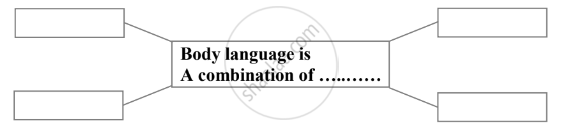
A3. Find the antonyms of: (2)
- verbal × ______
- entertaining × ______
- sender × ______
- comfortable × ______
A4. Do as Directed: (2)
- The eyes convey a range of emotions. (Frame a 'Wh' question in order to get the underlined part as answer).
- Physicians can tell about a patient's wellness. (Rewrite using 'able to')
A5. Personal Response: (2)
Non-verbal communication plays an important role in our daily life. Comment.
Enact any one anecdote in the classroom.
