Advertisements
Advertisements
Question
The lecture was delivered in 1864. What are the shifts in style and diction that make the language different from the way it is used today?
Advertisements
Solution
The shifts in style and diction are very evident in the text. Certain words like ‘assuredly’ is less used and words like ‘most distant’ are now incorrect because it has become ‘most distant’. Certain phrases like ‘peerage of words’ or national noblesse of words’ is no more used because aristocracy or nobility hardly exist anymore. Certain formations of sentences are also different like ‘no one has yet said it’ as opposed to how it is said today- ‘no one has said it yet’.
APPEARS IN
RELATED QUESTIONS
Notice these expression in the text. Infer their meaning from the context.
cairn of rocks
Briefly explain the following statement from the text.
“You need some interaction to cause a transition.”
The story is called ‘The Adventure’. Compare it with the adventure described in ‘We’re Not Afraid to Die...’
What do you understand of Einstein’s nature from his conversations with his history teacher, his mathematics teacher and the head teacher?
Discuss in groups plays or films with a strong message of social reform that you have watched.
Examine the communication channels in the story between Paul and Bassett.
What two things are compared in the poem?
Comment on the capitalisation of all the words in the line:
'Children Must be Disciplined'.
Fill in the blank.
“Hybrids need more _____________”, said Devu Handa.
How do stories/biographies of such famous people help youngsters?
Answer in your own words.
What helped Revathi to claim her plants - her belief in magic or the belief in her convictions? Explain your choice.
Think and answer in your own words.
What is the difference between a hawker and a shopkeeper?
complete the following sentence.
Ajoy reported about ________________.
Discuss in groups, reasons/ consequences/ effects:
The cherry blossomed.
Match the terms in ‘A’ with their explanation in ‘B’.
| 'A' | 'B' | ||
| (1) | tooth- extraction | (a) | a cut made for surgery |
| (2) | cardiac | (b) | having length, breadth, and depth |
| (3) | sedative | (c) | plastic surgery |
| (4) | tumor | (d) | related to the heart |
| (5) | incision | (e) | a control unit for a robotic surgery |
| (6) | a console | (f) | removing a decayed tooth |
| (7) | 3-D | (g) | a substance that makes a person sleep |
| (8) | Cushing clip | (h) | an extra growth in the body |
| (i) | a device to stop blood loss in neurosurgery |
Write 3 to 4 lines about the following in your own words.
The Robotic Surgery
Fill in the gaps in the table of Degrees of Comparison.
| Positive | Comparative | Superlative | |
| (1) | ____________ | ____________ | oldest |
| (2) | ____________ | healthier | ____________ |
| (3) | near | ____________ | ____________ |
| (4) | ____________ | finer | ____________ |
| (5) | ____________ | ____________ | earliest |
| (6) | small | ____________ | ____________ |
| (7) | ____________ | faster | ____________ |
| (8) | high | ____________ | ____________ |
Expand the idea inherent in the following proverb :
If winter comes, can spring be far behind? - Shelley
From the internet or other sources, find the other names by which Kabaddi is known in different parts of our country and the world.
Read the poem aloud. Recite any stanza of your choice from memory.
Form groups and discuss the following question:
The events described in the poem take place at a certain place, at a certain period of the year, under specific weather conditions. Describe the place, the time, and the weather conditions.
How are fabrics used in our daily life? List all the things that are made up of fabrics in your home. (At least 25)
Have you seen non-commercial advertisements - those that are not ‘selling’ anything but are only giving people useful information?
Guess the meaning of the following from the context.
The garden still is alight with lilies.
Prepare a ‘PowerPoint’ presentation, using one slide for each of the above points. Present your review in a PPT format in the classroom.
List the adverbs/adverbial phrases used in the passage.
Write the symbol that is used in the poem to represent the following idea.
Choice of two options.
Rewrite in your own words.
One of the Caesar’s traits that makes you laugh.
Often the brook speaks of itself as if it is human.
For example, 'I bicker down a valley.'
Find two other examples of the human activities of the brook.
Read aloud a couple of stanzas of the poem ‘Invictus’ and ‘Please Listen’. In what ways do they differ? Think and fill up the table with ‘Yes’ or ‘No’.
| Invictus | Please Listen | |
| Rhyming lines | ______ | ______ |
| Steady rhythm | ______ | ______ |
| Uniformity in the length of lines | ______ | ______ |
| Uniformity of the number of lines in each stanza. | ______ | ______ |
| Figurative language | ______ | ______ |
Rearrange the following in their proper order as in the poem. Write the serial number against each line:-
(a) The Ostad sang the Malkous Raga enchantingly.
(b) Akbar followed Tansen, dressed miserably.
(c) I request you to sing such a song that will I experience unmatched joy.
(d) Ostad was nowhere to be seen.
(e) O Divine Teacher, please gift us the joy of your song.
(f) One day, the singer sang Deepak Raga in the court.
(g) Akbar expressed his wish to meet the Teacher.
(h) He experienced heavenly delight.
(i) Tansen sings to please the earthly king but Ostad devotes his songs to God.
(j) She sang Raga Malhar, which had a cooling effect.
What did Gopal Bhand say he was doing?
Find out how the following game is played.
Table Tennis
List and say whether the following statement agrees with the passage or not.
If you don’t understand something, don’t let the others know about it.
Discuss how you will measure the worth of a sports event.
Describe the struggles underwent by the young seagull to overcome its fear of flying.
What did the bird suggest Chulong, in exchange for its freedom?
Write the name of the toys against each picture.

Who inhabited the jungles that the train passed through?
The eggs of an Olive Ridley are in the shape and size of a cricket ball.
The man didn’t want to get up because he was tired as he wcoas thrown into the ditch.
Look at the picture and Choose the correct word.

Look at the picture and tick choose the correct word.

What made him frightened?
Recite the poem 'A Voyage' with correct intonation.
Meena’s father was a fisher man.
______always stays to the last in our needs.
Match the rhyming words.
| 1. share | dare |
| 2. bread | rest |
| 3. care | needs |
| 4. deeds | ahead |
| 5. zest | bear |
Read the advertisement and answer the question given below.

What is the size of the screen?
Write a paragraph on the topic ‘Park’.
Mostly piggy banks look like______.
What does Amma often say?
Write the word with same meaning.

purse- ______
What was his dream ?
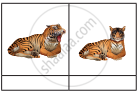
Write the correct word.
| rooster, king, hen, tiger, queen, tigress. |
Although Helen could not hear or see, what kind of girl was she?
Who was Nokomis?
Now, read the following passage on “Laughter Therapy” and answer the questions that follow.

- Laughing is an excellent way to reduce stress in our lives; it can help you to cope with and survive a stressful life. Laughter provides full-scale support for your muscles and unleashes a rush of stress-busting endorphins. Since our bodies cannot distinguish between real and fake laughter, anything that makes you giggle will have a positive impact.
- Laughter Therapy aims to get people laughing, in groups and individual sessions and can help reduce stress, make people and employees happier and more committed, as well as improve their interpersonal skills. This laughter comes from the body and not the mind.
- Laughter Yoga (Hasya yoga) is a practice involving prolonged voluntary laughter. It aims to get people laughing in groups. It is practiced in the early mornings in open-parks. It has been made popular as an exercise routine developed by Indian physician Madan Kataria, who writes about the practice in his 2002 book ‘Laugh for no reason'. Laughter Yoga is based on the belief that voluntary laughter provides the same physiological as well as psychological benefits as spontaneous laughter.
- Laughter yoga session may start with gentle warm-up techniques which include stretching, chanting, clapping, eye contact and body movements to help break down inhibitions and encourage a sense of playfulness. Moreover, laughter is the best medicine. Breathing exercises are used to prepare the lungs for laughter followed by a series of laughter exercises that combine a method of acting and visualization techniques. Twenty minutes of laughter is sufficient to augment physiological development.
- A handful of small-scale scientific studies have indicated that laughter yoga has some medically beneficial effects, including cardiovascular health and mood. This therapy has proved to be good for depressed patients. This laughter therapy also plays a crucial role in social bonding.
Answer the following.
a. How does laughter help one to cope with stress?
b. Which word in the text (para 2) means the same as ‘dedicated'?
c. Why do you think voluntary laughter provides the same physiological as well as psychological benefits as spontaneous laughter?
d. ‘Laughter is the best medicine’. Explain.
e. Given below is a set of activities. Which of these are followed in the ‘Laughter Yoga’ technique?
- sitting on the ground with legs crossed
- body movements
- clapping
- closed eyes
- breathing exercises
- chanting
- stretching of arms and legs
- bending backwards
- running/jogging
- eye contact
f. ‘Laughter therapy also plays a crucial role in social bonding’. How?
Which of the following should one avoid while using social media? Tick against the correct options.
Being a bachelor, the stranger had no patience with children.
