Advertisements
Advertisements
Question
The text is an excerpt from Sesame and Lilies which consists of two essays, primarily, written for delivery as public lectures in 1864. Identify the features that fit the speech mode. Notice the sentence patterns.
Advertisements
Solution
The text was given as a lecture hence it shares the features of a speech. His use of the first person or ‘I’ is the most direct feature. Repetition of certain expressions like “if you could, you would; you would write instead” is characteristic of an interaction and spontaneous explanation. He regularly asks questions like “Perhaps you think no book was ever so written?” which engages another person in a speech.
The sentence patterns are more conversational and fluid. The number of times he uses ‘and’, ‘but’ or ‘so’ shows a spontaneity of thought and explanation rather than the corrected lines of a written text.
APPEARS IN
RELATED QUESTIONS
A1. Order
Arrange the following sentences in the chronological order as they appear in the passage:
(i) On celebrations, parents can invest Rs. 200 and plant a sapling of a tree representing the child’s birth star.
(ii) He wants to create Brihat Panchvati.
(iii) He has been able to increase the areas of the Pavitra VanaVana.
(iv) Plans are afoot to create a Saptaswara forest.
Today, Reddy is one of the most well - known environment specialists in India. With his influence, he has been able to increase the areas of the Pavitra Vana and has plans to bring about awareness of Puranic trees and flowers for the knowledge of the Indian citizen.
He wants to create near the Pavitra Vana, a Brihat Panchavati so that parents can show their children the forest where Shakuntala lived or Sita spent her final days. There will also be a hillock where people can meditate. Plans are also afoot create a Saptaswara forest, pertaining to different ragas in music. Scientists have found that certain plants react in a particular way to different ragas. So in such a forest, when a musician performs certain ragas, the plants will reach in such a manner that it will benefit the audience, the musician and the whole environment. The other idea is an ecopark for children. On celebrations, like birthdays, parents can invest Rs. 200 and plant a sapling of a tree representing the child's birth star. The plant will also carry the child's name. The Pavitra Vana also houses a garden of Prophet Mohammed, which has some plants mentioned in the Holy Quran. There is the date plant - sacred to Islam - and the Mimosops elengi, the latter a highly fragrant variety. There is also the garden of Eden for housing plants sacred to Christianity, but the Pavitra Vana authorities have to procure most of them in the new sections.
A2. Find specialities
Write down the specialities of the following:
(i) Brihat Panchavati: ........................ ..... . .
(ii) Saptaswara Forest: ..................... ..... .............. . .
(iii) Eco-park: ..................................... . .
(iv) A garden of Prophet Mohammed:
A3. Antonyms Find antonyms for the following words from the passage:
(i) same
(ii) decrease
(iii) destroy
(iv) lost
A4. Language study
(i) He wants to create near the Pavitra Vana, a Brihat Panchavati. [Pick out an infinitive from the given line and use it in your own sentence]
(ii) Reddy is one of the most well-known environment specialists in India. [Begin with: Very few ………]
A5. Personal Response
Do you think one person alone can create an awareness towards environment conservation ? Support, your answer with appropriate reasons.
Answer the following question in 120-150 words :
Nancy Lammeter is a typical country girl. Comment.
Read the follow ing extract and answer the questions given below:
Not gold but only men can make
A people great and strong;
Men who for truth and honor's sake
Stand fast and suffer long.
Brave men who work while others sleep,
Who dare while others fly...
They build a nation's pillars deep
And lift them to the sky.
(1) What makes a nation strong?
(2) According to you, what makes India a strong and powerful nation?.
(3) Write down the rhyme scheme used in the extract.
(4) What does the phrase 'others fly ... ' mean?
In ‘The Diary of a Young Girl’ how did the Franks and others celebrate two festivals, Hanukkah and St. Nicholas Day in the Annexe ?
Read the following extract of the poem and complete the activities given below :
B1 State which of the following statements are
True or False :
(i) The elderly are nearest to our own exalted personality.
(ii) The elderly are those persons whose growth is stunted.
(iii) We should know our elderly people well, in order to receive guidance.
(iv) The elderly hold on to the frivolous aspects of life.
Elderly people should be around us. Justify.
(b) abb
(c) abba
Discuss in groups of four.
The sensitive behaviour of hill-folk.
|
The energy stored in coal and petroleum originally came to the earth from the sun. The bulk of the present-day supplies was laid down some 200 to 600 million years ago, when tropical conditions were widespread. Lush, swampy forests produced huge trees; warm coastal seas swarmed with microscopic forms of life. When these organisms died, much of their tissue was recycled as it is today — through scavenging and decay. But a significant amount of dead plant and animal material was covered with mud, which prevented complete decomposition. With the passage of time, layer upon layer of the fine sediment was deposited over the once-living material; the sheer weight turned the sediments to rock. Sandwiched between the layers, both coal and petroleum were produced and preserved under pressure. Coal was formed mostly of giant fern-like plants that have only small counterparts today. Coal may still be forming here and there on earth, but conditions are not right for the production of significant quantities. |
Combine related points.
Tick the statement that is true.
The story hinges on a particular historical event.
Why do you think Professor Gaitonde decided never to preside over meetings again?
Identify instances in the story that show the business acumen of Ramanand.
We 'draw up a deed'. Complete the following phrase with an appropriate word.
________a loan
Examine the communication channels in the story between Paul's mother and his uncle.
Discuss the importance of time in the narration of a story.
Discuss in pairs or in small groups
The description of novels as organisms.
Make groups and discuss the following:
What inspired them to spend the best part of their lives to research and share their findings?
The poem expresses feelings of serenity. Pick out expressions from the above poem that express the same.
Prepare an Acrostic from the word ‘Leisure’. The words should be related to what one likes to do in free time.
L______
E______
I______
S______
U______
Reading stories
E______
Complete the web with the help of adjectives used to describe eyes and nose in all respects. Two are done for you.
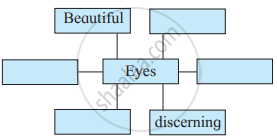

Expand the idea inherent in the following proverb:
A Bad workman blames his tools.
Find at least five other Akbar and Birbal stories and share them with your friends. Make a list of the stories collected by the entire class. Put your list in alphabetical order.
Form pairs. Make a list of as many games as you can. (At least 25) Then classify the games using the following criteria:
- Indoor and outdoor games.
- Games played with and without any equipment.
- Games which have one-to-one matches and those in which teams play against each other (Single-player or team)
- Games played mostly by children and games played by adult players.
- Shape and size of the court or field.
Use the following figures to show your classification.
Show the stages in the process in which Krakatoa collapsed and then Anak Krakatoa formed in the course of volcanic eruptions. Use the flowchart given below.
Find 2/4 expressions of humour from the extract.
Write a useful ‘ad’ for the importance of games, drinking enough water, your own school.
List five questions from the play which can be answered with 'yes' or 'no'.
Visit a library:
Find and read the biography of your favourite scientist.
Write any three of the silly remarks made by the characters other than Alice. Write why you think the remark is silly.
Write the following:
The sights seen through a railway carriage mentioned in the first stanza.
The items in the programme below have got mixed up. Rearrange them in the proper order. Just add the number in the left-hand column.
| Balanand Vidyalaya Art Festival Programme | |
| ( ) | → Koli Dance |
| ( ) | → igniting the Lamp |
| ( ) | → Chief Guest Speaks |
| ( ) | → Appraisal of the Art Festival |
| ( ) | → Dignitaries Arrive |
| ( ) | → Recital of ‘Taal kacheri’ |
| ( ) | → Welcome and Introduction of Guests |
| ( ) | → Prize Distribution |
| ( ) | → The Boy Comes Home - A skit by Std IX |
| ( ) | → Vote of Thanks |
‘Unke, Munke, Timpetoo,
I wish, my wish is coming true.’
Try to compose two other funny magical chants that have rhyming lines.
Read the following words aloud and copy them in your notebook.
- idle
- enough
- exclaimed
- commotion
- astounded
- antics
- wander
- wielding
Form a group of 4 or 5. Make a ‘storyboard’ for the story ‘Three Sacks of Rice’.
Arrange the story in the form of a sequence of pictures.
Decide what you will show in each picture; what words/lines you will write with each picture to explain what happens in it.
You can also add ‘speech balloons’ for the people in the pictures.
What difficulties do the people in the play face in the morning?
Make a list of the rhyming words in the poem.
Add one more rhyming word of your own to each pair.
What did he try to take the milk from?
List all the pairs of antonyms you find in the passage.
What was Ariel ordered to do with the people on the ship?
With their treasure, the boys would buy ______ in Eidgah.
He woke up very late in the morning.
What was the reaction of the inhabitants?
What did Grandmother feel about trees growing in the house?
According to the author the tendril was moving towards grandfather because it______.
Discuss in groups and share your views in three or four sentences with others in the class.
What is your favourite dish? Do you know the spices that go into it?
Gulliver managed to reach the land as he was______.
What was the epidemic that broke out in the story?
Vicky's father bought a______ robot
What did Anitha eat in the expo?
Raju loves______.
Write the rhyming word.
Nature - ______.
Write the correct form for the present perfect tense.
They ______ (start) playing.
Meena was transferred to a______.
Imagine your world and write its qualities in the cloud.

Why do the leafcutter ants grow the fungus?
Where did the tanker man take the water from the village?
What makes him fall?
Write the word with same meaning.

tap- ______
Is there something that you will struggle for? why?
How can we do our work better?
Recite the poem Never give up with correct intonation.
Read the passage below:
| 1. | Our history makes it evident that the Indian Plastics Industry made a vigorous beginning in 1957 but it took more than 30 years for it to pervade Indian lifestyles. In 1979, "the market for plastics' was just being seeded by the state-owned Indian Petro-Chemicals and it was only in 1994 that plastic soft drink bottles became a visible source of annoyance. |
| 2. | In the same year, people in other cities were concerned about the state of public sanitation and also urged regulatory bodies to ban the production, distribution and use of plastic bags. However, the challenge was greater than it appeared at first. |
| 3. |
The massive generation of plastic waste in India is due to rapid urbanisation, spread of retail chains, plastic packaging from grocery to food and vegetable products, to consumer items and cosmetics. The projected high growth rates of GDP and continuing rapid urbanisation suggest that India's trajectory of plastic consumption and plastic waste is likely to increase.
|
| 4. | According to the United Nations Environment Programme (UNEP) report of 2018, India stands among few other countries like France, Mongolia and several African countries that have initiated total or partial nationallevel bans on plastics in their jurisdictions. On World Environment Day in 2018, India vowed to phase out single-use plastics by 2022, which gave a much needed impetus to bring this change |
| 5. | In this context, thereafter ten states (Andhra Pradesh, Chhattisgarh, Gujarat, Himachal Pradesh, Karnataka, Madhya Pradesh, Meghalaya, Odisha, Rajasthan and Tamil Nadu) are currently sending their collected waste to cement plants for co-processing, twelve other states/UTs are using plastic waste for polymer bitumen road construction and still four other states are using the plastic waste for waste-to-energy plants and oil production. A world of greater possibilities has now opened up to initiate appropriate and concrete actions to build up the necessary institutions and systems before oceans turn, irreversibly into a thin soup of plastic. |
| 6. | However there is no one single masterstroke to counter the challenges witnessed by the staggering plastic waste management in the country. The time is now to formulate robust and inclusive National Action Plans and while doing so, the country will establish greater transparency to combat the plastic jeopardy in a more sustainable and holistic way. |

Based on your understanding of the passage answer any six out of the seven questions given below:
- What does the writer mean by 'visible source of annoyance'?
- Why did people demand a ban on plastics?
- What created a demand for plastics in India?
- With reference to the graph write one conclusion that can be drawn about the production of plastics in 2019 (approximately).
- What does the upward trend of the graph indicate?
- What does the line, oceans turning 'irreversibly into a thin soup of plastic', suggest?
- What step must be taken to combat the challenges of plastic waste management? What will be its impact?
