Advertisements
Advertisements
प्रश्न
The text is an excerpt from Sesame and Lilies which consists of two essays, primarily, written for delivery as public lectures in 1864. Identify the features that fit the speech mode. Notice the sentence patterns.
Advertisements
उत्तर
The text was given as a lecture hence it shares the features of a speech. His use of the first person or ‘I’ is the most direct feature. Repetition of certain expressions like “if you could, you would; you would write instead” is characteristic of an interaction and spontaneous explanation. He regularly asks questions like “Perhaps you think no book was ever so written?” which engages another person in a speech.
The sentence patterns are more conversational and fluid. The number of times he uses ‘and’, ‘but’ or ‘so’ shows a spontaneity of thought and explanation rather than the corrected lines of a written text.
APPEARS IN
संबंधित प्रश्न
Read the passage carefully.
1. I remember my childhood as being generally happy and can recall experiencing some of the most carefree times of my life. But I can also remember, even more vividly, moments of being deeply frightened. As a child, I was truly terrified of the dark and getting lost. These fears were very real and caused me some extremely uncomfortable moments.
2. Maybe it was the strange way things looked and sounded in my familiar room at night that scared me so much. There was never total darkness, but a street light or passing car lights made clothes hung over a chair take on the shape of an unknown beast. Out of the corner of my eye, I saw curtains move when there was no breeze. A tiny creak in the floor would sound a hundred times louder than in the daylight and my imagination would take over, creating burglars and monsters. Darkness always made me feel helpless. My heart would pound and I would lie very still so that 'the enemy' wouldn't discover me.
3. Another childhood fear of mine was that I would get lost, especially on the way home from school. Every morning, I got on the school bus right near my home ‒ that was no problem. After school, though, when all the buses were lined up along the curve, I was terrified that I would get on the wrong one and be taken to some unfamiliar neighbourhood. I would scan the bus for the faces of my friends, make sure that the bus driver was the same one that had been there in the morning, and even then ask the others over and over again to be sure I was in the right bus. On school or family trips to an amusement park or a museum, I wouldn't let the leaders out of my sight. And of course, I was never very adventurous when it came to taking walks or hikes because I would go only where I was sure I would never get lost.
4. Perhaps, one of the worst fears I had as a child was that of not being liked or accepted by others. First of all, I was quite shy. Secondly, I worried constantly about my looks, thinking people wouldn't like me because I was too fat or wore braces. I tried to wear 'the right clothes' and had intense arguments with my mother over the importance of wearing flats instead of saddled shoes to school. Being popular was very important to me then and the fear of not being liked was a powerful one.
5. One of the processes of evolving from a child to an adult is being able to recognise and overcome our fears. I have learnt that darkness does not have to take on a life of its own, that others can help me when I am lost and that friendliness and sincerity will encourage people to like me. Understanding the things that scared us as children helps to cope with our lives as adults.
(a) On the basis of your reading of the above passage, make notes using headings and subheadings. Use recognizable abbreviations wherever necessary.
(b) Make a summary of the passage in not more than 80 words using the notes made and also suggest a suitable title.
Write a character sketch of Mr. Barrymore in about 125 words
Anne's relationship with her mother was never simple. What created the tension and discord? Why
What is the meaning of the line “Both wry with the laboured ease of loss”.
What do the following utterance indicate?
(i)“I told her, through Daniel ...”
(ii)“It’s a cold,” he said finally through Tsetan.
Notice this expression in the text. Infer its meaning from the context.
blow-by-blow account
The story begins with a description of the setting. How does this serve as a fitting prelude to the events described in the story?
Make a list of the expressions that imbue the watch with human attributes.
Explain the phrase.
Time's fool
Why is the poem entitled 'Hawk Roosting'?
Read the extract and state whether the following statement is true or false. Correct the false statement.
Newer hybrid crops have a great appetite for chemicals.
Make groups and discuss the following:
Did they themselves suffer from those problems/setbacks?
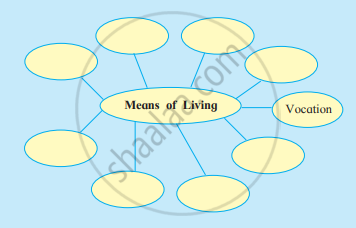
Pick out words that refer to ‘means of living’ and fill them in the Web.
(profession/recreation/occupation/job/ pastime/employment/hobby/career/entertainment/mission/trade/buisness/sports/retirement/placement)
Make a list of the preparations made for an assault on Tiger Hill.
After confirming the multidirectional assault as the best strategy the commanding officer ________________.
Find evidence from the lesson and write in your own words.
India has many amazing success stories.
Discuss the activities carried out by a farmer.

Life is an amalgam of happy and sad moments. Think of such moments in your life, pair with your classmate, and share both the aspects of life.
| Happy Moments | Sad Moments |
| 1. Winning the first prize in a competition | Losing your mobile, bicycle, or wallet |
| 2. | |
| 3. |
Go through the poem and state whether the following statement is true or false.
Planners paint beautiful pictures of the upcoming changes in the city that charm the citizens.
Your friend fell down learning to ride a bicycle and now has given it up altogether. What do you think will be the poet’s advice? Write it down.
Complete the following statements with the help of the text.
To learn about meditation, you have to see ____________________________________________________________ Watch your thinking. Do not ________________________ Do not ____________________________________ Begin to learn ______________________________ Just watch thought. Do not ____________________________________________________.
Fill in the gap, choosing a word from the bracket to make an appropriate comparison.
as ______ as a worm
Answer the following question in one sentence.
What does the title of the poem say?
How long a period did Shalihotra allow to find the missing things?
Portia’s suitors chose the gold and silver caskets.
Complete the following sentence with reference to the passage:
For six years did Gautama practise ____________.
Listen and complete:
Close your books. The teacher will dictate some lines from the poem. She will say the first half and you have to write the entire line/verse.
- I know a funny ____________ As quiet as a ____________ Who does the mischief that is done ____________.
- There’s no one ever sees his face, And yet we all ____________ That every plate we break was ____________ By ____________.
There were no human settlements on the moon.
Choose the appropriate phrase to insert in the gap, to make the sentence meaningful. Use the appropriate form of the verb.
Sorrowful times are ______ darkness.
Correct the following sentence and rewrite it.
The best shoes that Papa Panov had made were a pair of lady’s shoes.
How did the middle brother use rice?
Answer the question in a paragraph of about 100 – 150 word.
Narrate how Prospero made his enemies repent to restore his dukedom.
What will happen to the bird in imprisonment?
Answer the following question in about 80-120 word.
If you were to live in the Complaining Street, how would you deal with the people who grumble?
What other various pets did Somu have?
There were many toys in the stall. Three of Hamid’s friends had bought some toys.
Write the names of Hamid’s friends in column A and the toys they bought in column B
| A | B |
Read the letter again and write a few lines on each of the following.
- things that the coach taught….
- transformation in the child……..
- things that amazed the writer……..
Find a sentence/word from the text which express the following.
The parent’s earlier view of the child
How did the children react when they met each other at the ruins?
“Was it just the wind?”– What do you think Usha thought it was? Why?
ashen – pale
His face was ashen.
Neerja was sent to London based on______.
Read these lines and answer the questions given below.
And welcomes little fishes in
With gently smiling jaws!
- Who welcomes the fish? Why?
- Which line tells you that the crocodile is hungry?
Where did the boys and girls go?
The wild boar got up from its daybed because it was disturbed by another boar.
The second daughter ________ the milet to a flock of birds.
Why do the soldiers (people) die? When will it stop?
Jaswant Singh Rawat was awarded ______.
The old man helped ______ and ______.
Choose the correct option from the given homophones.
You should never ______ to your parents.
Where did we visit a mermaid?
Some words sound the same but their spelling and meaning are different. Such words are called homophones. There are many homophones.
Why did everyone ridicule the boy?
What party is that?
Jana saw a _______ behind her.
At the end of the festival , Kamali and Senthil saved______.
Whose word are these? Name the character.
“Utensils made of brass and tin for sale!”
Why did he rub the circle again and again?
“Something is wrong,” said Helen’s mother. What was wrong with Helen?
Now, read the following passage on “Laughter Therapy” and answer the questions that follow.

- Laughing is an excellent way to reduce stress in our lives; it can help you to cope with and survive a stressful life. Laughter provides full-scale support for your muscles and unleashes a rush of stress-busting endorphins. Since our bodies cannot distinguish between real and fake laughter, anything that makes you giggle will have a positive impact.
- Laughter Therapy aims to get people laughing, in groups and individual sessions and can help reduce stress, make people and employees happier and more committed, as well as improve their interpersonal skills. This laughter comes from the body and not the mind.
- Laughter Yoga (Hasya yoga) is a practice involving prolonged voluntary laughter. It aims to get people laughing in groups. It is practiced in the early mornings in open-parks. It has been made popular as an exercise routine developed by Indian physician Madan Kataria, who writes about the practice in his 2002 book ‘Laugh for no reason'. Laughter Yoga is based on the belief that voluntary laughter provides the same physiological as well as psychological benefits as spontaneous laughter.
- Laughter yoga session may start with gentle warm-up techniques which include stretching, chanting, clapping, eye contact and body movements to help break down inhibitions and encourage a sense of playfulness. Moreover, laughter is the best medicine. Breathing exercises are used to prepare the lungs for laughter followed by a series of laughter exercises that combine a method of acting and visualization techniques. Twenty minutes of laughter is sufficient to augment physiological development.
- A handful of small-scale scientific studies have indicated that laughter yoga has some medically beneficial effects, including cardiovascular health and mood. This therapy has proved to be good for depressed patients. This laughter therapy also plays a crucial role in social bonding.
Answer the following.
a. How does laughter help one to cope with stress?
b. Which word in the text (para 2) means the same as ‘dedicated'?
c. Why do you think voluntary laughter provides the same physiological as well as psychological benefits as spontaneous laughter?
d. ‘Laughter is the best medicine’. Explain.
e. Given below is a set of activities. Which of these are followed in the ‘Laughter Yoga’ technique?
- sitting on the ground with legs crossed
- body movements
- clapping
- closed eyes
- breathing exercises
- chanting
- stretching of arms and legs
- bending backwards
- running/jogging
- eye contact
f. ‘Laughter therapy also plays a crucial role in social bonding’. How?
Why is it not advisable to play online games?
