Advertisements
Advertisements
प्रश्न
We 'draw up a deed'. Complete the following phrase with an appropriate word.
________ends meet
Advertisements
उत्तर
To make ends meet
APPEARS IN
संबंधित प्रश्न
Give an example from the passage that proves the crow to be an intelligent bird.
|
The energy stored in coal and petroleum originally came to the earth from the sun. The bulk of the present-day supplies was laid down some 200 to 600 million years ago, when tropical conditions were widespread. Lush, swampy forests produced huge trees; warm coastal seas swarmed with microscopic forms of life. When these organisms died, much of their tissue was recycled as it is today — through scavenging and decay. But a significant amount of dead plant and animal material was covered with mud, which prevented complete decomposition. With the passage of time, layer upon layer of the fine sediment was deposited over the once-living material; the sheer weight turned the sediments to rock. Sandwiched between the layers, both coal and petroleum were produced and preserved under pressure. Coal was formed mostly of giant fern-like plants that have only small counterparts today. Coal may still be forming here and there on earth, but conditions are not right for the production of significant quantities. |
Underline the important words and phrases.
Read the text below and summarise it.
The Great Desert Where Hippos Once Wallowed
The Sahara sets a standard for dry land. It’s the world’s largest desert. Relative humidity can drop into the low single digits. There are places where it rains only about once a century. There are people who reach the end of their lives without ever seeing water come from the sky.
Yet beneath the Sahara are vast aquifers of fresh water, enough liquid to fill a small sea. It is fossil water, a treasure laid down in prehistoric times, some of it possibly a million years old. Just 6,000 years ago, the Sahara was a much different place.
It was green. Prehistoric rock art in the Sahara shows something surprising: hippopotamuses, which need year-round water.
“We don’t have much evidence of a tropical paradise out there, but we had something perfectly liveable,” says Jennifer Smith, a geologist at Washington University in St Louis.
The green Sahara was the product of the migration of the paleo-monsoon. In the same way that ice ages come and go, so too do monsoons migrate north and south. The dynamics of earth’s motion are responsible. The tilt of the earth’s axis varies in a regular cycle — sometimes the planet is more tilted towards the sun, sometimes less so. The axis also wobbles like a spinning top. The date of the earth’s perihelion — its closest approach to the sun — varies in cycle as well.
At times when the Northern Hemisphere tilts sharply towards the sun and the planet makes its closest approach, the increased blast of sunlight during the north’s summer months can cause the African monsoon (which currently occurs between the Equator and roughly 17°N latitude) to shift to the north as it did 10,000 years ago, inundating North Africa.
Around 5,000 years ago the monsoon shifted dramatically southward again. The prehistoric inhabitants of the Sahara discovered that their relatively green surroundings were undergoing something worse than a drought (and perhaps they migrated towards the Nile Valley, where Egyptian culture began to flourish at around the same time).
“We’re learning, and only in recent years, that some climate changes in the past have been as rapid as anything underway today,” says Robert Giegengack, a University of Pennsylvania geologist.
As the land dried out and vegetation decreased, the soil lost its ability to hold water when it did rain. Fewer clouds formed from evaporation. When it rained, the water washed away and evaporated quickly. There was a kind of runaway drying effect. By 4,000 years ago the Sahara had become what it is today.
No one knows how human-driven climate change may alter the Sahara in the future. It’s something scientists can ponder while sipping bottled fossil water pumped from underground.
“It’s the best water in Egypt,” Giegengack said — clean, refreshing mineral water. If you want to drink something good, try the ancient buried treasure of the Sahara.
Staff Writer, Washington Post
Briefly explain the following statement from the text.
“You have passed through a fantastic experience: or more correctly, a catastrophic experience.”
Both Ramanand and Azam Khan seem to have very fixed views. How does Ramanand score over Azam Khan towards the end of the story?
Paul's final bet his family richer but cost him his life. Explain.
Discuss in pairs or in small groups
What does a novel do?
Make groups and discuss the following:
Did they themselves suffer from those problems/setbacks?
Complete the following sentence.
Sujoy reported about ___________________.
Read the poem below and fill in the gaps, choosing appropriate pairs of rhyming words, to make them meaningful.
|
Little things Little drops of water, Thus the little minutes, Little deeds of kindness, |
(love - above / sand - land / be - eternity)
Say where . . . . . . .
______ do stars shine in the daytime?
Read the lesson and name the following.
The First successful Cardiac Surgeon ______
Read the passage and answer the following question:
What is 'Param Vir Chakra'?
Correct the given sentence with justification.
The play is restricted to only a part of the woods.
The man in the moon is mentioned in many nursery rhymes and stories. When people see the spots on the surface of the moon, they imagine that it’s a human face or the figure of a man who lives on the moon. Sometimes, other characters like rabbits are also imagined to live with the man. Here are two nursery rhymes about the man on the moon.
Form a pair. Write at least one short dialogue for the following expression.
I agree.
Find four words ending with ‘-ous’ from the story.
Can you add three more words ending with ‘-ous’ to this list?
Correct the following sentence using facts from the passage.
The great heroes avoided one another.
Write the following:
The sights seen through a railway carriage mentioned in the first stanza.
Complete the following sentence with reference to the passage.
Nobody knows for certain who ___________________.
Find the names of the exotic musical instruments and animals mentioned in the poem.
Rohan had finished ______ rounds of the tree before Mrs. Groover discovered him.
Present Mr. Wilson’s story as it would be shown in a comic strip. Write what picture you will show in each frame along with the dialogues. Write the dialogue with the help of the story. Examples:
 |
 |
 |
Listen carefully and guess how the sentence would end.
This step is broken. Please be ______.
Which event in the story tells us that the lion was brave?
Look at the photographs on textbook pages 19-20 carefully and imagine the following:
- The colours, shape, size, actions, etc. of what you see in the picture.
- The sound/sounds you may hear at the scene of the photograph.
- How the different things, birds, animals, etc. in the picture feel to the touch.
- The smell / smells you may smell at the scene of the picture.
- The taste of what you see in the pictures.
In short, let your imagination include oil your five senses.
Now, write short descriptions of any 8-10 of your choice.
Remember to make use of your senses (one or more!) when you describe a photograph. You will find the following words and phrases useful. You may also use other words you know.
What are search engines?
Share a memorable trip from your life
Where was the author when he heard the noise?
What did the narrator think the unusual sound was?
Read the following line from the poem and answer the question given below.
They growl at that and they growl at this;
Whatever comes, there is something amiss;
- What does the word ‘growl’ mean here?
- Why do they find everything amiss?
Identify the speaker/character.
‘ It’s Somu’s thoughtless ways that reduce me to tears’
The______ of ______ are nearly run.
- soft
- vain
- fear
- joy
- love
- heard
- toiled
- mild
- good
- sand
- life
- harsh
Fill in the blank.
______ is referred to as a festival of sacrifice.
“I will die, but not run away.” – Justify the saying of Neerja.
When should we have courage?
Read the following lines and answer the questions.
It isn’t an instantaneous thing
Born of despair with a sudden spring
- What does ‘it’ refer to?
- What does ‘born of despair mean’?
Is the brother boastful? What makes you think so?
The girl admitted to her brother that she was badly frightened.
Name the character or speaker.
"Why don't you do that yourself?"
Match the following.
| 1. | garden | very small |
| 2. | trash can | hungry and tired |
| 3. | old man | well maintained |
| 4. | hut | earthen pot |
| 5. | gruel | wasted food |
The bird-catcher let the pigeon jump into the fire.
Who is the guest?
Why did Uthaman become angry with the old man?
Choose the best answer.
Suddenly there was a______.
The official visited the rehabilitation centre daily.
Which disaster had hit the village?
Rani thought of herself as a _______ engineer.
Do you think it is right for the tanker to take water? Why?
In real the plate was made of ______.
Write the word with same meaning.

chips- ______
Do we worry when the progress is slow?
What happens when the day is over?
Who was Hiawatha?
What did the animals do when they saw the blue jackal?
Write the related words as shown in the example.
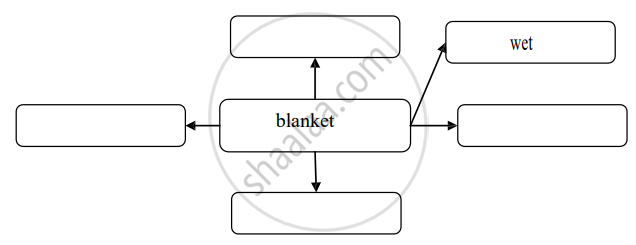
What should parents do to ensure cyber safety for their wards? (Any three points)
Collect the outer coverings of fast food items. Discuss the following points in groups and then write your observations in your notebook.
- Ingredients
- Manufactured by
- Net weight
- Veg or Non-veg
- Recipe
- Nutrition facts
- MRP
- Mfg date
- Website
- Other instructions, if any
Enact any one anecdote in the classroom.
