Advertisements
Advertisements
प्रश्न
What do the references to the birds and animals made in the poem suggest?
Advertisements
उत्तर
Refugee Blues is a melancholic poem that narrates the constant terror that hovers a Jew couple that escapes to America and their ordeal for no one sympathises with them. The constant fear of loss of home and death haunts them. They are unwelcome even to the newfound land, America as they accuse them that they will take away their 'bread'. The poet juxtaposes the free birds and animals to the lives of Jews. The freedom that the Dog, Cat, or Fish enjoy is not blessed to the Jew couple. They remember the orders of Fuhrer (Hitler) to wipe out the whole Jew race through the holocausts or concentration camps where they were thrust into gas chambers. It is brought out that even animals in America enjoy the freedom and are respected; whereas, Jews in Germany have no right to live as per the Nazi regime. The narrator is upset that even a fish who is at the mere distance of 10 feet from the narrator can swim freely in the waters while the narrator is mourning at his and his wife's misery.
APPEARS IN
संबंधित प्रश्न
Anne's father was close to her. What did she like about him? Why?
Read the extract and do the following activities:
A1 Complete :
| Night |
Morning |
| (i) | (i) |
| (ii) | (ii) |
There was a roaring in the wind all night;
The rain came heavily and fell in floods;
But now the sun is rising calm and bright,
The birds are singing in the distant woods;
Over his own sweet voice the Stock-dove broods;
The Jay makes answer as the Magpie chatters;
And all the air is filled with pleasant noise of waters
All things that love the sun are out of doors;
The sky rejoices in the morning’s birth;
The grass is bright with raindrops-on the moors
The hare is running races in her mirth;
And with her feet she from the plashy earth
Raises a mist; that, glittering in the sun,
Runs with her all the way, wherever she doth run.
A2 What do the different birds do? Discuss.
A3 The sky rejoices in the morning’s birth. (Name and explain the figure of speech)
Read the following passage and do the activities:
A1 True or False:
Rewrite the following statements and state whether they are ‘true’ or ‘false’.
(i) Mashelkar’s mother did menial work to bring him up.
(ii) Mashelkar’s father died when he was twelve.
(iii) Mashelkar was born in a very rich family.
(iv) Tatas added much value to Mashelkar’s life.
I start with my greatest guru-my mother. I was born in a very poor family and my father died when I was six. We moved to Mumbai and my mother did menial work to bring me up. Two meals a day was a tough challenge. I studied under street lights and I walked barefoot until, I think, I was twelve. I remember when I passed the seventh standard and I wanted to go into the eighth standard, our poverty was such that even to secure 21 rupees for secondary school admission became a big challenge. We had to borrow from a lady, who was a housemaid in Chaupati in Mumbai. That was the tough life I had.
In fact, I remember, my passing the SSC Examination-i.e. 11th standard. Those days it used to be not 10th standard or 12th standard but 11th standard. I stood 11th among 1,35,000 but I was about to leave higher education and find a job. What helped me was the scholarship by Sir Dorab Tata Trust. It was just 60 rupees per month and would you believe that 60 rupees per month from Tatas added so much value to my life that I have been able to stand here today before you to speak to you.
I am on the Board of Tatas now and it is very interesting that the same Bombay House where I used to go to collect that 60 rupees per month now one goes and sits there like a Director on the Board of Tata Motors. The turn that these 40 years have taken is very interesting. It has all been possible because of the chance I got to do higher studies at the insistence of my mother. She gave me the values of my life. She was one of the noblest parents I have met in my life.
So, my greatest guru was my mother. My second guru was Principal Bhave, about whom I made a mention earlier. He taught us Physics. Because it was a poor school, I remember, it had to innovate to convey to the young students the message of Science.
A2 Complete:
Complete the following sentences and write:
(i) Mashelkar was inspired by his greatest guru _______
(ii) Mashelkar studied under _______
(iii) Principal Bhave taught _______
(iv) The scholarship by _______ Trust helped him in higher education.
A3 Find the meaning:
Choose the appropriate meaning of the underlined words from the given alternatives:
(i) We moved to Mumbai and my mother did menial work.
(a) skilled
(b) hard
(c) unskilled
(d) of low status
(ii) Because it was a poor school, it had to innovate to convey to the young students the message of science.
(a) do a cheap experiment
(b) introduce new things
(c) avoid
(d) try hard
(iii) I got to do higher studies at the insistence of my mother.
(a) firm saying
(b) being inspired
(c) being inspected
(d) being instigated
(iv) That was the tough life I had.
(a) difficult
(b) soft
(c) cheap
(d) simple
A4 Match:
Match the following sentences with their tags:
| 'A' | 'B' | ||
| (i) | I stood 11th among 1,35,000 |
(a) | aren’t I? |
| (ii) | I am on the Board of Tatas | (b) | didn’t we? |
| (iii) | It was a poor school | (c) | didn’t I? |
| (iv) | We moved to Mumbai | (d) | wasn’t it? |
A5 Personal Response:
“Mother is the greatest Guru.” Discuss.
Answer the following question in 30-40 words:
“The sight of the food maddened him.” What does this suggest? (His First Fight)
Briefly comment on:
The author’s meeting with Norbu.
Tick the statement that is true.
The places mentioned in the story are all imaginary.
'The Address' is a story of human predicament that follows war. Comment
We 'draw up a deed'. Complete the following phrase with an appropriate word.
________one's word
Explain the line:
She makes too much steam–you want to hang the monkey wrench on the safety valve!
Notice these expressions in the poem and guess their meaning from the context:
| rancid breath | squelching tar |
| spectroscopic flight of fancy | |
| rearing on the thunderclap | brunette |
| peroxide blonde | clinical assent |
| raven black |
Why have the words, 'pretended' and 'seemed' been used in the lines:
...Pretended to believe every single word
of what the tiger king said.
And seemed to be taken in by all the lies.
How does the sense of these lines connect with the line 'Ajamil wasn't a fool'?
Read the following statement and mark those that apply to you.
I make friends easily.
Read the following statement and mark those that apply to you.
Someone has extended a hand of friendship towards me and I have not accepted it.
Read the extract and state whether the following statement is true or false. Correct the false statement.
The author did not succeed in finding Kasbai.
Which pictures reflect gender equality? Write their numbers.
Discuss the activities carried out by a farmer.

Read the lesson and name the following.
The First surgeon to perform operations ______
Proverbs associated with the word season: for eg: Make hay while the sun shines.
- _________________________
- _________________________
Answer the following question in short.
On what condition did Tenali Raman agree to take up the challenge?
Comment on the given statement after reading the given dialogue -
It’s a pity some honest man not to be better of that ________________________________________________.
State whether the following statement is True or False:
Both Demetrius and Lysander fight for Hermia.
Write short note on the following:
The 1883 eruption
How do the following avoid giving anything to the traveller?
Motiram
(Answer in one or two lines.)
Write a short note on the following:
Utilization of animal by-products in the ancient world.
What themes did the committee identify?
What themes would you like to add to the themes given in this passage?
Find out the following with the help of your teacher and the internet.
Rain in countries like the UK which experience spring-summer-autumn-winter.
Describe a crocodile in your own words.
Answer in your own words.
Why does a mother tell Neel about his Grandpa?
Choose the appropriate phrase to insert in the gap, to make the sentence meaningful. Use the appropriate form of the verb.
The minister ______ his personal body-guards.
Who is the speaker in this poem?
Write in your own words.
How does the poet glorify his home in the first stanza?
Guess the meaning of the following word.
novel
Read the word. Write the words that combine to make it.
springtime
What different names is ‘Rangoli’ known by in different regions?
Does Chulong want to earn money honestly?
What were Chulongs plans for the bird?
What happened when Somu left Zigzag with the Krishnans?
Which gift did Anne value the most?
Hamid’s friends are ______
Write the name of the toy against the picture.

Hamid’s granny scolded him for buying iron tongs. Then she understood that Hamid had bought it ______.
What was the reaction of the inhabitants?
Fill in the table given below.
| S. No | Problems faced by the hatchlings | Effect | Solution |
| 1. | Pollution | Survival of sea turtles becomes difficult. | Reduce the usage of plastics. |
| 2. | Predators | ||
| 3. | Human Activities |
A sea turtle camouflages its nest by tossing sand on it to ______.
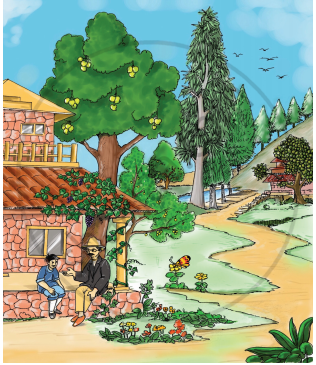
Listen to your teacher read the first part of the story. Many things described in the story can be seen in the picture. Find and name them.
The eggs hatched and the babies flew away.
Work in pair, find answer for the question and share in the class.
When is it autumn in India? Why does the poet say this? Is there an autumn season in India?
Match the dialogue to the character.
| "I will do all the work myself." |  |
| "First, you charge my battery." |  |
| "I have bought you a robot." |  |
Name the character or speaker.
"Play me a pleasant song."
The rich man ______ at the beggar.
______is a Do It Yourself kid.
Circle and write the adverbs.
Suddenly the old man fainted. ______
Guess how would the sparrow pull the elephant and the crocodile.
Why did Tenzin cry every day?
Choose the word with same meaning.
Kingdom- ______
Does the brush bend to her will?
What was the truth finally learned by Chris?
Now, read the following biographical extract on Sujatha Rangarajan, a Sciencefiction writer, and answer the questions that follow.
- Sujatha is the allonym of the Tamil author S. Rangarajan and it is this name that is recognised at once by the Tamil SciFi reading community. You might have seen the Tamil movie ‘Endiran’ where the robot Chitti exhibits extraordinary talents in an incredible manner. The robot could excel a human being in any act, beyond one’s imagination. Jeeno, a robotic dog which appeared in Sujatha’s science fiction novel “En Iniya Iyandhira” (My Dear Robot) formed the basis of Chitti’s character. Like Chitti, Jeeno was an allrounder who could cook, clean and fight. High-tech computer technology terms are used in the story. Jeeno, a pet robot, plays an important role throughout the story. As the story proceeds, it behaves and starts to think on its own like a human and instructs Nila, a human being, on how to proceed further in her crises.
- In the preface of ‘En Iniya Iyandhira’, the writer states the reason for his attraction to the genre: “Science gives us the wonderful freedom to analyse thousands and thousands of alternative possibilities. While using it, and while playing with its new games, a writer needs to be cautious only about one thing. The story should draw some parallels or association from the emotions and desires of the present humankind. Only then it becomes interesting. Jeeno, the robot dog, was intelligent. But the character became popular only because of the robot’s frequently displayed human tendencies.” It is no wonder that all his works echo these words and will remain etched in the minds of the readers who enjoy reading his novels to have a wonderful lifetime experience.
- It was Sujatha, who set the trend for sci-fi stories. He had tracked the origin from Mary Shelly’s Frankenstein to his short stories. He has written 50 sci-fi short stories and these were published in various Tamil magazines. His stories have inspired many readers to extend their reading to English sci-fi writers like Isaac Asimov. The themes were bold, even if there was a dependence on a very well-established characterization of English fiction. Sujatha opened up a new world to us with his writings on holograms, computers and works like ‘En Iniya Iyanthira’ inspire many to study computer science.
- He has been one of the greatest writers for more than four decades. He combined reasoning and science in his writings. Being a multifaceted hi-fi and sci-fi humanistic author, he expressed his views distinctively. He was the one who took Tamil novels to the next level. As an MIT alumnus and an engineer at BHEL, he was very good at technology. He could narrate sci-fi stories impressively. His readers always enjoyed reading all his detective and sci-fi novels which featured the most famous duo ‘Ganesh’ and ‘Vasanth’.
- Sujatha has played a crucial role as a playwright for various Tamil movies which have fascinated movie lovers. Hence, it is fathomable that the writer’s perspective of future India enthuses every reader and paves a new way to reading sci-fi stories in English.
A. Answer the following questions in a sentence or two.
- How was Jeeno different from other robots?
- What precaution should one take while writing Science fiction stories?
- What inspired Sujatha’s themes?
- Why were Sujatha’s sci-fi stories impressive?
B. Find words from the passage which mean the same as the following.
- difficult to believe (para 1)
- a style or category of art, music or literature (para 2)
- having many sides (para 4)
- capable of being understood (para 5)
What is Gandhiji’s ideal?
