Advertisements
Advertisements
प्रश्न
How does the poet juxtapose the human condition with the behaviour of the political class?
Advertisements
उत्तर
The poem is crafted in the environment when the whole of Germany rose to the ideology of Nazism and the political thinkers were determined to terminate the whole of the Jew community.
The thunderous rumbling of Adolf Hitler that “they must die” shook waves of terror across Europe paralysing Jews to utmost horror. The narrator exclaims at this that they are in his mind! In a public meeting in the USA, where they took refuge, the speaker spoke anti-Jews as well. He possibly meant that if Jews were allowed to settle in they would steal their jobs and food. Jews across America and Europe were looked at with bitter hatred. Everyone wanted them dead. At this time the couple is left destitute at the hands of fate. They are scared and bewildered. They have nothing to go back to the nation that was once there. They suffer the loss of identity and are threatened with death constantly. A striking contrast is drawn between the two sects that the world around them is divided into. One is comprising of people like them, the Jews and the other is the one hunting for them, wanting to kill them. One is the sufferer and the other is the one inflicting pain on the first one.
APPEARS IN
संबंधित प्रश्न
Life is a gift to be used every day,
Not to be smothered and hidden away,
It isn’t a thing to be stored in the chest
Where you gather your keepsakes and treasure your best;
It isn’t a joy to be sipped now and then
And promptly put back in a dark place again
Life is a gift that the humblest may boast of
And one that the humblest may well make the most of
Get out and live it each hour of the day,
Wear it and use it as much as you may,
Don’t keep it in niches and corners and grooves,
You’ll find that in service its beauty improves.
(1) What do we treasure in a chest?
(2) How does the poet went us to use the gift of life?
(3) Do you agree that life should be measured un deeds and not in years? Why?
(4) Which words in the poem mean the following :
(a) Kept from developing
(b) Hollow places in a wall
(5) Life is a gift to be used every day. [Name and explain the figure of speech]
Helen's struggle has become a source of inspiration for all less fortunate. Comment.
Divide the article into four sections based on the shifts in the sub-topics and give a suitable sub-heading for each section. One has been done for you in the article as an example.
What kind of a person do you think the narrator is?
What do you understand of the natures of Ramanand and Azam Khan from the episode described?
How does the insertion of dialogue in the story contribute to its interest?
What impression would you form of a state where the King was 'just and placid'?
Why does Russell call the three passions 'simple'?
Discuss in small groups.
‘On reading Shelley’s A Defence of Poetry, the question insistently occurs why there is no similar A Defence of Science written by a scientist of equal endowment.’
The following common word is used in a different sense in the poem. Guess what it means.
Personification is a figure of speech that attributes human qualities to inanimate things and abstract ideas. How has it been used in the poem?
Comment on the contemporary concern that the poem echoes.
Find from the poem, positive qualities to fill up the web.
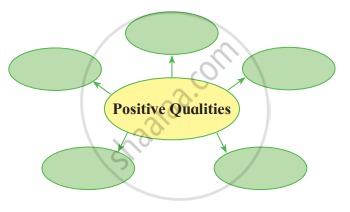
Divide the class into 5 groups. Each group can prepare a decorative chart/poster using an epigrammatic line from the poem. You may use calligraphy/painting/or Paint program on a computer. (With permission, put up these charts in your school.)
Go through the text again and find the reasons that forced Peter to shoot down a person.
- The keepers spotted him.
- _________________________
- _________________________
Find evidence from the lesson and write in your own words.
Indians respect the freedom of others.
State whether the following statement is True or False. Correct the false statement by finding evidence from the poem to support your remark.
The poet repents planting the cherry tree.
‘Never mind faded forests, Austin’. The word ‘faded’ means to become dim or faint. The word describes the forests that have become faint or dim in appearance. Now go through the poem again and complete the table.
| Describing word | Object | Explanation |
| 1. faded | forests | The forests have become faint or dim in appearance. |
| 2. silent | ||
| 3. unfading | ||
| 4. bright |
Honey-bees live an organized life like human beings. Discuss what work the following honey-bees do, as per the poem. Write it down in your own words, in your notebook.
- King/Emperor bee
- Magistrate bees
- Merchant bees
- Soldier bees
- Mason bees
- Civilian bees
- Porter bees
- Judge bee
Write a short note on Emperor Akbar.
Visit a library: Find the stories of
- Mulla Nasiruddin
- Gopal Bhand and
- Tenali Raman. Share them in the class.
Read the following sentence carefully and choose the correct meaning.
The Peacock had a gorgeous tail like no other bird.
Comment on the given statement after reading the given dialogue -
I wouldn’t be in your shoes if he rewards me ten times as much. People generally fall victim to incentives. Some people stick to values. They _________________.
Form a pair. Write at least one short dialogue for the following expression.
I agree.
The merchant ships brought spices and other treasures from India and other countries to Italy.
What themes would you like to add to the themes given in this passage?
Visit a library:
Find and read the biography of your favourite scientist.
Guess the meaning of the following from the context.
Dawn wakes the starling.
Read the following sentence aloud. Write who said it and to whom.
“Would you lend me this, just this?”
Read the passage and name the following.
He persuaded Helen to elope with him.
Complete the following sentence with reference to the passage.
It is believed that _________ Homer, who __________ and who ________ to all who __________________.
Observe the picture and the labels carefully. Then match the words and the meanings given in the following table.
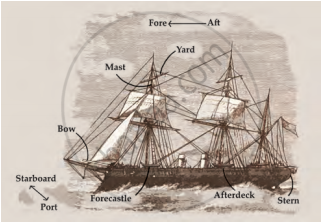
| Words | Meaning |
| 1. yard | (a) a floor, flat area built on a ship |
| 2. mast | (b) the forward part of the main body of a ship |
| 3. bow | (c) the forward part of a deck |
| 4. deck | (d) tall, upright pole on a ship |
| 5. forecastle | (e) a pole slung across a ship’s mast. A sail hangs from a yard. |
| 6. starboard | (f) the rearmost (back) part of a ship |
| 7. stern | (g) the part which is always at the front while the ship is sailing. |
| 8. afterdeck | (h) the right-hand side of a ship as one faces forward |
| 9. fore | (i) an open deck near the back |
Using your imagination, write how the other pets in the house could have objected to Caesar living in their house.
How does the following character in the story live up to their name? Provide points from the story.
Taffimai Metallumai
Find out how the following game is played.
Lawn Tennis
Enact the play.
What is meant by browsing or surfing?
Identify the speaker/character.
‘ Remember the tiny penknife he gave me last year’.
What are the two reasons the author gives for the plants moving towards grandfather?
Read the questions related to the three sports stars you have read about and tick the appropriate boxes.
 |
 |
 |
|
| 1. Who won the Olympic 2016 silver medal in badminton? | |||
| 2. Who is the role model for her siblings? | |||
| 3. Whose mother tongue is Tamil? | |||
| 4. Whose attitude is 'never-say-die spirit'? | |||
| 5. Which player works in the Police Department? | |||
| 6. Which player holds the record for the highest individual score in cricket? |
Read the lines and answer the question given below.
And ever again, in the wink of an eye,
Painted stations whistle by
- ‘In the wink of an eye’ means very quickly. Explain ‘painted stations whistle by’.
Gulliver was the captain of the ship.
Read the lines and answer the questions given below.
Spring is pretty
but short and sweet
when you can smell the grass
from your garden seat
- How does the poet describe the spring season?
- Which line tells you that the garden is fresh?
- Who does ‘you’ refer to?
Read the lines and answer the questions given below.
Autumn is English
in red, yellow and brown
Autumn is Indian
Whenever leaves fell down
- How is autumn in India?
- Compare the English autumn with the Indian autumn.
The man destroyed ______.
Why do the soldiers (people) die? When will it stop?
Choose the odd one out.
Connect and write the homophones in the box.
|
Sea |
 |
|
One |
 |
|
Flower |
 |


What made him frightened?
Why do we ask questions?
The official and his wife liked______.
Name the character or speaker.
"Did someone scold you?"
When does the world become green?
Senthil bought a ______ from his savings.
Write the word with same meaning.

Flat
Replace the bold word/words with a word from the quiver and re-write the sentence –
In no time she hit the object she aimed at.
What happens when the day is over?
What did the boy make with the branches of the tree?
Now, read the following biographical extract on Sujatha Rangarajan, a Sciencefiction writer, and answer the questions that follow.
- Sujatha is the allonym of the Tamil author S. Rangarajan and it is this name that is recognised at once by the Tamil SciFi reading community. You might have seen the Tamil movie ‘Endiran’ where the robot Chitti exhibits extraordinary talents in an incredible manner. The robot could excel a human being in any act, beyond one’s imagination. Jeeno, a robotic dog which appeared in Sujatha’s science fiction novel “En Iniya Iyandhira” (My Dear Robot) formed the basis of Chitti’s character. Like Chitti, Jeeno was an allrounder who could cook, clean and fight. High-tech computer technology terms are used in the story. Jeeno, a pet robot, plays an important role throughout the story. As the story proceeds, it behaves and starts to think on its own like a human and instructs Nila, a human being, on how to proceed further in her crises.
- In the preface of ‘En Iniya Iyandhira’, the writer states the reason for his attraction to the genre: “Science gives us the wonderful freedom to analyse thousands and thousands of alternative possibilities. While using it, and while playing with its new games, a writer needs to be cautious only about one thing. The story should draw some parallels or association from the emotions and desires of the present humankind. Only then it becomes interesting. Jeeno, the robot dog, was intelligent. But the character became popular only because of the robot’s frequently displayed human tendencies.” It is no wonder that all his works echo these words and will remain etched in the minds of the readers who enjoy reading his novels to have a wonderful lifetime experience.
- It was Sujatha, who set the trend for sci-fi stories. He had tracked the origin from Mary Shelly’s Frankenstein to his short stories. He has written 50 sci-fi short stories and these were published in various Tamil magazines. His stories have inspired many readers to extend their reading to English sci-fi writers like Isaac Asimov. The themes were bold, even if there was a dependence on a very well-established characterization of English fiction. Sujatha opened up a new world to us with his writings on holograms, computers and works like ‘En Iniya Iyanthira’ inspire many to study computer science.
- He has been one of the greatest writers for more than four decades. He combined reasoning and science in his writings. Being a multifaceted hi-fi and sci-fi humanistic author, he expressed his views distinctively. He was the one who took Tamil novels to the next level. As an MIT alumnus and an engineer at BHEL, he was very good at technology. He could narrate sci-fi stories impressively. His readers always enjoyed reading all his detective and sci-fi novels which featured the most famous duo ‘Ganesh’ and ‘Vasanth’.
- Sujatha has played a crucial role as a playwright for various Tamil movies which have fascinated movie lovers. Hence, it is fathomable that the writer’s perspective of future India enthuses every reader and paves a new way to reading sci-fi stories in English.
A. Answer the following questions in a sentence or two.
- How was Jeeno different from other robots?
- What precaution should one take while writing Science fiction stories?
- What inspired Sujatha’s themes?
- Why were Sujatha’s sci-fi stories impressive?
B. Find words from the passage which mean the same as the following.
- difficult to believe (para 1)
- a style or category of art, music or literature (para 2)
- having many sides (para 4)
- capable of being understood (para 5)
Being a bachelor, the stranger had no patience with children.
