Advertisements
Advertisements
प्रश्न
How does the connection drawn between the tail and the eyes add to the descriptive detail of the poem?
Advertisements
उत्तर
Sujata details the plumage of the peacock with finesse. The whole poem is a celebration of the beauty of the peacock. The vivid impressions on the feathers, the eyes of the peacock, are best seen when it fans its tail. The pattern actually resembles an eye, which she is appreciates immensely. The poet when tries to get a glimpse of the peacock, alert, it gathers its tail and eludes. Then the poet praises these eye impressions and calls that these violet fringed with golden amber, dark glowing eyes are always open, of course as they can not have eyelids. The poet calls them the 'eyes of the peacock'. She describes them violet fringed with golden amber. The shaking of the feathers is compared to the blinking of eyes like the eyes on the feathers will not blink any other way but by the shaking of the feathers.
APPEARS IN
संबंधित प्रश्न
We sang our school fight song dozens of times – en route to Arlington National cemetery, and even on an afternoon cruise down the Potomac River. We visited the Lincoln Memorial twice, once in day – light, the second time at dusk. My classmates and I fell silent as we walked in the shadows of those 36 marble columns, one for every state in the Union that Lincoln laboured to preserve. I stood next to Frank at the base of the 19 foot seated statue. Spotlights made the white Georgian marble seem to glow. Together we read famous words from Lincoln’s speech at Gettysburg remembering the most bloody battle in the war between the status : “………….we here highly resolve that these dead shall not have died in vain – that this nation, under God, shall have a new birth of freedom………..”
As Frank motioned me into place to take my picture, I took one last look at Lincoln’s face. He seemed alive and so terribly sad.
The next morning I understand a little better why he wasn’t smiling. “Clifton,” a chaperone said, “could I see you for a moment?”
(1) When did the boys visit Lincoln Memorial?
(2) What made the Georgian marble glow?
(3) What did the words: “………. We here highly resolve that these dead shall not have died in vain – that this nation, under God, shall have a new birth of freedom …………” remind them?
(4) Do you believe in building memorials? What kind should they be, if your answer is ‘yes’? If no, give reasons why you do not believe in memorials?
Describe the role of Mr. Keith in the life of Helen in ‘The Story of My Life’.
How is the social life at Raveloe different from that at Lantern Yard ?
Read the passage carefully and complete the activities given below :
A1 True or False
A2 Mention the two things that were found when the tall grass was hacked.
A3 The narrator prayed that Rex should not make any sudden movements meets. Explain giving reasons.
Answer the following in 200-250 words :
What are Helen's opinions about examinations?
Divide the article into four sections based on the shifts in the sub-topics and give a suitable sub-heading for each section. One has been done for you in the article as an example.
Read the play out in parts. Enact the play on a suitable occasion.
Look at the words given in the box below
|
snigger |
wriggle |
sneak |
squeak |
|
squawk |
titter |
pant |
chuckle |
|
giggle |
jeer |
chortle |
guffaw |
|
sigh |
sidle |
boo |
shriek |
|
scramble |
croak |
straggle |
plod |
|
gasp |
|
|
|
Now classify them according to their closeness in meaning to the words given below
|
A |
B |
C |
D |
E |
|
snigger |
wriggle |
squeak |
jeer |
sigh |
Discuss in pairs or groups of four.
It is difficult to part with personal items like a watch which have a sentimental value attached to them.
What makes the urgency of the child's demand seem logical?
How is the essence of the poem captured in the lines 'two tickets to Happiness'?
Answer in your own words.
How did the plants respond when Revathi played her favourite tune?
Compare and contrast the two opposing human feelings as expressed by the poet.
Behrman was a hard-hearted person.
Read the lesson and name the following.
The First surgeon to perform operations ______
Proverbs associated with the word season: for eg: Make hay while the sun shines.
- _________________________
- _________________________
The ______ bees make honey from nectar.
Your friend fell down learning to ride a bicycle and now has given it up altogether. What do you think will be the poet’s advice? Write it down.
Choose any one of the objects we use daily and find out how it is made. Present the information in the form of a chart.
The description of the character is given below. Identify the character from the play. Find some sentences which support your choice.
He is a major character. He dominates in the story.
India is famous for its handloom fabrics. Write the story of a handloom kurta in your own words.
Do you know any poem or song about the moon in your own language? Sing it in the class.
Explain the following statement with reference to the context.
From now on The Herald shall be my artillery.
Shylock was not at all generous.
Write about one occasion when you have behaved like -
Mr. Nobody
Find out the following with the help of your teacher and the internet.
Rain in countries like the UK which experience spring-summer-autumn-winter.
Talk about the good qualities of any one person you do not like. (You need not name the person.)
Find one example of the following given below from the poem: Simile.
Prepare charts for each one of the asanas described in the passage. Use the following points:
- Name (in English, in your mother tongue)
- Meaning in English
- General information
- Steps and pictures
- Benefits
Fill in the table.
| Period | Way of Addressing a Mother | Boy’s Costume | Lady’s Costume | Daily Chores | Games |
| The 1950s | silk saree | ||||
| 1910 | Kurta pajama and cap | ||||
| The 1800s | |||||
| The 1500s | |||||
| 1000 | |||||
| 100 AD | feed poultry tend sheep keep away birds plaster the yard | ||||
| 3000 BC | Chaupar |
Read: ‘The Psalm of Life’- a poem by H. W. Longfellow.
Write in your own words.
What does the poet hope for?
Write other meaningful words that begin/end with footprint.
What does the poet want to know from the goldfish?
Why did Chulong catch the bird?
The narrator searched for three days to buy ceramic paint.
With their treasure, the boys would buy ______ in Eidgah.
What did Granny say about Hamid’s parents?
“Was it just the wind?”– What do you think Usha thought it was? Why?
The turtles use their flippers and make a hollow for their nests.
Women should not be compared with men in cricket, says Mithali.
What does ‘charges along like troops in a battle’ mean?
Gulliver was the captain of the ship.
Complete the sentence given below with word/phrase.
The hole in the ground was filled______.
A day in Mars is called ______.
The ________ are trying to terraform Mars.
What should we do to save the Earth?
The old man helped ______ and ______.
How did he lose his hand?
Humans give importance to save______.
Speak and win.
Join in one of the two groups. Choose two characters. Support or oppose any one of the characters. Say some sentences for the one you support and say some sentences against the other one, to win.
| I support | I oppose |
The goose is swimming with its ______.
Who is responsible for the society?
In real, the test is for______.
Appa weaves beautiful sarees with______.
What would you have done if your grandmother would have slipped?

What did the boy wonder about?
How did the animals know that the king was just a jackal?
The passage given below is on Kabbadi. Read the passage and complete the activities that follow.
Kabbadi (கபடி - in Tamil) is a contact team sport that originated in Tamil Nadu, India. It is the national sport of Bangladesh. It is also popular in South Asia and is the state game of the Indian states of Tamil Nadu, Kerala, Andhra Pradesh, Bihar, Haryana, Karnataka, Maharashtra, Punjab, and Telangana.
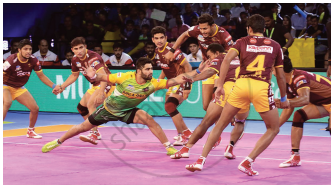
Kabbadi is played between two teams of seven players: the objective of the game is for a single player on offence referred to as a 'raider', to run in to the opposing teams half of a court, tag out as many of their defenders as possible, and return to their own half of the court–all without being tackled by the defenders. Points are scored for each player tagged by the raider, while the opposing team earns a point for stopping the raider. Players are taken out of the game if they are tagged or tackled, but can be 'revived' for each point scored by their team from a tag or tackle. The raider should hold his breath and utter the words like 'kabbadi kabbadi, hututu hututu, chadu kudu' etc. while the opponents try to catch him. If he stops uttering these words, he is considered out.
The game is known by its regional names in different parts of the subcontinent, such as Kabbadi or Chedugudu in Andhra Pradesh, Kabbadi in Kerala and Telangana, Hadudu in Bangladesh, Bhavatik in Maldives, Kauddi or Kabbadi in the Punjab Region, Hu-Tu-Tu in Western India and Hu-Do-Do in Eastern India and Chadakudu in South India. The highest governing body of Kabbadi is the International Kabbadi Federation.
Given below is the visual presentation of the first paragraph.
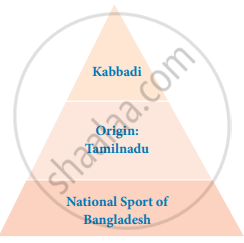
i) Represent the other paragraphs in a visual form of your choice(flow chart, mind-map, pie-chart, etc.).
ii) Choose the correct option.
1. A contact sport usually involves a ______contact between players.
- violent
- gentle
- physical
2. Kabbadi is a game played between ______.
- seven teams of two players
- two teams of seven players
- four teams of seven players
3. A single ______.
- player on offence is referred to as a raider
- offence is referred to as a raider
- raider is an offence by the player
iii) Answer the following.
- How does a raider score points for his team?
- When does a raider concede a point to the opponent team?
- Can a player be revived when he/she is out of the game? Explain your answer.
- Kabbadi is called by different names in different parts of India. Do you know how Pallankuzhi is called in Karnataka, Andhra Pradesh and Kerala?
Read the following information given in the table below and answer the questions.
| A nice choice from Chennai to the National capital | |||
| RAJADHANI EXPRESS TIMETABLE | |||
| Shortest Route between Chennai and Hazrat Nizamuddin 8 Halts & 324 intermediate stations in between | |||
| Station Name | Departs | Day | Speed |
| Chennai Central | 06.05 | 1 | 75 |
| Vijayawada | 11.55 | 1 | 76 |
| Warangal | 14.40 | 1 | 77 |
| Balharshah | 18.00 | 1 | 78 |
| Nagpur | 20.45 | 1 | 74 |
| Bhopal | 02.10 | 2 | 89 |
| Jhansi | 05.31 | 2 | 99 |
| Gwalior | 06.32 | 2 | 85 |
| Agra Cantt | 07.57 | 2 | 76 |
| Hazrat Nizamudin | 10.25 | 2 | - |
a) The number of stations between Chennai Central and Hazrat Nizamudin is______.
- five
- ten
- eight
- eleven
b) The train is expected to reach ______ around 8.45 PM
- Warangal
- Vijayawada
- Bhopal
- Nagpur
c) Between ______ the train runs at its maximum speed.
- Bhopal and Gwalior
- Bhopal and Jhansi
- Bhopal and Hazarat Nizamudin
- Bhopal and Agra
d) Almost ______ the train reaches Vijayawada.
- the day after
- around early morning
- late night
- around noon
e) People prefer the Rajadhani Express to travel from Chennai to reach the capital because ______.
- it reaches the destination on the same day
- the charge is reasonable.
- the train halts at ten stations.
- it is the shortest route from Chennai to New Delhi.
f) The destination of Rajadhani express is______.
- Hazarat Nizamudin.
- New Delhi junction.
- Old Delhi.
- Rajkot.
