Advertisements
Advertisements
प्रश्न
Read the following extract and then do all the activities that follow :
I rain into a stranger as he passed by
“Oh, excuse me please” was my reply.
He said, “please excuse me too; wasn't even watching for you.”
We were very polite, this stranger and I.
We went on out way and we said good-bye.
But at home a different story is told.
How we treat out loved ones, young and old.
Later that day, cooking the evening meal,
My daughter stood beside me very still.
When I turned, I nearly knoked her down.
“Move out of the way,” I said with a frown.
She walked away, her little heart broken.
I didn't realize how harshly I'd spoken.
While I lay awake in bed,
God's still small voice came to me and said,
“While Dealing with a stranger, common courtesy you use,
But children you love, you seem to abuse.”
A1. Order-
The incidents narrated in the extract are arranged in a jumbled manner here, Rearrange them in a proper order as they occur in the extract:
(i) The poet and the stranger went on their way saying good-bye.
(ii) Seeking excuse politely from the stranger, she went her way.
(iii) The poet ran into a stranger on the road.
(iv) The poet yelled at her daughter.
A2. Poetic device:
Make a list of rhyming pairs from the second stanza and note down the rhyme scheme of the same stanza.
A3. Personal Response:
Understanding and politeness are the essentials of out everyday life. Explain your views in brief.
A4. Creativity -
Frame two poetic lines on the following situation using a rhyming pattern with the help of clues given:
“While introducing great personalities, we praise them highly and talk about their qualities, but while speaking
about our friends we may not follow the same trend.”
While introducing great personalities, — a
------------------------------------ — a
But while speaking about our friends, — b
------------------------------------ — b
Advertisements
उत्तर
A1.
(iii) The poet ran into a stranger on the road.
(ii) Seeking excuse politely from the stranger, she went her way.
(i) The poet and the stranger went on their way saying good bye.
(iv) The poet yelled at her daughter.
A2.
The list of rhyming pairs from the second stanza are:
told – old, meal – still, down – frown, broken – spoken.
The rhyme scheme of the same stanza is aabb.
A3.
Human personality consists of multiple layers & stanges of formation which includes manners, behaviour, character, personality & individuality. Understanding and politeness reflects a person's behaviour and manners both. In our daily life, we have lot of ups and down because not all days are the same. So, being understanding & adapt according to the situation is essential for an individual or else he/she will not be able to survive during that time. Showing understanding in several life issues shows the maturity level of a person & can avoid several consequences arising out of it. Politeness is one's behaviour or you can say a basic manners. Whether a person is known to us or he/she is a stranger it is our duty to be polite and be kind towards every living being as this is one of the parameters where an individual's character is also judged. Also, when you are polite to everyone people around will like you & appreciate your presence in daily life. Hence, both understanding & politeness are the essentials of our everyday lif.
A4.
while introducing great personalities,
we do not check their humanities
But while speaking about our friends,
we forget half of them pretend.
APPEARS IN
संबंधित प्रश्न
A1. (i) Two activities that mother was free to do:
(a)...........................................
(b)............................................
(ii)Two activities that children avoided doing because of television:
(a) .....................................
(b) ...................................
Oh yes, we know it keeps them still,
They don't climb out the window sill,
They never fight or kick or punch,
They leave you free to cook the lunch
And wash thedishes in the sink
But did you ever stop to think,
To wonder just exactly what
This does to your beloved tot?
It rots the sense in the head!
It kills imagination dead!
It clogs and clutters up the mind!
It makes a child so dull and blind
He can no longer understand
A fantasy, a fairyland!
His brain becomes as soft as cheese!
His power of thinking rust and freeze!
He cannot think - He only sees!
'All right!' you'll cry. 'All right!' you'll say,
'But if we take the set away,
What shall-we do to entertain
Our darling children? Please explain!'
We'll answer this by asking you,
'What used the darling ones to do?'
'How used they keep themselves contented
Before this monster was invented?'
Have you forgotten? Don't you know?
A2. According to the poem, why is excessive watching of TV harmful?
A3. His brain became as soft as cheese. The figure of speech is ..........because............
India, my India, where the first human eyes awoke to heavenly light! All Asia’s holy place of pilgrimage, great Motherland of might! World – mother, first giver to humankind of philosophy and sacred lore, knowledge thou gav’st to an, God – love, works, art, religion’s opened door.
O even with all that grandeur dwarfed or turned and can vaunt thy mighty name?
Before us still there floats the idea of those splendid days of gold; a new world in our vision wakes, Love’s India we shall rise to mould. India, my India, who dare call thee a thing for pity’s grace today? Mother of wisdom, worship, works nurse of the spirit inward ray!
(1) The poem is a ……………………
(a) Praise
(b) Prayer
(c) Story in the form of poem
(d) Song of condolence [Choose the correct alternative]
(2) What has India given to the world?
(3) How does the poet visualize New India?
(4) Give the rhyme scheme of the first four lines.
(5) Name and explain the figure of speech that dominates the poem.
Answer any four of the following questions in 30-40 words each:
(a) How could the peddler enter the forge without being noticed by the blacksmith?
(b) At Champaran what did the British landlords want from the sharecroppers?
(c) How does the poet show the futility of Aunt Jennifer's efforts?
(d) Stephen Spender in his poem, 'An elementary School Classroom in a Slum' paints a dismal picture of poverty. Comment.
(e) How did Evans have the last laugh at the Governor?
(f) How did the General plan to get rid of the American POW?
Answer any four of the following in 30 − 40 words each:
(a) "It is his karam, his destiny." What is Mukesh's family's attitude towards their situation?
(b) What were the terms of the indigo contract between the British landlords and the Indian peasants?
(c) How will 'keeping quiet' protect our environment?
(d) Which objects of nature does Keats mention as sources of joy in his poem, 'A Thing of Beauty'?
(e) Why did the Tiger King decide to get married?
(f) What was Sadao's father's dream for him? How did Sadao realise it?
Complete the flow-chart :

Read the following extract and do the given activities:
B.1) Fill in the Balloons with suitable ideas from the poem:
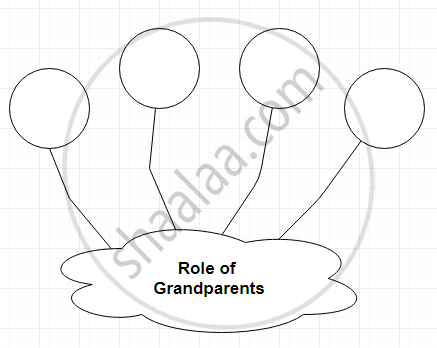 “Oh, the value of the elderly! How could anyone not know?
They hold so many keys, so many things they can show.
We all will read the other side this I firmly believe
And the elderly are closest oh what clues we could retrieve.
For their characters are closest to how we’ll be on high.
They are the ones most developed, you can see it if you try.
They’ve let go of the frivolous and kept things that are dear
The memories of so sweet, of loved ones that were near.
As a nation, we are missing our greatest true resource,
To get to know our elders and let them guide our course.”
B.2) Find Evidence:
Pick out the line from the extract which supports the given ideas:
(i) The elders have many things to share.
(ii) Everybody knows the value of elderly people.
(iii) The elderly people have vast experience.
(iv) The elderly people are a boon to the nation.
B.3) Write a pair from the extract that rhymes with the given word:
| Fear | ........................... | .......................... |
What does the word ‘cardboard’ denote in the poem? Why has this word been used?
What does “this circumstance” refer to?
Notice these expression in the text. Infer their meaning from the context.
careered down
What kind of a person do you think the narrator is?
Look up the dictionary for the meaning of the word ‘diaspora’. What do you understand of the Indian diaspora from this piece?
Comment on the way in which the theme of the story has been introduced.
Locate expressions in the text reflect the Indian idiom, for example, the pride of the generations of his ancestors.
How, according to you, can peace and liberty be maintained in a state?
The power of poetry lies in suggestion and understatement. Discuss this with reference to the poem.
Personification is a figure of speech that attributes human qualities to inanimate things and abstract ideas. How has it been used in the poem?
Give a brief account of the interaction between Grandpa and Jo.
Select any one of the famous personalities mentioned in ‘Warming up 1’ on page no. 5. From the library or internet find out their success story. Write it in your own words in about 20 to 30 lines of your notebook.
Give your write-up a suitable title.
Add the appropriate Prefix to make the following word opposite in meaning.
continue
Go through the text again and find the reasons that forced Peter to shoot down a person.
- The keepers spotted him.
- _________________________
- _________________________
The word 'report' means -
(a) Give a spoken or written account of something.
(b) Cover an event or subject as a journalist or reporter.
Write down any two Slogans on 'Gender Equality'.
Discuss in groups, reasons/ consequences/ effects:
The life of the cherry tree was threatened.
Pick out a word from the poem to complete the sentence meaningfully.
She ______ (bargained) with the hawker to reduce the price.
Behrman was a hard-hearted person.
Correct the following statement.
Sue ignored Johnsy completely.
State whether the following statement is true or false. Correct the false statement.
The Ear was appointed as a judge.
Read different stories about intelligent ministers of kings, whose judgments helped to bring about law and order in society. For example - Birbal, Tenalirama, etc. Write 5 such stories in your notebook.
Proverbs associated with the word season: for eg: Make hay while the sun shines.
- _________________________
- _________________________
Expand the idea inherent in the following proverb:
A Bad workman blames his tools.
Say WHY. . . . . .
Hardy and Ramanujan could not talk freely with each other.
Answer the following question in short.
What punishment did the emperor threaten the Pundits with?
Draw a picture of the scene described in the poem.
The word 'Review' is different from summarizing and appeal writing. Choose the correct statements of the following.
What is described in the poem?
What did one of the fluttering creatures do?
Discuss and write 1-2 lines about the following.
Yonamine’s fight with Bushi (disguised as a bandit).
Discuss and write 1-2 lines about the following,
The lesson that Bushi learned.
The wheel, which was probably invented more than 6000 years ago, is thought of as one of the greatest technological advances made by man. Why do you think the wheel is so important in human civilization?
Write a short note on the following:
Veterinary Science in Ancient India.
Read the following words. Write the words that are combined to make these words.
- faraway
- nobleman
- whoever
- moneylender
- sometimes
Add ten more words to the list on your own. Each of the component words must be meaningful.
Hold a mock trial for the following offence. There should be a complainant, a defendant, and lawyers to argue the case on behalf of them. The whole class can vote to pass the judgment. On what occasions will you plead for justice? What punishment will you suggest? When will you plead for mercy?
A very poor and honest servant has broken a vase while cleaning it. The vase was valuable and the employer liked it very much.
Hold a mock trial for the following offence. There should be a complainant, a defendant, and lawyers to argue the case on behalf of them. The whole class can vote to pass the judgment. On what occasions will you plead for justice? What punishment will you suggest? When will you plead for mercy?
A poor man stole some ornaments from a rich girl.
Visit a library:
Find and read stories and poems written by Edith Nesbit.
Apart from class/school, where else are you likely to find a time table useful?
Form groups of five and discuss:
There are many things that seem small, minor, or insignificant to some people but the same may be the cause of great pain, suffering for others. Can you list such things? What can you do to provide help on those occasions?
Imagine you are Malti. Write about any one event in the story from Malti’s point of view.
Think and answer:
Is the poet talking about heavy rains in the rainy season or rain that has come after a long time?
This story takes an unexpected turn when the lion decides to spare the camel’s life. Choose any fable, a story that you like, and rewrite it giving it an unexpected turn.
Many changes had occurred on the earth in the hundred years before Sayali’s trip to the moon.
The Emperor says he had realised earlier that Abdul has great talent. Does this tally with his actions? Give your opinion.
Note that most of the time well-known works are parodied, because people can enjoy the parody better when they know the original. Try to find more examples of parodies in English or other languages.
We find the following in the script of a skit or play. Rearrange these steps in the proper order and write them down in the form of a flow chart.
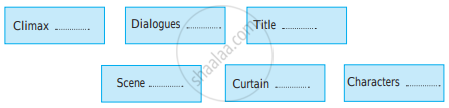
Present these points in the form of a review, and give it a suitable title.
Answer in your own words.
What did the ancestor from 1910 wish to do instead of making his bed?
Answer in your own words.
How many chores did the ancestor from 1800 have to do?
Choose the appropriate phrase to insert in the gap, to make the sentence meaningful. Use the appropriate form of the verb.
Before we ______ let us stand in attention for the National Anthem.
Write your own impressions about the news items given in (a), (b), (c), and (d) in the table below.
| News item | Good news Bad news | Reliable Unreliable | Interesting Uninteresting Boring | Others |
| (a) | ||||
| (b) | ||||
| (c) | ||||
| (d) |
Pick out from the poem, two lines each that reflect an optimistic (positive) attitude and pessimistic (negative) attitude.
Optimism :
- ______
- ______
Pessimism :
- ______
- ______
Form a group of four to six. As a group activity, write a conversation in which a person/a group of person thanks to someone.
Describe the following in one or two lines.
The first little house of the bird.
What did Gopal Bhand want to tell the husband and wife?
Read the poem and answer the following.
Which strawberries are plump and juicy?
Find the meaning of the following word.
delicious
Read the word. Write the words that combine to make it.
springtime
List the characters in the play.
Birds and animals
Enact the play.
Write in short how the travellers crossed the first ditch.
Where was the well situated?
Write a short note on ‘money’.
What is meant by 'Honour the white cane'?
What does 'Rangaawali' mean?
Your parents sometimes behave like the young bird’s parents. They may seem cruel and unrelenting. Does it mean that they do not care for you? Explain your views about it with reference from the story
Identify the speaker/character.
‘ It’s Somu’s thoughtless ways that reduce me to tears’
Read the letter again and write a few lines on each of the following.
- things that the coach taught….
- transformation in the child……..
- things that amazed the writer……..
Identify the character/speaker.
I'll see you later at the Queen's croquet game.
Have you ever had a strange dream? Share your dream in the class.
Look at the number pattern. Fill the blank in the middle of the series or end of the series.
QPO, NML, KJI, ______, EDC
The terrorists asked Neerja to collect the passports of the passengers because ______.
How did Grandfather’s dream come true?
Why did Muthu and his friends step out of the train?
Narrate the story based on the story map
What sight made the farmer thankful?
Work in pair, find answer for the question and share in the class.
When is it autumn in India? Why does the poet say this? Is there an autumn season in India?
A day in Mars is called ______.
Match the planet with its feature.
| 1. | Mars | blue ice giant |
| 2. | Saturn | red storm |
| 3. | Jupiter | red planet |
| 4. | Neptune | ring and moons |
Imagine you are the girl and give a different ending to the story.
Match the following.
| cuckoo | blows |
| breeze | sings |
| river | swims |
| fish | flows |
Why did Santhosh forget to watch television or play video games?
It is used in the fisher’s _____.
Where did Anitha go?
What day is it?
Whose hospitality is described in the poem?
The pigeon flew away for dry twigs.
Why did the audience cheer?
Recite the poem 'Treasure Trove' with the correct intonation.
Match the words with the pictures.
| Robinson |  |
| cannibals |  |
| Friday |  |
| footprint |  |
The old man is _____.
What was the message on the chit?
Robinson sailed England after ______ years.
Divide the following word.
hotel
Fill in the blank
Do you like apple______ orange?
People ran off when the seawater receded.
What were the people excited about?
Why was the teacher annoyed?
Who helped Tenzin in learning English words?
Where were they going?
Divya and Rani decided to draw a ________.
Senthil bought a ______ from his savings.
What happened to Jayan?
Write the word with same meaning.

queue- ______
Draw me some hair, quickly, I look like a ______.
Match with the opposite gender.
| 1. | prince | bridegroom |
| 2. | hero | princess |
| 3. | bride | heroine |
List three questions that the little boy asks.
- ______
- ______
- ______
Choose the right word.
This famous tree is in ______.
Why did the child in the poem like looking at the pictures?
From where did the naughty boy come?
