Advertisements
Advertisements
प्रश्न
Have you are wondered why soldiers are always clad in green? This is to enable them to camouflage themselves during wartime. Hiding in the jungles, their green attire blends into the surrounding trees and shrubs, making it difficult for the enemies to spot them.
Long before man-made use of camouflaging, insects have already adopted the tactic of disguise to escape from the clutches of their predators. By having body colour close to those of the rocks and dried leaves, they can escape from being pursued by the predators.
Butterflies and moths have developed a variety of camouflage strategies since they are quite defenceless and their predators are abundant. Possessing wings which resemble dried leaves help certain butterflies and moths to hide among heaps of dried leaves when predators are around.
Fortunately, not all insects choose the art of disguise to escape from their predators; otherwise, the world would be so dull and colourless. There are insects which assimilate the bright body colours of bees and wasps to escape from being pursued by their predator. Long ago, birds have already learnt to avoid brilliantly coloured wasps and bees in fear of their painful stings. Hence, over millions of years, many harmless insects have assimilated the bees and wasps by imitating. their bright body colours and shapes. In this way, they appear dangerous and hence ward them off.
The beefy, not only appears like the bumblebee in terms of body colour, even its hums sound similar too. The only difference is that the beefy does not have a stirring and is hence harmless. The hoverfly is another insect which imitates. the body colours of the wasps. Their bodies are striped yellow and black. The only deviations are that hoverflies do not have stings, and they have only one pair of wings each while wasps have two pairs each. These variations are hardly noticed by the predators and hence help them to escape.
A1. Complete the table with the information from the passage : (2)
| Insects | Similarity | Difference |
| Bumblebee - Beefy | ||
| Wasp - Hoverfly |
A2. Complete the tree diagram : (2)

A3. Find out : (2)
‘Nature has given a self-protection mechanism to insects’.
Find out at least two examples from the passage to prove this statement.
A4. Vocabulary - (2)
Find the words from the passage for :
(i) animal or bird that hunts other for food
(ii) to get free from danger
(iii) to prevent something from harming
(iv) to make a copy
A5. Personal response - (2)
‘Soldiers disguise themselves to prevent enemies to spot them’.
Give two more examples when the disguising technique is used by humans.
A6. Grammar - (2)
Rewrite the following sentences in the ways instructed :
(i) They have only one pair of wings.
(Make it negative without changing the meaning)
(ii) Insects have already adopted the tactic of disguise to escape from the clutches of their predators.
(Replace infinitive with gerund and rewrite)
(B) Summary : (3)
Summarise the above extract with the help of the points given and suggest a suitable title.
Camouflage of soldiers and insects - reason and ways for disguising - assimilation of insects - need of imitation.
Advertisements
उत्तर
A1.
| Insects | Similarly | Difference |
| Bumblebee-Beefy | Body colour and hums sound | Beefy does not have a sting & hence it harmless. |
| Wasp – Hoverfly | Body colour (yellow & black stripes) | Hoverflies do not have stings and they have the only a pair of wings each while wasps have two pairs each. |
A2.
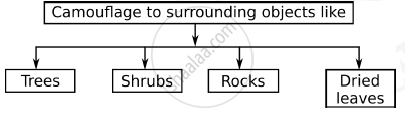
A3.
The examples from the passage to prove the statement- 'Nature has given self-protection mechanism to insects’ are :
(i) By having body colour close to those of the rocks and dried leaves, they can escape from being pursued by the predators.
(ii) Possessing wings which resemble dried leaves help certain butterflies and moths to hide among heaps of dried leaves when predators are around.
A4.
(i) predators
(ii) escape
(iii) tactics
(iv) imitates
A5.
The examples of the disguising technique used by humans are:
(i) Native American Hunters wore wolf skins to stalk buffalo.
(i) The cloaks of invisibility used for magic shows or duplicate the person.
A6.
(i) They do not have more than one pair of wings.
(ii) Insects have already adopted the tactic of disguise for escaping from the clutches of their predators.
(B)
The Deceptive marking
Camouflage is used by soldiers in order to protect them from the enemies and also to be safe from the
insects who are camouflaging in the jungle in between the rocks, trees, shrubs and dried leaves. Soldiers use this technique so that they can hide in the jungle area and their enemies could not spot them easily and attack. Nature has given insects the art of disguise naturally like having body colour or possessing wings which resemble dried leaves or rocks. So that they can escape from being pursued by the predators. The assimilation of insects is done as their bright body colour and shapes so that they appear dangerous and hence ward them off. There are several similarities and differences between beefy, bumblebee, hoverfly, wasp and other insects. The need for imitation in insects is required because their variations are hardly noticed by the predators and it helps them to escape
APPEARS IN
संबंधित प्रश्न
Which literary device is used in the last two lines:
Tinkling, luminous, tender, and clear, Like her bridal laughter and bridal tear.
What is the rhyme of ‘The Patriot: An Old Story’?
It was roses, roses, all the way,
With myrtle mixed in my path like mad;
The house-roofs seemed to heave and sway,
The church-spires flamed, such flags they had,
A year ago on this very day.
Read the above lines and answer the question that follow.
When was the patriot welcomed?
Write a short note on Abou bin Adhem.
Describe the angel. How did he look at Abou?
What does Hemingway want to convey about the affects of war through the story?
Show liow Narayan depicts women in the story and their role in a man’s life.
Your uncle has offered to get you a pet for your birthday. Write a letter to him telling him what you would like, give reasons for your choice and tell him how you Would-take care of your pet.
Fill in the blank with an appropriate word:
The poet's mother was stung __________ a scorpion.
Join the following sentence to make one complete sentence without using and, but or so.
She was so excited about her performance. She could not sleep at night.
We were asked to gather_________ the teacher.
Discuss the following in groups of two pairs, each pair in a group taking opposite points of view.
Advanced technology gives us conclusive evidence of past events.
Name some leaves and flowers that are used as adornments in our country.
Notice this expression in the text. Infer its meaning from the context.
a holistic and ecological view
Give reasons for the following.
Srinath and his family members’ eager expectation of Satyajit’s arrival.
There are quite a few places where the author uses the expressions 'my heart sank', 'panic seized' etc. What was the reason for this?
Your teacher will speak the word given below. Write against two new words that rhyme with it.
fast ______ ______
If you see someone lonely or sad you will –
- _______________________
- _______________________
- _______________________
Write down the significance of the following in the context of 'On to the Summit': Ice axe.
Frame a pointwise Analysis of the poem ‘The worm’. Use the following points.
- Poem and poet:
- Theme:
- Tone:
- Structure and stanzas:
- Rhyme and Rhythm:
- Language and Imagery:
- Figures of Speech:
The cherry tree is a narrative poem. Features that make it a narrative poem are given below. Justify them with proper examples.
Different places are mentioned.
You have just returned after your first experience of the kite - festival in Gujarat / Ahmedabad. You were thrilled with the festivities.
You have a friend who lives abroad. Write a letter to your friend describing how you enjoyed the kite-festival.
Your examinations are only two months ahead. Plan your schedule of studies and write in your notebook.
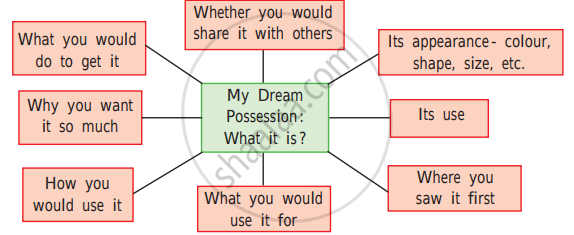
Is there something that you would like to own more than anything else? Describe your dream possession with the help of the following points. You may add your own points, too.
Prepare a News Report in brief on this Art Festival.
Discuss the following elements of a detective or mystery story.
- a mystery
- strange happenings
- a smart detective who investigates the happenings
- a crime/possibility of a crime
- preventing the crime and catching the criminal.
- characteristics of the victim
- characteristics of the criminal
- characteristics of the detective
Use the elements to prepare outlines of detective stories using your imagination. Write a story using any one of the outlines.
Answer the following question :
What are the advantages of an imaginary argument with a person having a different bias?
When you open a savings account at the bank you need to fill up Deposit forms/slips. Observe the following forms and fill up your details.

Write the reason in your own words.
Akbar had to dress like a slave.
Write a short essay on the following.
What I would like to do for my country.
Imagine that you are the Captain of your team. A famous cricketer is going to visit your school. You are assigned the task to conduct an interview of that famous cricketer. Frame a set of 10 questions that you will ask the cricketer. Take help of the points given below.
- Early life
- Interest in this field
- Inspiration
- Coaching and guidance
- Achievement/Records
- Future plans
- Advice to youngsters
Dinesh and Divya have been assigned homework on non-finite. They are not sure when to use a gerund and when to use an infinitive. They decide to meet their teacher and get their doubts cleared. The teacher introduces them to Mr. Gerund and Ms. Infinitive.
Write a four-line poem with rhyming words describing your family.
“I met you yesterday.” Sam told me that he had met me ______
Find example of alliteration and write them in the blank.
in a blaze of heat
with sunny smiles.
Fill in the blank with choosing the preposition from the option.
He noticed the creeper ______ the foot of the tree.
Connect the pairs of sentences below using and or but.
- It is time to get up for school.
- I want to sleep for some more time.
Fill in the blanks according to the example given below
| tiny | tinier | tiniest |
| big | ______ | biggest |
| sleepy | sleepier | ______ |
| ______ | lovelier | loveliest |
| ______ | later | ______ |
| round | ______ | ______ |
| small | ______ | ______ |
| good | ______ | best |
Now make one more question for each picture. Write the question in the space below each picture. Use how many, what are, where are/is, how, why, to make questions.
 |
 |
 |
 |
 |
 |
This is a picture of Rahul Gupta. Using the clues given, write a paragraph about him in your notebook.

|
Clues Indian, cricket, eight hours, practises, eats healthy food, runs two kilometres every day, batsman |
Alice follows the strange rabbit because she wants to know a number of things. Re-arrange the words to make the questions that Alice has in her mind, and put a question mark (?).
talk rabbit a how can
This is a park where children talk to different animals and birds. Write four sentences about the picture. Use capital letters where required, complete sentences and punctuation.

Now colour the picture.
In the sentence below the capital letter, comma, full stop and question mark are missing. Put these in the correct place.
every sunday i go for a walk have breakfast read story books listen to music and watch television
In the sentence below the capital letter, comma, full stop and question mark are missing. Put these in the correct place.
laxmi why are you crying
Make word families. The first word in each has been written for you.


How is that day celebrated?
How did Mary Kom manage to get financial support for her trip to the USA?
Now, refer to a dictionary and match the professions with their relevant job descriptions.
| A | B |
| 1. pathologist | studies languages and their structure |
| 2. ornithologist | studies atmosphere, weather and climate |
| 3. entomologist | studies the matter that constitutes the earth |
| 4. archaeologist | studies earthquakes |
| 5. sociologist | studies reptiles and amphibians |
| 6. geologist | studies functioning of human society |
| 7. linguist | studies artefacts and physical remains |
| 8. seismologist | studies birds |
| 9. herpetologist | studies insects |
| 10. meteorologist | studies diseases |
Why did they sympathize with the first patient?
Write conversation on the following situation.
Between two friends on an exciting cricket match
Why did Leacock assume that the photographer was praying?
The narrator went to the photographer to ______.
The photographer told him to ______.
Observe the following picture and write a paragraph in about 150 word about each one of them.

Write a composition in approximately 350 – 400 words on the following subject:
(You are reminded that you will be rewarded for orderly and coherent presentation of material, use of appropriate style and general accuracy of spelling, punctuation, and grammar.)
Write an original short story entitled: ‘The Missed Call’.
“What man calls civilization always results in deserts. Man is never on the square he uses up the fat and greenery of the earth. Each generation wastes a little more of the future with greed and lust for riches”- Don Marquis
With our modern awareness of ecology are we likely to make sufficient progress in conservation, or are we still in danger of damaging the earth beyond repair? Write a discursive essay discussing the issue being raised.
Write letter to your father asking permission to go on a educational tour.
Prepare a tourist leaflet for a historical place or a hill station using the following points.
- Place
- Special features
- Distance
- How to go there
- Accommodation
- Food
- Climate
What do you think prompts the poet’s desire for a temporary escape in the poem, Birches? Why does he wish to come back to Earth? Write your answer in a short paragraph of about 100-150 words.
