Advertisements
Advertisements
प्रश्न
Give reasons for the following.
Srinath and his family members’ eager expectation of Satyajit’s arrival.
Advertisements
उत्तर
There was a very valid reason for Srinath and his family members to have high expectations and eager eyes towards Satyajit's arrival. Satyajit was very liberal in his days of prosperity. His wealth made him reach high levels of status. Although they did not share any blood relation but Satyajit boasted and felt pride in helping Srinath in the marriage of his other daughters. He enjoyed success and attention while they needed money. It was a relation of pure give and take.
APPEARS IN
संबंधित प्रश्न
What brought the six humans together? Where were they?
Is there any significance of the logs of wood in the hands of the six people?
Pick out words and phrases which are examples of visual and auditory imagery in the poem.
Do you agree with his justification of the war? Why/ why not?
What does Wordsworth compare the daffodils to? Is the comparison appropriate?
Who are ‘they’ referred to in the third line of the last stanza? When had the poet come across them?
In what mood is the speaker now? Where is he?
It was roses, roses, all the way,
With myrtle mixed in my path like mad;
The house-roofs seemed to heave and sway,
The church-spires flamed, such flags they had,
A year ago on this very day.
Read the above lines and answer the question that follow.
When was the patriot welcomed?
What event is referred to in the poem?
Don John:
Fie, fie, they are not to be nam'd my lord, not to speak of, There is not chastity enough in language Without offence to utter them. Thus, pretty lady, I am sorry for thy much misgovernment.
Claudio:
O, Hero! What a Hero hadst thou been If half thy outward graces had been plac'd About thy thoughts and counsels of thy heart! But fare thee well, most foul, most fair; farewell Thou pure impiety and impious purity For thee I'll lock up all the gates of love, And on my eyelids shall conjecture hang To turn all beauty into thoughts of harm, And never shall it more be gracious.
(i) Where are the speakers? What leads Claudio to speak in this manner?
(ii) What are the charges levelled against Hero by Don Pedro?
(iii) Explain the lines:
"What an I lero hadst thou been If half thy outward graces had been plac'd About thy thoughts and counsels of thy heart!"
(iv) What are the immediate reactions of Leonato and Hero to Claudio's words?
(v) What impressions do we form about Leonato in this scene?
(vi) Give the meanings of the following words as they are used in the context of the passage: misgovernment; impiety; conjecture
The programme ran________six hours.
The character of King Richard I is presented in Ivanhoe not only with all his admirable qualities but also with his shortcomings. Elaborate with close reference to the text.
How did the narrator and Lord Otori overpower the intruder?
If Mary catches the first bus, she will be on time for school.
(Begin : Unless …………….)
Describe an early morning walk through your city or town in winter. Give details of the smells, sights, sounds, and feelings you experienced.
Give reasons for the following.
Tut’s body was buried along with gilded treasures.
What laburnum is called in your language?
The words ‘grip’, ‘dawn’. ‘usher’, ‘coin’, ‘passport’ have a literal as well as a figurative meaning. Write pairs of sentences using each word in the literal as well as figurative sense.
Based on the text enact your own version of the play. Work in pairs.
Find out the information about the qualification and eligibility required in the profession related to wild life such as:
Forest officer / Ranger
A handicraft exhibition is being organized in your college. You are given the task to compere the inaugural function. Write the script for comparing.
Your teacher will speak the word given below. Write against two new words that rhyme with it.
wax ______ ______
Multiple Choice Question:
What does the phrase in the extract ‘turned black’ mean here?
Use the phrase in a sentence of your own, after finding out its meaning.
streaked over
Write a paragraph about beauty. Use your own ideas along with the ideas in the poem. (You may discuss your ideas with your partner.)
Complete the following web diagram.

Complete the following web diagram.

What vocation / profession / business would you like to take up in the future? Prepare a fact file for the same using the following points.
- Name of the vocation / profession / business ____________
- Educational qualifications required ____________
- Work profile / description ____________
- Opportunities for advancement ____________
- Your personal skills / talents for the choice ____________
Explain the extended metaphor related to dentistry in the poem.
Interpret the following lines in simple English.
Puck: I’ll follow you.
Bottom: The Finch, the sparrow.
Discuss the following and write about the following in your own words in 5-6 lines.
What would you do, if something like this happens to you?
Imagine someone has invited your family to a programme and you were the only person at home when the invitation was given orally.
Write a note (4-5 lines) to pass on the message to the other people in your family. Or, Write an imaginary conversation in which you pass on the message to your parents.
Study the following format of an informal letter carefully. Using the format,

Write a personal letter of thanks to an elder person.
Hold a story-telling competition in which each one narrates a folk-tale or fairy-tale.
Create a Personal Particular for your class with support from your teacher and collect personal and educational information.
‘What Men Can Do, Women can do better’
Divide your class in 2 groups. Let one group offer points ‘For the topic’ and the other, ‘Against the topic.’ Note down the points in your notebooks, expand the points in two separate paragraphs of about 15 to 20 lines each. Suggest suitable titles for each.
Write a Diary entry each day for a month and compile them into a book. You may also name your diary as Anne Frank did.
Write an email to your teacher about the interesting English model that you have prepared for the literary fest.
Write a letter of enquiry for the following.
Write a letter to the head of the BSNL office enquiring regarding the internet broadband scheme launched recently.
“I met you yesterday.” Sam told me that he had met me ______
Tortoises and Turtles are not the same. Read the facts given below. List the similarities and differences between them.
| Tortoise | Turtle |
| reptile family | reptile family |
| land animal | sea animal |
| has a long life | lives for many years |
| uses tiny feet to walk | use flippers to swim |
| eats grass, weeds and flowers | eats insects and bugs |
| Similarities | Differences |
Make a diary entry on the impact of a sports personality who is an inspiration to you.
Note
- Date your entry.
- Write naturally and truthfully.
- Use first person. (I read about Mithali, I like her playing style, etc.,)
- Make your entry informal and expressive.
- Use words that express feelings and write what you feel about it.
Let's write a poem.
I have a kite but need a friend to fly it with,
I know a song but need someone to hear it,
I have a ball but need someone to catch it,
I ______
I ______
I ______
I ______
______ is your birthday?
Have a conversation with your partner based on the picture below. You can start as -
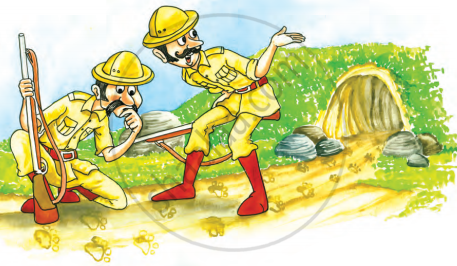
| Hunter 1 | “Look at the footprints in the mud!” |
| Hunter 2 | |
| Hunter 1 | |
| Hunter 2 |
Rewrite the passage below using capital letters where necessary
one saturday afternoon amarjit and his little sister rani went for a picnic to india gate. there they saw ducks, water and their friend raj
Find one word from the story that means
to think w ______.
State whether the following statement are true or false
The cop suddenly slowed his walk, when he heard the barking of dogs.
Why did Philip Sletherby visit Brill Manor?
Explain the following phrase selected from the story in your own word and work with a partner to make sentence using these phrase:
a double-distilled idiot
What was the human side to the photographer?
What was the only similarity between Leacock’s face and his photograph?
On seeing the photograph the narrator ______.
What was the blue bead?
What might success mean to the following people? Think about it and write.
A person who has applied for a job
What provisions should be made in public places so that everyone gets the same access to public facilities?
Do you like cartoons and cartoon films? Which one do you like best?
Using the given informal letter as a model, write a letter about the topic given below.
Write a letter to your father asking permission to go on an educational tour.
As a Member of the Student Council of ABC School, you wish to start a Laughter Club to develop the appreciation for humour among students. Write a proposal in not more than 150 words, outlining the steps you would take to make this club a success.
Using the given informal letter as a model, write a letter about the topic given below.
Write letter to your father asking permission to go on a educational tour.
