Advertisements
Advertisements
प्रश्न
Why did they sympathize with the first patient?
Advertisements
उत्तर
The first patient was seated inside the surgical room of the dentist for a long time. His devoted wife was anxiously waiting out for a long time. Whenever a noisy groan escaped the dentist’s surgical room, she cried. She wanted to rush to the room but was often restrained by the second person. Every adult who watched the lady in distress sympathized with her.
APPEARS IN
संबंधित प्रश्न
Here is a topic for you to
1. think about;
2. give your opinion on.
Find out what other people think about it. Ask your friends/seniors/parents to give you their opinion.
‘Career Building Is the Only Goal of Education.’
Or
‘Getting a Good Job Is More Important than Being a Good Human Being.’
You can use the following phrases
(i) while giving your opinion:
• I think that...
• In my opinion...
• It seems to me that…
• I am of the view that...
• As far as I know...
• If you ask me...
(ii) saying what other people think:
• According to some...
• Quite a few think...
• Some others favour...
• Thirty per cent of the people disagree...
• Fifty per cent of them strongly feel...
(iii) asking for others’ opinions:
• What do you think about...
• What do you think of...
• What is your opinion about...
• Do you agree...
• Does this make you believe...
What is universal about the theme – that is, what can we all learn from the poem?
Why is the word ‘ cried’ used by the poet in the line, ‘It was the English, Kaspar cried’?
How does the poet use the contrast between the two birds to reveal racism in America?
Alack, it was I who leaped at the sun
To give it my loving friends to keep!
Naught man could do,have I left undone:
And you see my harvest, what I reap
This very day, now a year is run.
Read the above lines and answer the question that follow.
What does the word ‘harvest ‘ connote here?
The programme ran________six hours.
Your class wants to visit a well-known historical monument in a nearby town. Write a letter to your Principal seeking permission and say why you would benefit from the visit.
Fill in the blank with an appropriate word:
His teacher is very pleased ……… him.
My daughter believes_____________ fairies.
‘Catamaran’ is a kind of a boat. Do you know which Indian language this word is derived from? Check the dictionary.
Here are some commonly used medical terms. Find out their meanings.
| CT scan | MRI | tomography |
| Autopsy | dialysis | ECG |
| Post mortem | angiography | biopsy |
Examine the subtle humour in the narration of the story that lightens the gravity of the subject matter.
We add ‘un-’ to make opposites. For example, true — untrue. Add ‘un’– to the word below to make its opposite. Then look up the meaning of the word you have formed in the dictionary.
interesting: ____________
Find five words in the following paragraph, which are generally associated with trees. But here, they have been used differently. Underline the words.
Hari leaves for work at nine every morning. He works in the local branch of the firm of which his uncle is the owner. Hari’s success is really the fruit of his own labour. He is happy, but he has a small problem. The root cause of his problem is a stray dog near his office. The dog welcomes Hari with a loud bark every day.
Read the words/phrases in the box. With your partner find their meaning in the dictionary.
|
Harsh conditions harmless survive intruder threatened predators prey continually |
Fill in the blanks in the following passage with the above words/phrases.
All animals in forests and deserts struggle to ______________________in ______________
___________________ . Though most of the animals are ___________________, some are
dangerous when _____________________. If an ___________________ is noticed, they attack
or bite to save themselves. They struggle __________________ for food and water.
Some animals are called ______________because they __________________ on other animals.
Discuss with your partner and complete the web of different activities related to climbing.

Go through the text once again and note down Devu Handa’s fond memories of Kasbai in your exercise book. One is done for you.
Devu Handa has fond memories of Kasbai. They are as follows!
(a) It needs ______________ rain.
(b) _________________
(c) _________________
The poet has described two different shades of human feelings by using imagery of various forces of Nature in the poem. Pick out the terms or phrases that describe them. Complete the table given below. One is done for you.
| Nature | Feelings |
| Faded forests | Sad/gloomy |
Guess the meaning of the above proverbs and write them down along with a sentence of your own.
Write a paragraph of 100 – 120 words about a memorable anecdote/incident of your life.
You are waiting to board a train in a railway station. The train is delayed by an hour. Write a paragraph about the crowded scene in the railway station based on your observation.
| vendors | tea vendors | shops | families | piles of luggage |
| porters | trolley | scroll board | announcement | ticket counter queue |

Work in groups and write a paragraph on “Laughter is the best medicine.”
______ do you get up?
Answer the question by looking at the picture.
Example: What is happening in picture 5?

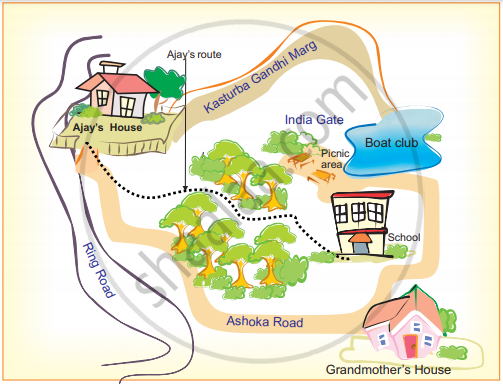
Use the above map to answer the questions.
- What does the dotted line on the map show?
- What road would Ajay take to get to the boat club?
- What building is next to the picnic area?
- What road passes by Ajay’s house?
- What other way could Ajay use to get from his house to his grandmother’s house?
Now write:
Use verbs like go, turn, cross
Use prepositions like: across, between, in front of, beside, near, behind, and write how you get home from school.
Choose a story that you like.
In groups of four, write down dialogues for the story and make it into a short play. You may then present it in the class.
Why didn’t the grandmother feel sentimental when the author went abroad for higher education?
State whether the following statement are true or false
Both Jimmy and Bob were of the same age.
What are all the factors that influence our moods?
Work in groups and prepare an attractive wrapper or packet for any product of your choice. Prepare an advertisement for your product.
