Advertisements
Advertisements
प्रश्न
Read the following extract and then do all the activities that follow :
I rain into a stranger as he passed by
“Oh, excuse me please” was my reply.
He said, “please excuse me too; wasn't even watching for you.”
We were very polite, this stranger and I.
We went on out way and we said good-bye.
But at home a different story is told.
How we treat out loved ones, young and old.
Later that day, cooking the evening meal,
My daughter stood beside me very still.
When I turned, I nearly knoked her down.
“Move out of the way,” I said with a frown.
She walked away, her little heart broken.
I didn't realize how harshly I'd spoken.
While I lay awake in bed,
God's still small voice came to me and said,
“While Dealing with a stranger, common courtesy you use,
But children you love, you seem to abuse.”
A1. Order-
The incidents narrated in the extract are arranged in a jumbled manner here, Rearrange them in a proper order as they occur in the extract:
(i) The poet and the stranger went on their way saying good-bye.
(ii) Seeking excuse politely from the stranger, she went her way.
(iii) The poet ran into a stranger on the road.
(iv) The poet yelled at her daughter.
A2. Poetic device:
Make a list of rhyming pairs from the second stanza and note down the rhyme scheme of the same stanza.
A3. Personal Response:
Understanding and politeness are the essentials of out everyday life. Explain your views in brief.
A4. Creativity -
Frame two poetic lines on the following situation using a rhyming pattern with the help of clues given:
“While introducing great personalities, we praise them highly and talk about their qualities, but while speaking
about our friends we may not follow the same trend.”
While introducing great personalities, — a
------------------------------------ — a
But while speaking about our friends, — b
------------------------------------ — b
Advertisements
उत्तर
A1.
(iii) The poet ran into a stranger on the road.
(ii) Seeking excuse politely from the stranger, she went her way.
(i) The poet and the stranger went on their way saying good bye.
(iv) The poet yelled at her daughter.
A2.
The list of rhyming pairs from the second stanza are:
told – old, meal – still, down – frown, broken – spoken.
The rhyme scheme of the same stanza is aabb.
A3.
Human personality consists of multiple layers & stanges of formation which includes manners, behaviour, character, personality & individuality. Understanding and politeness reflects a person's behaviour and manners both. In our daily life, we have lot of ups and down because not all days are the same. So, being understanding & adapt according to the situation is essential for an individual or else he/she will not be able to survive during that time. Showing understanding in several life issues shows the maturity level of a person & can avoid several consequences arising out of it. Politeness is one's behaviour or you can say a basic manners. Whether a person is known to us or he/she is a stranger it is our duty to be polite and be kind towards every living being as this is one of the parameters where an individual's character is also judged. Also, when you are polite to everyone people around will like you & appreciate your presence in daily life. Hence, both understanding & politeness are the essentials of our everyday lif.
A4.
while introducing great personalities,
we do not check their humanities
But while speaking about our friends,
we forget half of them pretend.
APPEARS IN
संबंधित प्रश्न
How did Helen display her passion for Radcliffe College?
Answer any four of the following in 30−40 words each:
(a) What did garbage mean to the children of Seemapuri and to their parents?
(b) How did Rajkumar Shukla establish that he was resolute?
(c) 'Life is what it is all about;...' How is keeping quiet related to life?
(d) Mention any four things of beauty that add joy to our life.
(e) The manner of his (the Tiger King's) death is a matter of extraordinary interest. Comment.
(f) In what condition did Dr. Sadao find the American soldier at the seashore?
To what end have humans used their superior intelligence ?
Answer the following in 200-250 words :
Describe the relationship between Anne and Margot?
Talk to your partner about the following.
The author’s grandmother was a religious person. What are the different ways in which we come to know this?
Look for a story, a poem and a newspaper article on environment conservation and see how the style of each is different from the other.
Notice this expression in the text. Infer its meaning from the context.
blow-by-blow account
Tick the statement that is true.
The story tries to relate history to Science.
In which language do you think Gangadharpant and Khan Sahib talked to each other? Which language did Gangadharpant use to talk to the English receptionist?
Comment on the way in which the theme of the story has been introduced.
What do you infer from Darwin's comment on his indifference to literature as he advanced in years?
The peacock is a colourful bird. How does the poem capture the various colours that its plumage displays?
What are the criteria that Ruskin feels that readers should fulfil to make themselves fit for the company of the Dead?
What would you say are 'the finer growths' that the story supports in a novel?
Name the world-famous personality who reached great heights despite of humble circumstances.

What strong qualities possessed by them, could have helped them achieve success and fame, all over?
Arrange the following set of words in the alphabetical order in your notebook.
ship, small, successful, scoldings, stone, saving, someone, stood, streets, still, screamed, sat, seemed, saint, share.
Find from the story one word for the following.
the highest-ranking officer in the Municipality of a city/town ______
Write down any two Slogans on 'Gender Equality'.
Find proof from the poem for the following.
The poet’s minute observations of the steady growth of the cherry tree.
Read the poem below and fill in the gaps, choosing appropriate pairs of rhyming words, to make them meaningful.
|
Little things Little drops of water, Thus the little minutes, Little deeds of kindness, |
(love - above / sand - land / be - eternity)
|
Little things Little drops of water, Thus the little minutes, Little deeds of kindness, |
What important message does the above poem convey?
The poem is a Petrarchan Sonnet. The poem is divided into two parts -
- An Octave
The first part comprising eight lines. - A sestet
The second part comprising six lines.
Read the first four lines of the poem. The rhyme scheme is a b b a. Read the rhyme scheme for the next four lines. It is a b b a. Now read the first three lines of the sestet and note the rhyme scheme. It is c d c. The rhyme scheme of the last three lines is d c d. This is the common design of a Petrarchan Sonnet.
This is a Petrarchan Sonnet. Complete the given table by giving examples from the poem.
| Features | Examples / Lines |
| Objects used | |
| Praise/blames | |
| Metaphor | |
| Simile | |
| Personification | |
| Number of lines | |
| Rhyme scheme |
Discuss in groups and share with one another.
Do you spend time admiring and thinking over the beauties of nature? Elaborate on your response.
Read different stories about intelligent ministers of kings, whose judgments helped to bring about law and order in society. For example - Birbal, Tenalirama, etc. Write 5 such stories in your notebook.
Read the lesson and name the following.
The Father of modern neurosurgery ______
Read the lesson and name the following.
The world’s most advanced surgical robot ______
Expand the idea inherent in the following proverb :
If winter comes, can spring be far behind? - Shelley
Say WHY. . . . . .
Mother agreed to send Ramanujan to England.
Birbal thought Akbar was greater than God.
Make a list of the channels available on your TV under the following categories: News, entertainment, sports, movies, music, etc. Which are the channels on which you can watch programs on animals, wildlife, conservation of the environment, etc.?
Suggest what you would do in the following situation:
You are going through a crisis that is making you short-tempered and impatient, due to which you end up causing harm to your family and friends. They have started complaining about it quite often.
Complete the following sentence using your own ideas.
The princess was as ______ as ______. (Positive)
What did one of the fluttering creatures do?
Find sentences from the play related to the given points.
Loyalty in Irish Nationalism:
- Maybe Sergeant you’ll be on the side of the country yet.
- ____________________________
- ____________________________
- ____________________________
Discuss the following question after you have seen a presentation of the ‘ad’.
How many times is the name Krispy Krunchy repeated in the ad? Why?
Explain the following statement with reference to the context.
Because your father can't do without my help.
Explain the following statement with reference to the context.
And it's by no means the small sacrifice the town will have to make.
Discuss the following question after you have seen a presentation of the ‘ad’.
Why does Didi say ‘No party for me!’?
Discuss and write 1-2 lines about the following,
Yonamine’s ideas about marriage.
Answer the following question in one sentence.
What would he do if he had the power to do it?
‘Smart Answers’: Form a large group. Each person asks the next one a question to get him to say ‘yes’ or ‘no’. He/She can use appropriate statements, requests, or even other questions as a response. But if he/she says ‘yes’ or ‘no’, he/she is out. Otherwise, he/she continues the game. Questions cannot be repeated.
What time is being described in the poem?
Read the passage and answer the following:
Where does the story take place?
Read the passage and name the following.
He composed the Illiad and Odyssey.
Find three lines, that contain images of nature in the autumn season.
During daytime
- _______________________
- _______________________
- _______________________
Complete the following diagram.
List the names of body parts used in the passage.
Read the following from the Language Study pages:
- adjective clause
- adverb clause
- noun clause
Find one example of each from the passages. (Note the linking word when you do that.)
Often the brook speaks of itself as if it is human.
For example, 'I bicker down a valley.'
Find two other examples of the human activities of the brook.
Read: ‘Just So Stories’ and ‘The Jungle Book’ by Rudyard Kipling.
Write in your own words.
How does the poet glorify his home in the first stanza?
Write in your own words.
How does the poet describe his home in the second stanza?
Present Mr. Wilson’s story as it would be shown in a comic strip. Write what picture you will show in each frame along with the dialogues. Write the dialogue with the help of the story. Examples:
 |
 |
 |
Fill in the blank choosing the appropriate word/idiom from the lesson.
As soon as I ______ of my home, I greet my family.
Find out when and where we get strawberries in Maharashtra.
Find out how the following game is played.
Football
What did the important-looking man tell Gulliver?
Read the following line from the poem and answer the question that follow.
In the dim past, nor holding back in fear From what the future veils; but with a whole And happy heart, that pays its toll To Youth and Age, and travels on with cheer.
- What does the poet mean by the phrase ‘in the dim past’?
- Is the poet afraid of future?
- How can one travel on with cheer?
Read the following line from the poem and answer the question that follow.
My heart will keep the courage of the quest And hope the road's last turn will be the best.
|
My heart will keep the courage of the quest, And hope the road's last turn will be the best. |
- What kind of quest does the poet seek here?
- What is the poet’s hope?
Why did Prospero set Ferdinand a severe task to perform?
Why did Chulong catch the bird?
What will happen to the bird in imprisonment?
Who is wise according to you?
Departure was delayed because of the author.
The weather is always too hot or cold; Summer and winter alike they scold. Nothing goes right with the folks you meet Down on that gloomy Complaining Street.
Pick out the rhyming words and identify the rhyme scheme of the above lines.
Read the story again and write how these character reacted in these situation:
It’s Somu’s thoughtless ways that reduce me to tears. Mrs. Krishnan …………………....…..
Dr. Krishnan ……………..…......…….
Read the story again and write how these character reacted in these situation:
Zigzag hardly never sleeps.
Somu………………………
Dr.Krishnan……………………….
How were offerings carried during the ancient period?
Who baked the homemade cookies?
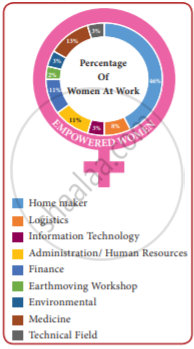
Read the data below and answer the following question.
Choose the correct answer.
What is the difference between the percentage of women working in logistics and Medicine?
What should we learn from our teachers?
Pick out the words which rhyme with the given words and write similar rhyming words on your own.
| 1. | far | ||
| 2. | fear | ||
| 3. | low | ||
| 4. | kind | ||
| 5. | remain | ||
| 6. | they |
Neerja leapt into action when she______.
Identify the speaker/character.
Don't worry, Madam, it's only a warning.
Ridleys come to lay their eggs in the month of January.
Narrate the story based on the story map
Identify the speaker/character.
He felt something moving along his body almost up to his chin.
Complete the sentence given below with word/phrase.
The whole earth smelled ______ and ______.
Name the planets the poet flies through.
The boy and the girl were taken by the cavalry to explain their action.
How did the cavalry officers look? What happened to them finally?
How did Santhosh record his diary?
It is used in the fisher’s _____.
We don’t use _________ in the soil.
How do we work?
The farmer had _______ daughters.
How do we keep our integrity?
Jaswantgarh is named after the Indian soldier ______.
Vicky decided to______ the robot at the end.
Arrange the pictures by using numbers.

Write the rhyming word.
culture - ______.
Why did the bird catcher need fire?
Recite the poem ‘Mother Nature’.
Akilan learnt Judo for ______.
Match the rhyming words.
| mars | crime |
| bed | cars |
| time | head |
What did the oil seller perform?
Circle the animals which are in the voyage.

Write the rhyming word.
gale
The brown sparrow laid ________eggs.
How did they go to school?
Read the advertisement and answer the question given below.

What is free, for LED TV?
Moles bite and ______ the earth worms.
Where do the moles save their food?
If we didn’t have boundaries, we don’t need _______.
_____ fights with everyone in school.
Jana and her family moved to the village _______ ago.
The villagers took oath not to harm the _______.
What did Ani's parents teach her?
What will help you say the truth?
Write the word with same meaning.

post- ______
Read the passage 3 times and colour the trees for each time.
Trees help us in many ways. The colour green is calming and heals your worries. By planting and caring for trees, we help improve our surroundings, as they give fresh air. When air is dirty the people of Delhi suffered a lot. But people of Madhubani district in Bihar have shown how art can be used to make our air clean. So that people made paintings on trees to stop people from cutting the trees.

What was Farhan's father's advice to his son?
What happen to a child who shuts his ears?
Draw me some hair, quickly, I look like a ______.
What is the one thing you will try and improve after reading the story? How?
Are these sentence TRUE or FALSE
The poet tells the child to think of friends after it is dark.
Now, read the following biographical extract on Sujatha Rangarajan, a Sciencefiction writer, and answer the questions that follow.
- Sujatha is the allonym of the Tamil author S. Rangarajan and it is this name that is recognised at once by the Tamil SciFi reading community. You might have seen the Tamil movie ‘Endiran’ where the robot Chitti exhibits extraordinary talents in an incredible manner. The robot could excel a human being in any act, beyond one’s imagination. Jeeno, a robotic dog which appeared in Sujatha’s science fiction novel “En Iniya Iyandhira” (My Dear Robot) formed the basis of Chitti’s character. Like Chitti, Jeeno was an allrounder who could cook, clean and fight. High-tech computer technology terms are used in the story. Jeeno, a pet robot, plays an important role throughout the story. As the story proceeds, it behaves and starts to think on its own like a human and instructs Nila, a human being, on how to proceed further in her crises.
- In the preface of ‘En Iniya Iyandhira’, the writer states the reason for his attraction to the genre: “Science gives us the wonderful freedom to analyse thousands and thousands of alternative possibilities. While using it, and while playing with its new games, a writer needs to be cautious only about one thing. The story should draw some parallels or association from the emotions and desires of the present humankind. Only then it becomes interesting. Jeeno, the robot dog, was intelligent. But the character became popular only because of the robot’s frequently displayed human tendencies.” It is no wonder that all his works echo these words and will remain etched in the minds of the readers who enjoy reading his novels to have a wonderful lifetime experience.
- It was Sujatha, who set the trend for sci-fi stories. He had tracked the origin from Mary Shelly’s Frankenstein to his short stories. He has written 50 sci-fi short stories and these were published in various Tamil magazines. His stories have inspired many readers to extend their reading to English sci-fi writers like Isaac Asimov. The themes were bold, even if there was a dependence on a very well-established characterization of English fiction. Sujatha opened up a new world to us with his writings on holograms, computers and works like ‘En Iniya Iyanthira’ inspire many to study computer science.
- He has been one of the greatest writers for more than four decades. He combined reasoning and science in his writings. Being a multifaceted hi-fi and sci-fi humanistic author, he expressed his views distinctively. He was the one who took Tamil novels to the next level. As an MIT alumnus and an engineer at BHEL, he was very good at technology. He could narrate sci-fi stories impressively. His readers always enjoyed reading all his detective and sci-fi novels which featured the most famous duo ‘Ganesh’ and ‘Vasanth’.
- Sujatha has played a crucial role as a playwright for various Tamil movies which have fascinated movie lovers. Hence, it is fathomable that the writer’s perspective of future India enthuses every reader and paves a new way to reading sci-fi stories in English.
A. Answer the following questions in a sentence or two.
- How was Jeeno different from other robots?
- What precaution should one take while writing Science fiction stories?
- What inspired Sujatha’s themes?
- Why were Sujatha’s sci-fi stories impressive?
B. Find words from the passage which mean the same as the following.
- difficult to believe (para 1)
- a style or category of art, music or literature (para 2)
- having many sides (para 4)
- capable of being understood (para 5)
