Notice this expression in the text. Infer its meaning from the context. blow-by-blow account
Advertisements
प्रश्न
Notice this expression in the text. Infer its meaning from the context.
blow-by-blow account
Advertisements
उत्तर
detailed account. In the text “The Adventure” this expression occurs in the context of Gangadharpant trying to understand the outcome of the Battle of Panipat by reading a book on the topic.
APPEARS IN
संबंधित प्रश्न
How did the air raids disrupt the Dutch public life?
Read the passage given below and answer the questions that follow:
1. Air pollution is an issue which concerns us all alike. One can willingly choose or reject a food, a drink or a life comfort, but unfortunately there is little choice for the air we breathe. All, what is there in the air is inhaled by one and all living in those surroundings.
2. Air pollutant is defined as a substance which is present while normally it is not there or present in an amount exceeding the normal concentrations. It could either be gaseous or a particulate matter. The important and harmful polluting gases are carbon monoxide, carbon dioxide, ozone and oxides of sulphur and nitrogen. The common particulate pollutants are the dusts of various inorganic or organic origins. Although we often talk of the outdoor air pollutions caused by industrial and vehicular exhausts, the indoor pollution may prove to be as or a more important cause of health problems.
3. Recognition of air pollution is relatively recent. It is not uncommon to experience a feeling of 'suffocation' in a closed environment. It is often ascribed to the lack of oxygen. Fortunately, however, the composition of air is remarkably constant all over the world. There is about 79 per cent nitrogen and 21 per cent oxygen in the air − the other gases forming a very small fraction. It is true that carbon dioxide exhaled out of lungs may accumulate in a closed and over-crowded place. But such an increase is usually small and temporary unless the room is really air-tight. Exposure to poisonous gases such as carbon monoxide may occur in a closed room, heated by burning coal inside. This may also prove to be fatal.
4. What is more common in a poorly ventilated home is a vague constellation of symptoms described as the sick-building syndrome. It is characterized by a general feeling of malaise, head-ache, dizziness and irritation of mucous membranes. It may also be accompanied by nausea, itching, aches, pains and depression. Sick building syndrome is getting commoner in big cities with the small houses, which are generally over-furnished. Some of the important pollutants whose indoor concentrations exceed those of the outdoors include gases such as carbon monoxide, carbon dioxide, oxides of nitrogen and organic substances like spores, formaldehydes, hydrocarbon aerosols and allergens. The sources are attributed to a variety of construction materials, insulations, furnishings, adhesives, cosmetics, house dusts, fungi and other indoor products.
5. By-products of fuel combustion are important in houses with indoor kitchens. It is not only the brining of dried dung and fuelwood which is responsible, but also kerosene and liquid petroleum gas. Oxides of both nitrogen and sulphur are released from their combustion.
6. Smoking of tobacco in the closed environment is an important source of indoor pollution. It may not be high quantitatively, but significantly hazardous for health. It is because of the fact that there are over 3000 chemical constituents in tobacco smoke, which have been identified. These are harmful for human health.
7. Micro-organisms and allergens are of special significance in the causation and spread of diseases. Most of the infective illnesses may involve more persons of a family living in common indoor environment. These include viral and bacterial diseases like tuberculosis.
8. Besides infections, allergic and hypersensitivity disorders are spreading fast. Although asthma is the most common form of respiratory allergic disorders, pneumonias are not uncommon, but more persistent and serious. These are attributed to exposures to allergens from various fungi, molds, hay and other organic materials. Indoor air ventilation systems, coolers, air-conditioners, dampness, decay, pet animals, production or handling of the causative items are responsible for these hypersensitivity − diseases.
9. Obviously, the spectrum of pollution is very wide and our options are limited. Indoor pollution may be handled relatively easily by an individual. Moreover, the good work must start from one’s own house
(Extracted from the Tribune)
(a) (i) What is an air pollutant? (1)
(ii) In what forms are the air pollutants present? (2)
(iii) Why do we feel suffocated in a closed environment? (1)
(iv) What is sick building syndrome? How is it increasing? (2)
(v) How is indoor smoking very hazardous? (1)
(vi) How can one overcome the dangers of indoor air pollution? (2)
(b) Find the words from the above passage which mean the same as the following: (3)
(i) giddiness (para 4)
(ii) constant (para 8)
(iii) humidity (para 8)
Read the following extract of the poem and complete the activities given below :
B1 State which of the following statements are
True or False :
(i) The elderly are nearest to our own exalted personality.
(ii) The elderly are those persons whose growth is stunted.
(iii) We should know our elderly people well, in order to receive guidance.
(iv) The elderly hold on to the frivolous aspects of life.
Elderly people should be around us. Justify.
(b) abb
(c) abba
Notice these expressions in the text. Infer their meaning from the context.
-
honing our seafaring skills
-
ominous silence
-
Mayday calls
-
pinpricks in the vast ocean
-
a tousled head
Notice these expression in the text. Infer their meaning from the context.
cairn of rocks
Briefly comment on:
Tsetan’s support to the author during the journey.
The narrative has many phrases to describe the scenic beauty of the mountainside like:
A flawless half-moon flated in a perfect blue sky.
Scan the text to locate other such picturesque phrases.
Tick the item that is closest in meaning to the following phrase.
to take issue with
Did the boys return the horse because they were conscience-stricken or because they were afraid?
What was the reason for young Paul's restlessness at the beginning of the story? How did it find expression?
Discuss in pairs or groups of four.
Replacing old machines with new is better than getting them repaired.
Certain words in the poem are in capital letters — why?
Find from the poem, positive qualities to fill up the web.
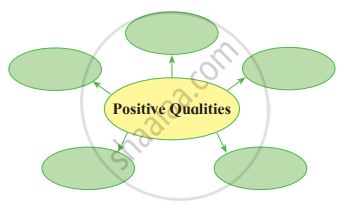
Make sentence of your own using the following expression.
put up with:
State whether the following statement is True or False. Correct the false statement by finding evidence from the poem to support your remark.
The poet was exalted at the sight of the cherry tree.
A small thought, put in action, led to a great achievement. Pick out the lines from the beginning and end of the poem and explain their significance.
Answer the given question in your own words.
Why did the Swallow finally decide not to leave the Prince?
‘Never mind faded forests, Austin’. The word ‘faded’ means to become dim or faint. The word describes the forests that have become faint or dim in appearance. Now go through the poem again and complete the table.
| Describing word | Object | Explanation |
| 1. faded | forests | The forests have become faint or dim in appearance. |
| 2. silent | ||
| 3. unfading | ||
| 4. bright |
Proverbs associated with the word season: for eg: Make hay while the sun shines.
- _________________________
- _________________________
Form suitable groups and discuss the following.
You have heard/read stories of Akbar and Birbal, Tenali Raman, Mulla Nasruddin. Recollect and write down the names of those stories.
Pick out those aspects of a story that you find a common in all their stories.
- Humour
- Supernatural event
- Wisdom
- Suspense
- Magic
- Beauty of Nature
- Wit
- Play upon words
- Sadend
- Violence
Read the following sentence carefully and choose the correct meaning.
The Peacock had a gorgeous tail like no other bird.
Describe the following with the help of the story.
The fabric is woven by Thiruvalluvar
Explain the term plot.
Find sentences from the play related to the given points.
The tension between different loyalties
- It’s little we get but abuse from the people, and no choice but to obey our orders.
- ________________________________
- ________________________________
- ________________________________
Discuss the following question after you have seen a presentation of the ‘ad’.
Why does Didi say ‘No party for me!’?
Can you imagine life without wheels? Try and think of what life would be like if there were no wheels around.
Write a recipe for the stone soup.
Talk about your strengths.
Correct the following sentence and rewrite it.
Papa Panov gave hot soup to the sweeper, milk to the young mother, and coffee to the beggars.
Listen carefully and write all the words correctly.
You are right. Write it down in the right-hand corner.
Why is Great January annoyed with Holena and her mother? Does he help them?
Find out how the following game is played.
Hockey
List the rhyming words in the (On the water) poem.
Why does the poet say that the dewdrops greet the dawn?
What does the poet want to know from the goldfish?
Make a collection of Rangoli motifs and patterns.
Write about each motif or pattern in your own words -
it could just be a label or a description or some information or comment.
Identify the character or speaker.
I will soon move you.
Read the comic strip and answer the following question.
Can we read and access the information free of cost?
Read the poem and fill in the blanks with the correct option.
It is better far to rule by ______, than ______.
- soft
- vain
- fear
- joy
- love
- heard
- toiled
- mild
- good
- sand
- life
- harsh
Why does Alice drink from the bottle that says ‘DRINK ME’ and why does she eat from the cake that says ‘EAT ME’?
Look at the number pattern. Fill the blank in the middle of the series or end of the series.
QPO, NML, KJI, ______, EDC
The terrorists asked Neerja to collect the passports of the passengers because ______.
Neerja passed on the warning in a code to the pilots because she______.
What does the peepul do?
What is the setting of the story?
How did Santhosh know that the river was clean?
Karmugilan went to __________ for higher studies.
What did Anitha eat in the expo?
What does Megalai do with elders?
Match the following.
| 1. | garden | very small |
| 2. | trash can | hungry and tired |
| 3. | old man | well maintained |
| 4. | hut | earthen pot |
| 5. | gruel | wasted food |
Who is the guest?
Why was the fish floating on top?
Why did they sail?
Why did Kani run to the kitchen?
Who helped Tenzin in learning English words?
Read the passage carefully and answer the following question.
What is the main idea of the story?
A person who overcomes problems, will get ______ at the end.
Do we worry when the progress is slow?
Why did Nasruddin take someone else’s name each time he missed the target?
What did the books in the library look like ?
