Advertisements
Advertisements
प्रश्न
The peacock is a colourful bird. How does the poem capture the various colours that its plumage displays?
Advertisements
उत्तर
An Asian bird, the peacock is one of the most colourful known birds. Its plumage is a myriad of colours. Sujata Bhatt has detailed the tail of numerous colours with such finesse that it is not hard to visualise the blue and golden of the peacock. In the very beginning when she tells the reader of the presence of a peacock in the vicinity she talks of the turquoise flashed in the peepal tree, a vibrant reflection of the turquoise colour, which is most dominating in its feathers, forms an image in the reader's mind. Even when the peacock makes a spectacle, the poet talks of its dark glowing eyes (in feathers), describing them “violet fringed with golden amber”. It creates vivid imagery of a widespread plumage of the peacock with all the vibrant colours reflecting the flamboyance.
APPEARS IN
संबंधित प्रश्न
A1. True or False
State whether the following statements are true or false:
(1) The author's new house was situated at Bangalore.
(2) The writer was delighted because their new house, was the biggest they ever lived.
One of the advantages of growing up in an Army household was the frequency with which we moved. 'Postings' came with predictable regularity every three years. What was unpredictable and therefore exciting was the suspense. Where would we go this time? Ambala, Pune, Dehradun, Allahabad, Tejpur, Bangalore, Yo! ............ In my short span of thirteen years we had moved lock. stock and barrel eleven times!
Every move meant change. New journeys, new places, new schools, my new books, new uniforms, new friends and new houses. We lived in tents, bashas, Nissen huts, flats and bungalows. No matter what the shape and size of the dwelling, mother soon put her own special stamp on it and transformed it into a familiar place - our home - complete with bright yellow-curtains, coffee-brown carpet, assorted pictures, hanging ferns and potted palms - providing a comforting sense of continuity in our essentially nomadic life.
I was thirteen, the year we moved to the Cantonment at Allahabad. In stark contrast to the razzle-dazzle of the city's commercial areas like Katra and Chowk, the Cantonment was a quiet, orderly place with broad tree-lined roads that still carried the names of long-dead Britishers. Our bungalow was on a sleepy by-lane called MacPherson Road. When we first saw it, my brothers and I were delighted. It was by far the biggest house we had ever lived in. The task of furnishing those huge, echoing rooms daunted Mother.
A2. Complete
a. The broad tree-lined roads were named after.............................
b. Katra and Chowk are .............................
c. Mother was daunted with the task of................................. .
d. The suspense was exciting because the posting was.........................
A3. Personal response
What do you think are the problems faced by those who change households frequently.
B1. Complete the following statements:
(i) The poet is talking about............................. .
(ii) As a nation weare missing our .................................... .
(iii) Old people havekeys ........................... .
(iv) The elderly remember .......................... .
"Oh the value of the elderly! How could anyone not know? They hold so many keys, so many
things they can show.
We all will read the other side this I firmly believe.
And the elderly are closest oh what clues we could retrieve.
For their characters are closest to how we'll be on high.
They are the ones most developed, you can see it if you try.
They've let go of the frivolous and kept things that are dear.
The memories of so sweet, of loved ones that were near.
As a nation we are missing our greatest true resource,
To get to know our elders and let them guide our course."
B2 Express
State what the underlined words mean:
(i) Oh the value of the elderly! State the value ............. .
(ii) They are the ones most developed. 'They' stand for ............. .
B3: Match the words in Column A with their rhyming word in Column B:
| Column A | Column B |
| (i) Course | (a) Show |
| (ii) Believe | (b) resource |
| - | (c) retrieve |
Complete the following statements :
(ii) Maharashtra depends on India, because ................
Answer the following question in 200-250 words:
"The best and most beautiful things in the world can't be seen or even touched. They must be felt with the heart." Justify the famous quote of Helen Keller.
Talk to your partner about the following.
Would you agree that the author’s grandmother was a person strong in character? If yes, give instances that show this.
Briefly explain the following statement from the text.
“The lack of determinism in quantum theory!”
Look up the dictionary for the meaning of the word ‘diaspora’. What do you understand of the Indian diaspora from this piece?
How does Shelley's attitude to science differ from that of Wordsworth and Keats?
What two things are compared in the poem?
What do the references to the birds and animals made in the poem suggest?
' Kummi', ' ghumar' and 'dandia' are some dance forms mentioned in the text. Make an inventory of folk dance forms in the different regions of the country.
Read the following statement and mark those that apply to you.
Someone has extended a hand of friendship towards me and I have not accepted it.
Answer in your own words.
What did Revathi discover about her balsam plants?
Think and answer in your own words in your notebook.
Why do you think God created worms? What is their ecological importance?
Correct the following statement.
Sue ignored Johnsy completely.
Discuss orally in your class.
In what subjects is knowledge of mathematics used, at school level, and college/university level? Name them.
Did you know maths is used in music and poetry also? Can you tell how?
Read the passage and answer the following question:
What makes Indra’s vajra or weapon invincible?
Look at the following words carefully for one minute. Now close your book and try to write down as many of the words as you can remember.
| crust, tremendous, lava, crater, volcanic, tsunami, island, extinct, disaster, dormant, eruption, plume, inland, molten, active, coast |
Discuss and write 1-2 lines about the following,
Why Bushi told Yonamine not to travel at night.
Find what Hirabai tells the traveller by reading her words from right to left.
Find the meaning of ‘Charity begins at home’. Find other sayings which have a similar meaning.
Read the passage aloud playing the roles of the different characters.
Answer in your own words.
What excuses did Neel give to avoid cleaning his room?
Answer in your own words.
How many chores did the ancestor from 1800 have to do?
Colour, sound, and images from nature add to the beauty of a poem: 'Tartary' is a perfect example of the above. Pick outlines that contain –
- Colour
- Sound
- Images from nature
Choose the appropriate phrase to insert in the gap, to make the sentence meaningful. Use the appropriate form of the verb.
Before we ______ let us stand in attention for the National Anthem.
Complete the following diagram.

Describe the following with the help of the (The Twelve Months) story.
Summer
Guess the meaning of the following word.
pounced
Read the following line from the poem and answer the question that follow.
My heart will keep the courage of the quest And hope the road's last turn will be the best.
|
My heart will keep the courage of the quest, And hope the road's last turn will be the best. |
- What kind of quest does the poet seek here?
- What is the poet’s hope?
Read the following line from the poem and answer the question that follow.
Let me but live my life from year to year, With forward face and unreluctant soul; Not hurrying to, nor turning from the goal; Not mourning for the things that disappear.
Identify the rhyme scheme of the given lines.
Who was Caliban? What was he employed for?
How did Miranda feel when her father raised the storm to destroy the ship?
Is the bird a crow?
Read the story again and write how these character reacted in these situation:
You’re both quite mistaken.
Dr. Krishnan ........…………………….
Mrs. Krishnan……....…………………
Hamid thought that his grandma would be pleased if he bought______
Rearrange the jumbled sentences and write them in the correct order.
- But Hamid bought a pair of tongs.
- Granny Ameena felt proud of her grandson.
- Hamid’s friends bought different toys of their choice.
- Hamid proudly compared his tongs with a brave tiger.
- Hamid had less money than his friends.
- Granny Ameena was worried as he had to go to the Eidgah alone.
Read the letter again and write a few lines on each of the following.
- things that the coach taught….
- transformation in the child……..
- things that amazed the writer……..
“Was it just the wind?”– What do you think Usha thought it was? Why?
Why should we speak gently?
Look at the number pattern. Fill the blank in the middle of the series or end of the series.
ELFA, GLHA, ILJA, ______, MLNA
He preferred handling mail by himself.
Identify the speaker/character.
Don't worry, Madam, it's only a warning.
Identify the speaker/character.
Wake up, child.
Geetha madam couldn’t stop the children running out of the train because they ______.
Why does the child clamber and scramble?
Who was challenged for a race?
Try your own.
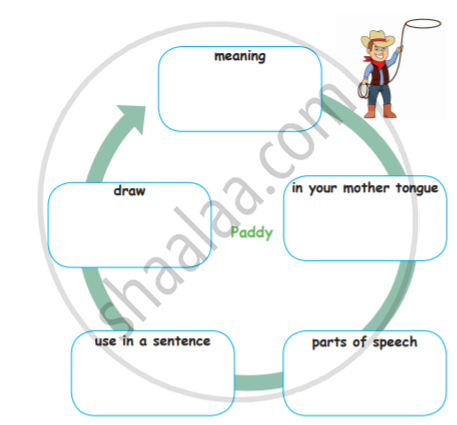
Put the given time expressions in the correct columns.
| winter | morning | 2’ o clock | evening | 1947 |
| March | Sunday | 15th August | 4.30 PM | wedding day |
| in | at | on |
Look at the picture and Choose the correct word.

Meena was transferred to a______.
Name the character or speaker.
"Do you have a fever?"
Divya and Rani decided to draw a ________.
Match the rhyming words.
| Say | grow |
| All | time |
| Go | day |
| Rhyme | fall |
Match the rhyming words.
| strokes | floor |
| shore | rush |
| brush | chokes |
Name a few things that sink.
The rabbit had
What was the most important thing that Helen finally understood?
What did the boy make with the branches of the tree?
Being a bachelor, the stranger had no patience with children.
