Advertisements
Advertisements
प्रश्न
Identify the words that help you understand the nature of the poet's father.
Advertisements
उत्तर
There are such words in the poem that help one understand the nature of the poet's father.
The father was a much practical man. Probably because the whole family was moving to Baroda, the father got all the trees removed and the surrounding property demolished. He was not an emotional man but a man of actions.
“the structures were demolished”
“but he massacred them all”
“My father ordered it to be removed”
APPEARS IN
संबंधित प्रश्न
Dolly Winthrop has a very noble nature. Comment.
Notice these expression in the text. Infer their meaning from the context.
billowed
Notice these expression in the text. Infer their meaning from the context.
salt flats
Tick the item that is closest in meaning to the following phrase.
to give vent to
The school system often curbs individual talents. Discuss.
Discuss in groups plays or films with a strong message of social reform that you have watched.
Discuss in pairs
Ruskin's insistence on looking intensely at words, and assuring oneself of meaning, syllable by syllable – nay, letter by letter.
What do the references to the birds and animals made in the poem suggest?
What were the concepts that Kumudini Lakhia represent through Duvidha, Atah Kim and panch Paras?
Discuss the following in pairs or in small groups.
“Before you begin experimenting you need to perfect the technique with which you experiment.”
Make groups and discuss the following:
What inspired them to spend the best part of their lives to research and share their findings?
Say why the speaker of the poem wishes to be a-
hawker
Breeding worms to use them to convert organic waste into fertilizer is called Vermiculture or vermicomposting.
Find out more about Vermiculture and how you can carry out the same in your garden/backyard, to fertilize your plants at home.
State whether the following statement is True or False. Correct the false statement by finding evidence from the poem to support your remark.
The cherry tree did not take long to grow.
Kite - flying in Gujarat, is a competitive sport - cum - festival.
The kite - Bazar in Ahmedabad, is open day and night for a week.
Select any four zoo animals mentioned in the poem. Imagine they are able to talk in English. Compose a dialogue among the four animals discussing their discomfort and illnesses.
The ______ bees make honey from nectar.
Write a sentence each about three of your friends. Each time you should say what your friend cannot do, and yet, pay a compliment to your friend.
Collect as many pictures as you can, or draw diagrams of all the sources you have listed above. Make a scrapbook using them.
Write a conversation between a donkey and a school boy.
To whom is the poem addressed?
Draw word webs for the following.
Begin with the given word and go on writing as many other words associated with it, as you can.
Use these words to write other related words to form a word web.

Read the following sentence aloud. Write who said it and to whom.
“Look, here’s something for you.”
Complete the following sentence with reference to the passage.
At the back rose the high peak of Mount Ida, from which _______________.
Read the following:
- Charging along like troops in a battle.
- Fly as thick as driving rain.
Using your imagination, write one or two comparisons each with -
- like ______
- as ______ as
Form groups of 4-5. Read the following sentences aloud. Using your imagination and with the help of group discussion, write other situations in which the sentences can be used.
- The outcome: disappointment and anger.
- The hour of battle had sounded
- What a chase!
- This was our chance, .........
Read the following from the Language Study pages:
- adjective clause
- adverb clause
- noun clause
Find one example of each from the passages. (Note the linking word when you do that.)
Find the meaning of the following word.
abused
Name the following.
Not comfortable with the wet ground.
Read the word. Write the words that combine to make it.
snowwhite
The poem has rhyming words at the end of the lines. Find and write the pairs of rhyming words in each stanza.
Guess the meaning of dreary.
Give an instance that shows the pathetic condition of the young bird.
What powers did Prospero posses?
Why did Chulong catch the bird?
Read the story again and write how these character reacted in these situation:
Zigzag hardly never sleeps.
Somu………………………
Dr.Krishnan……………………….
Hamid was like one with wings on his feet. This means ______
Read the comic strip and answer the following question.
What do you mean by cyber safety?
Write the names of the characters in this story.
1. ______ 2. ______ 3. ______
Turtles come ashore to lay eggs
The hatchlings use a tiny egg-tooth to come out of the eggs.
Why did the author leave town?
Write a summary based on the story map.

Discuss in groups and share your views in three or four sentences with others in the class.
What is your favourite dish? Do you know the spices that go into it?
A school-going girl writes the diary account.
Read scene I of the play carefully and answer the question below.
Match the following.
| Sr.No. | CHARACTER | TRAIT |
| a. | Father Wolf | with a grey nose…feeds her four cubs |
| b. | Tabaqui | the big one from Waingunga River with a lame foot |
| c. | Mother Wolf | the chief of the Wolves |
| d. | Shere Khan | begs for meat and thanks for the meal/warns the wolves about the arrival of Shere Khan |
How was the rich man's house?
Where did the bird catcher sit?
How does a friend support us?
Why was the teacher annoyed?
Tenzin is from ______.
List the things that humans should save.
Why did Jana have a nightmare?
Name the animal and sound it makes.
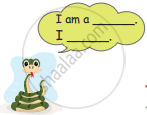
Write the word with same meaning.

Flat
Before going to bed that night, Chris gave his new teacher a ______.
What would you have done if your grandmother would have slipped?

Write the related words as shown in the example.
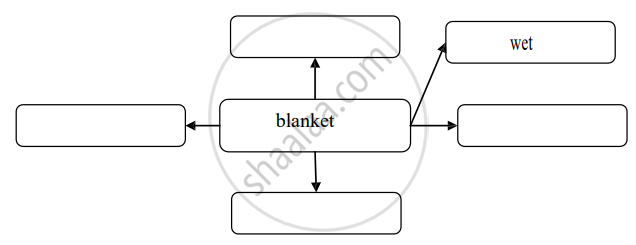
Read the following passage and do the activities:
A1. Fill in the blanks: (2)
- ______ percent of our daily communication is non-verbal.
- Eye contact is another type of ______ communication.
- Frequent blinking is a sign of the person feeling ______.
- One can readily detect _______.
|
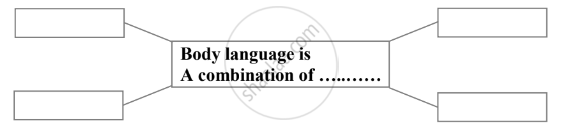
According to some experts, a staggering 93 percent of our daily communication is non-verbal. Facial expressions are easy to decipher. One can readily detect happiness, sadness, anger. Physicians can tell a patient is doing well (or not) by looking at his/her face. Eye contact is another type of non-verbal communication, which can tell a lot about the other person. The eyes convey a range of emotions-happiness, sadness, boredom, surprise, confidence .......... even emotional interest. Staring at someone's forehead may intimidate the recipient, staring at the mouth is sometimes interpretated as a sign of emotional interest. In fact, staring into someone's eyes is a sign of lying, and so is looking away. In certain cultures, lack of eye contact is taken as a sign of respect. If body language is to be defined, it is a combination of facial expression, gestures, eye contact, body movements and posture and voice. Frequent blinking is a sign of the person feeling distressed or uncomfortable. If the pupils are dilated, it ofter indicates interest, even emotional interest. The lips also reflect our body language, and lip biting indicates worry and/or anxiety; tightening of the lips may be an indication of disapproval. Slightly turned-up lips indicate happiness and slightly turned-down lips indicate sadness. |
A2.
A3. Find the antonyms of: (2)
- verbal × ______
- entertaining × ______
- sender × ______
- comfortable × ______
A4. Do as Directed: (2)
- The eyes convey a range of emotions. (Frame a 'Wh' question in order to get the underlined part as answer).
- Physicians can tell about a patient's wellness. (Rewrite using 'able to')
A5. Personal Response: (2)
Non-verbal communication plays an important role in our daily life. Comment.
