Advertisements
Advertisements
प्रश्न
What kind of a person do you think the narrator is?
Advertisements
उत्तर
A model answer has been provided for students' reference.
It is strongly recommended that students prepare the answer on their own.
Shyama, a person who is too attached to his soil and his village, is the narrator of Ranga's Marriage. When the story starts the reader expects something about a marriage happening. However, the narrator takes the reader on a tour of his village, Hosahalli, explaining the specialities about it. He does not believe in the English culture. He tells how 10 decades ago there was no such culture and how he thinks that the language has changed the atmosphere totally. How a distinction has descended between those who speak English and those who do not. Shyama is person who respects a person who believes in her/his culture; for example, when Ranga payed homage to him, he bowed down and touched Shyama's feet as a namaskar. This made Shyama happy that even after studying away from home Ranga had not forgotten his roots. Even though Ranga was an educated boy and was determined to get married to a girl who is mature enough, Shyama got him married to Ratna, who was much younger and not at all the kind of girl he would have married. This shows his beliefs in arrange marriage and also that he was a determined person who always got done what he had decided. He was a person who strongly believed in his tradition and culture.
संबंधित प्रश्न
B1. Find reasons
(i) The effect of receding forest …………………………………. .
(ii) The number of animals is reduced because ………………………. .
(iii) Elephants entered the city because…………………… .
(iv) Elephants lived a wary life …………………….. .
On the left bank of the Ganga, where it emerges from the Himalayan foothills, there is a long stretch of heavy forest. There are villages on the fringe of the forest, inhabited by bamboo cutters and farmers, but there are few signs of commerce or pilgrimage. Hunters, however, have found the area an ideal hunting ground during the last seventy years, and as a result, the animals are not as numerous as they used to be. The trees, too, have been disappearing slowly; and, as the forest recedes, the animals lose their food and shelter and move further on into the foothills. Slowly, they are being denied the right to live
Only the elephants can cross the river. And two years ago, when a large area of the forest was cleared to make way for a refugee resettlement camp, a herd of elephants - finding their favourite food, the green shoots of the bamboo, in short supply - waded across the river. They crashed through the suburbs of Haridwar, knocked down a factory wall, pulled down several tin roofs, held up a train, and left a trail of devastation in their wake until they found a new home in a new forest which was still untouched. Here, they settled down to a new life but an unsettled, wary life. They did not know when men would appear again, with tractors,bulldozers and dynamite.
B2. Find out
Mention four things the elephants did when they found shortage of food:
(i)………………
(ii)………
(iii) …………
(iv) ………….
B3.Phrases
Make meaningful sentences by selecting any two of the following phrases:
(i) to make way for
(ii) in short
(iii) on the fringe of.
B4. Language study
Select the proper alternative to make the correct voice:
(i) Hunters have found an ideal hunting ground.
-An ideal hunting ground ........found by hunters. (had been, has been, was)
(ii) They are being denied the right to live.
- The people ........them the right to live. (are denying, were denying, denying)
B5.Personal response
What would be your contribution to protect the natural habitat of animals?
Answer any four of the following questions in 30 - 40 words each:
(a) What does the poet's smile in the poem, 'My Mother at Sixty-six' show?
(b) Listening to them, I see two distinct worlds ... ." In the context of Mukesh, the bangle maker's son, which two worlds is Anees Jung referring to ?
(c) Though the sharecroppers of Champaran received only one-fourth of the compensation, how can the Champaran struggle still be termed a huge success and victory?
(d) Which article in McLeery's suitcase played perhaps the most significant role in Evans' escape and how?
(e) Why does Derry’s mother not want him to go back to visit Mr. Lamb?
(f) What considerations influenced the Tiger King to get married?
Answer any four of the following questions in 30-40 words each :
(a) Why was Franz not scolded for reaching the school late that day?
(b) Sophie was dreaming of so many things in her life. What were they?
(c) Why are the youngsters described as springing? (My Mother at Sixty-six)
(d) In the hot season, how do man and beast get comfort? (A Thing of Beauty)
(e) How did the Maharaja deal with a high ranking British officer who wanted to shoot a tiger?
(f) Having got rid of his stink, what problem did Roger Skunk face?
Answer any three of the following in 30-40 words each:
(a) Why has the poet’s mother been compared to the ‘late winter’s moon’?
(b) The poet says, ‘And yet, for these Children, these windows, not this map, their world.’ Which world do these children belong to? Which world is inaccessible to them?
(c) What was the plea of the folk who had put up the roadside stand?
(d) What will happen to Aunt Jennifer’s tigers when she is dead?
The poet’s mother laughed at the snapshot. What did this laugh indicate?
In which language do you think Gangadharpant and Khan Sahib talked to each other? Which language did Gangadharpant use to talk to the English receptionist?
How do you distinguish between information gathering and insight formation?
Discuss in groups plays or films with a strong message of social reform that you have watched.
Comment on the way in which the theme of the story has been introduced.
Study each of the following sentences and notice the balance between its parts. Pick out other sentences in the text that reflect this kind of balance
a. It is right that a false Latin quantity should excite a smile in the House of Commons; but it is wrong that a false English meaning should not excite a frown there.
b. Let the accent of words be watched, by all means, but let the meaning be watched more closely still, and fewer will do the work.
Fill in the blank.
“Hybrids need more _____________”, said Devu Handa.
Make sentence of your own using the following expression.
overcome:
Read the story and complete the following.
Revathi was confident of proving her ownership of her pot of plants because, ____________.
Study the pictures below and note down the differences.
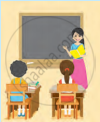
Read the poem and complete the web about the activities the planners do.

Write 3 to 4 lines about the following in your own words.
The Robotic Surgery
Read the following word and use it in a sentence of your own.
Renown
Complete the following web diagram.

Suggest what you would do in the following situation:
One particular friend of yours is always late for college, social functions, movies, etc. and delays everyone.
Choose the odd one out :
Bottom, Moth, Mustardseed, Cobweb.
Show the three categories of volcanoes using the following tree diagram structure.
Explain the following statement with reference to the context.
Because your father can't do without my help.
Answer the following question in one sentence.
What should human beings do in order to make progress?
Apart from the stone, how many things go into the soup?
What is your favourite time of the day? Describe it in detail.
A parody is a playful, comic imitation of a writer’s style. A parody is like a verbal cartoon. Compare the original poem and its parody given on page 35 using the following points:
|
How doth the little busy bee |
How doth the little crocodile (parody) |
| Choice of a subject (an animal) | __________________ |
| __________________ | __________________ |
| Number of lines and stanzas | __________________ |
| __________________ | __________________ |
| Same or similar constructions | __________________ |
| __________________ | __________________ |
| Tone of the poem | __________________ |
| __________________ | __________________ |
Answer in your own words.
What task did Grandpa wish to avoid?
Write the symbol that is used in the poem to represent the following idea.
Some other time.
‘And calls our Best away’ is a gentle way of expressing the unpleasant idea of a loved one dying. It is an example of euphemism. Think and write down 3 or 4 ways in which we can express the idea of ‘death’ in a tactful and gentle manner.
- _________________
- _________________
- _________________
- _________________
Read: ‘The Open Window’ by H. H. Munro (Saki).
Who said the following, to whom, and when?
“O Holy Master, bless us with thy song !”
Why is Great January annoyed with Holena and her mother? Does he help them?
List the characters in the play.
Human characters
Find two examples of the following from the lesson.
An Exclamation
Do you agree with the poet’s thoughts? Why?
Find a word that has a similar meaning.
Sorry
What woke up the mother?
Read the following line from the poem and answer the question given below.
They growl at that and they growl at this;
Whatever comes, there is something amiss;
- What does the word ‘growl’ mean here?
- Why do they find everything amiss?
Why was the elephant owner happy with the deal?
It is a problem for sea turtles to come ashore because ______.
Read the comic strip again. Make groups of four and frame some questions on what you have read. Each group should ask a question in turns. You cannot repeat the same question. The team which asks more questions is the winner.
e.g:
- Which are the foreign vegetables mentioned?
- What was sad for Columbus?
Mithali is one of the women players to score seven consecutive 50s.
What made the trip a memorable one?
Merlin was thrilled when the school arranged the trip because ______.
_______ broke out in the near by villages.
What is the use of mechanical parts?
Recite the poem ‘Mother Nature’.
Write the rhyming word.
away
Meena studied in ______ standard.
Three waves hit the village.
Circle and write the adverbs.
We will leave today. ______
Find and write the clues.
Clue for lame ______.
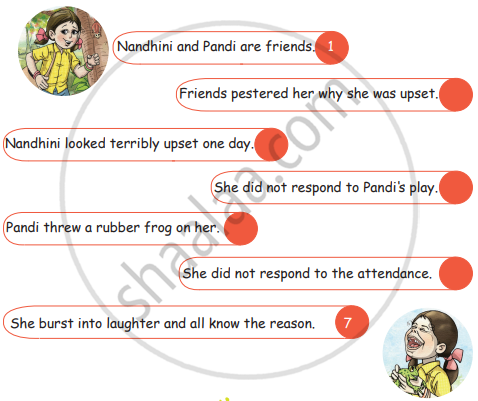
What was the reason behind Nandhini’s dullness?
Number the actions of Pandi and Nandhini in order.
What will you do if you have a gold plate?
Appa weaves beautiful sarees with______.
In memory of his mother, he carved ______ statue.
Are these sentence TRUE or FALSE
The poet tells the child to be afraid when it is dark.
Write compound word using the pictures.
 |
+ |  |
| ____________ | ||
