Advertisements
Advertisements
प्रश्न
The school system often curbs individual talents. Discuss.
Advertisements
उत्तर
A model answer has been provided for students' reference.
It is strongly recommended that students prepare the answer on their own.
Various points to prove the fact that the school system curbs individual talents are:
Focusses more on memorising facts and data rather than encouraging them to understand concepts and ideas.
Thrust on taking exams rather than focussing on increasing the mental and intellectual aptitude of a student;
The irregular student-teacher ratio makes it impossible for the teachers to provide individual attention to each and every student.
One-to-one interaction with the kids have lessened these days.
Quantity matters more than quality.
संबंधित प्रश्न
Helen's statement, "We worked hard and faithfully, yet we did not quite reach our goal" tells us about her failure to achieve the goal at the Wright-Humason School in New York City. What was the goal that she failed to achieve there?
Answer any four of the following in 30–40 words each :
(a) Describe the irony in Saheb's name.
(b) Why was Gandhiji opposed to C.F. Andrews helping him in Champaran?
(c) Aunt Jennifer's efforts to get rid of her fear proved to be futile. Comment.
(d) What does Stephen Spender want to be done for the children of the school in a slum?
(e) When he was only ten days old, a prediction was made about the future of the Tiger King. What was ironic about it?
(f) What was his father's chief concern about Dr. Sadao?
Read the following extract carefully and complete the activities given below :
A1 Complete the following :
(i) Books were found on the _____________ and ____________.
(ii) The tales are described as ______________ and __________.
|
Have you forgotten? Don't you know?
We'll say it very loud and slow:
THEY ... USED ... TO ... READ! They'd READ and READ,
AND READ and READ, and then proceed
To READ some more. Great Scott! Gadzooks!
One-half of their lives was reading books!
The nursery shelves held books galore!
Books cluttered up the nursery floor!
And in the bedroom, by the bed,
More books were waiting to be read!
Such wondrous, fine, fantastic tales
Of dragons, gypsies, queens, and whales
And treasure isles, and distant shores
Where smugglers rowed with muffled oars,
And pirates wearing purple pants,
And sailing ships and elephants,
And cannibals crouching 'round the pot,
Stirring away at something hot.
(It smells so good, what can it be?
Good gracious, it's Penelope.)
|
Answer the following in 200-250 words :
What are Helen's opinions about examinations?
Attempt the following question in 100-150 words:
What do you think about Anne’s talent for writing essays, which she wrote convincingly when punished by the teacher?
Answer the following question in 150-200 words:
Why did Anne like her father more than she liked her mother?
Briefly comment on:
“As a Buddhist, he told me, he knew that it didn’t really matter if I passed away, but he thought it would be bad for business.”
The episode has been narrated in a light vein. What social mores does the author seem to ridicule?
What was the importance of the watch to the author?
What do you understand of the three voices in response to the question 'What does a novel do' ?
Bring out the parallel suggested between the predatory instincts of the bird and human behaviour.
An acrostic is a poem or a write· up in which the first letter of each line forms a word. when it is read vertically.
For example,
Faithful
Reliable
Inspiring
Encouraging
Noble
Dedicated
With your benchmate / group, complete the acrostic of BELIEVE and FAITH.
(Please note that the words / phrases should be more or less related to the topic. You can use a thesaurus.)
Be certain of
E ......................
L ......................
I ......................
E ......................
V ......................
E ......................
F ......................
A ......................
I ......................
T ......................
H ......................
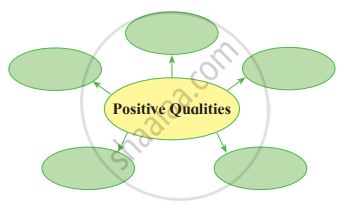
Find from the poem, positive qualities to fill up the web.
Read the story and complete the following.
Revathi was confident of proving her ownership of her pot of plants because, ____________.
Write down any two Slogans on 'Gender Equality'.
Answer in your own words.
What are the provisions in the Declaration of the United Nations, to ensure the equality of men and women?
A small thought, put in action, led to a great achievement. Pick out the lines from the beginning and end of the poem and explain their significance.
The tone of the poet is sarcastic. When he writes ‘All spaces are gridded filled with permutations of possibilities’ he intends to indicate the efforts made by the planner to exploit every available piece of land without any consideration of harming nature or violating attachments of people to places. Make pairs/groups and find out some more sarcastic lines having the same effect.
Expand the idea inherent in the following proverb :
One should eat to live, not live to eat - Franklin.
Match the professions with the field of work.
| Profession | Field of work | ||
| (1) | Chief Minister | (a) | Business |
| (2) | Magistrate | (b) | Transport |
| (3) | Soldier | (c) | Construction |
| (4) | Trader | (d) | Administration |
| (5) | Builder | (e) | Education |
| (6) | Driver | (f) | Defence |
| (7) | Teacher | (g) | Law |
Describe the following with the help of the story.
The fabric is woven by Thiruvalluvar
Show the stages in the process in which Krakatoa collapsed and then Anak Krakatoa formed in the course of volcanic eruptions. Use the flowchart given below.
Answer the following question in one sentence.
Who misses all the fun?
Guess the meaning of the following from the context.
The meadow is wrapped in shadow.
Complete the following sentence with reference to the passage:
For six years did Gautama practise ____________.
Read the passage and answer the following:
Where does the story take place?
Write the symbol that is used in the poem to represent the following idea.
Some other time.
Rewrite in your own words.
One event from the story.
Find out when and where we get strawberries in Maharashtra.
List all the words and phrases in this story that indicate 'time'.
What mistake did the man in the moon make?
What did the Judge tell Ahmad?
List the words or phrases related with computers or the Internet.
Find a word that has a similar meaning.
happily
The author left the ties in the taxi.
What did Usha buy in the market? List them.
Fill in the blank
______ is the festival which fills our hearts with delight.
Fill in the blank.
______ is referred to as a festival of sacrifice.
Read these lines and answer the questions given below.
Where the voice of the wind calls our wandering feet
Whose ‘Wandering feet’ is referred to here?
Read the following lines and answer the questions.
It’s part of his hours, his days and his years,
Back of his smiles and behind his tears.
What does ‘tears’ mean?
Identify the speaker/character.
Don't worry, Madam, it's only a warning.
Where did Raj’s mother send him?
What did mother ask Raj to buy?
Geetha madam couldn’t stop the children running out of the train because they ______.
Read the lines and answer the questions given below.
Spring is pretty
but short and sweet
when you can smell the grass
from your garden seat
- How does the poet describe the spring season?
- Which line tells you that the garden is fresh?
- Who does ‘you’ refer to?
How does the poet describe the Indian seasons? Write in your own words in about 50 words.
Imagine you are the girl and give a different ending to the story.
What did the father give to all the daughters?
Read the passage and colour one flag each time you read.
Our national emblem is taken from Ashoka’s pillar at Sarnath. It is found on all government documents, coins, currency notes, postcards, and envelopes. It consists of four lions standing back to back but, we can see only three lions at a time. There is a Dharma chakra in the centre of the base plate, with the figure of a bull in the right and that of a horse in the left. The entire structure is sitting on a lotus. The words ‘Sathyameva Jayate’ is written under it in Devanagari script. These words mean, ‘Truth alone Triumphs’.
Who sews the cloth?
Kani and Teddy were in the garden at _____.
Do you think you treat everyone equally? Justify with an example.
Where were they going?
The villagers took oath not to harm the _______.
Hundial is a______ pot.
What does she paint?
Mugund learnt the art from his ______.
What was the truth finally learned by Chris?
Read the following passage and do the activities:
A1. Fill in the blanks: (2)
- ______ percent of our daily communication is non-verbal.
- Eye contact is another type of ______ communication.
- Frequent blinking is a sign of the person feeling ______.
- One can readily detect _______.
|
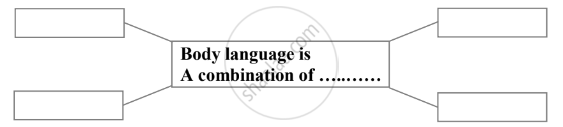
According to some experts, a staggering 93 percent of our daily communication is non-verbal. Facial expressions are easy to decipher. One can readily detect happiness, sadness, anger. Physicians can tell a patient is doing well (or not) by looking at his/her face. Eye contact is another type of non-verbal communication, which can tell a lot about the other person. The eyes convey a range of emotions-happiness, sadness, boredom, surprise, confidence .......... even emotional interest. Staring at someone's forehead may intimidate the recipient, staring at the mouth is sometimes interpretated as a sign of emotional interest. In fact, staring into someone's eyes is a sign of lying, and so is looking away. In certain cultures, lack of eye contact is taken as a sign of respect. If body language is to be defined, it is a combination of facial expression, gestures, eye contact, body movements and posture and voice. Frequent blinking is a sign of the person feeling distressed or uncomfortable. If the pupils are dilated, it ofter indicates interest, even emotional interest. The lips also reflect our body language, and lip biting indicates worry and/or anxiety; tightening of the lips may be an indication of disapproval. Slightly turned-up lips indicate happiness and slightly turned-down lips indicate sadness. |
A2.
A3. Find the antonyms of: (2)
- verbal × ______
- entertaining × ______
- sender × ______
- comfortable × ______
A4. Do as Directed: (2)
- The eyes convey a range of emotions. (Frame a 'Wh' question in order to get the underlined part as answer).
- Physicians can tell about a patient's wellness. (Rewrite using 'able to')
A5. Personal Response: (2)
Non-verbal communication plays an important role in our daily life. Comment.
