Advertisements
Advertisements
प्रश्न
How do you respond to these lines?
Light, chill and yellow,
Bathes the serene
Foreheads of houses
Advertisements
उत्तर
The poem Coming by Philip Larkin is dedicated to the beauty the spring brings along with it. It is a celebration of humanity. In the beginning, the poet creates a picturesque in the mind of a reader. Larkin creates beautiful evening scenery. The longer evenings of the spring are jeweled by the forehead of calm houses' rooftops, washed down by the chilly and yellow light of the setting sun. The reader is imparted with beautiful imagery of the whole environment sitting serenely and enjoying the sun going down as the spring beckons. They all dance to the humming of the thrush in the deep garden. It feels like the whole nature has come alive in the lovely evening and join the party to welcome the coming of the spring.
APPEARS IN
संबंधित प्रश्न
Write a character sketch of Mrs. Van Daan.
Attempt a character sketch of Mr Gilman as a teacher.
Talk to your partner about the following.
Describe the changing relationship between the author and his grandmother. Did their feelings for each other change?
What does the word ‘cardboard’ denote in the poem? Why has this word been used?
What has the camera captured?
Guess the meaning of the following word:
Kora
In which language are these word found?
Tick the item that is closest in meaning to the following phrase.
to take issue with
Do you know of any incident when someone has been brought back to life from the brink of death through medical help. Discuss medical procedures such as organ transplant and organ regeneration that are used to save human life.
What was Uncle Williams' comment on the 'tinkerers' of the world?
How does Shelley's attitude to science differ from that of Wordsworth and Keats?
The peacock is a colourful bird. How does the poem capture the various colours that its plumage displays?
You know what ‘hide-and-seek’ is. What would ‘hide-and-speak’ mean?
Read the extract 'Being Neighborly' and complete the following statement:
To Jo, the fine house seemed like ______.
Read the extract and state whether the following statement is true or false. Correct the false statement.
The author wanted to grow the desi variety of rice.
Think and answer in your own words.
What exactly does the speaker in the poem crave for?
Think and answer in your own words.
Does the poet really wish to become a hawker/gardener/watchman? Justify your response.
In Gujarat, the kite - festival is celebrated to welcome the Spring.
Expansion of Idea:
Expand the following idea in about 100-150 words by using the points.
'Beauty is truth, truth beauty'.
- Meaning of the proverb
- Significance of the proverb
- Add your own points.
Form suitable groups and discuss the following.
You have heard/read stories of Akbar and Birbal, Tenali Raman, Mulla Nasruddin. Recollect and write down the names of those stories.
Pick out those aspects of a story that you find a common in all their stories.
- Humour
- Supernatural event
- Wisdom
- Suspense
- Magic
- Beauty of Nature
- Wit
- Play upon words
- Sadend
- Violence
Draw a picture of the scene described in the poem.
Read the description of the Kabaddi match and do the following:
Write, in your own words, what happened in the second half.
Make a list of functions/events/programs/activities organized in your junior college. Choose three events and plan a program schedule of your own. Prepare a script as well to show the associating role of the compere for a particular event. Make your own sequence and design a template for the same.
Explain the term plot.
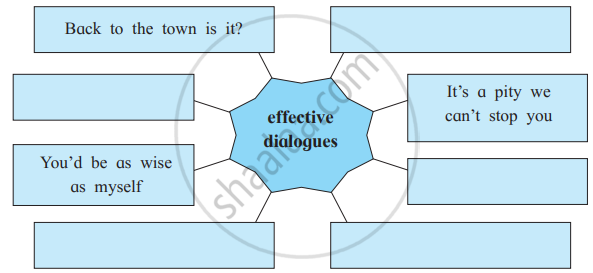
There are some dialogues that are short, but quite effective. They give us enjoyment and add beauty to the main story. Find some more from the text.
The consequences of Oberon’s jealousy for Titania are comic rather than tragic. Comment.
Explain the following statement with reference to the context.
From now on The Herald shall be my artillery.
Where does the story take place?
Discuss what a friendly and good-natured peacock would say to a crane. Write his speech. (5-8 lines.)
Read the following words. Write the words that are combined to make these words.
- faraway
- nobleman
- whoever
- moneylender
- sometimes
Add ten more words to the list on your own. Each of the component words must be meaningful.
What themes would you like to add to the themes given in this passage?
Read the poem: ‘Home they brought her warrior dead’ by Alfred Lord Tennyson.
Complete the following sentence with reference to the passage.
It is believed that _________ Homer, who __________ and who ________ to all who __________________.
Make as many 5 to 8 letter words as you can within 5 minutes, from the name.
| TESHUMAI TEWINDROW | |||
| Five-letter words | Six-letter words | Seven-letter words | Eight-letter words |
Gather more information about cold winters in Russia.
What did Anshuman’s father compare bad habits to?
Have you ever seen or used a computer?
Read the following incident carefully to answer the question that follow.
The tie that does not bind
“Oh, so you’re going abroad? Can you bring me back…..?” I’ve been asked to bring back a vaccine for a course. Once I searched the suburbs of Paris for two days for a special brand of ceramic paint. Having spent a lot of money for Cartier lighter refills, I had them confiscated at the airport just before boarding because the gas might be dangerous in the air.
Now, two months before a trip, I stop talking to people so they won’t suspect I’m about to travel. But someone always catches me.” I’ve heard you’re going to New York, and I want you to get something for me. It’s just a little thing you can find anywhere. I don’t know exactly how much it costs, but it shouldn’t be much. We’ll settle up when you get back”.
What Gilson asked me to buy was, in fact, a little thing: a tie. But not just any tie. He wanted a tie with a small embroidered G. Any colour would do, as long as it had his initials. Look, this is a special flight, I explained. We are only staying Saturday through Tuesday. On the day we arrived I didn’t have time to think about the tie, but strolling around on Sunday I did see ties bearing various letters in more than one shop window. They were cheap, just a dollar, but all the shops were closed.
On Monday, lunch lasted the whole afternoon. Then it was Tuesday morning, time to leave. It was only when I saw our airport bus waiting outside the hotel that I remembered the tie.
I told the group to go on. I would get a taxi to the airport. And so I went in search of a nearby shop where I had seen ties.
But I couldn’t find it. I walked further down the street-one, two, three blocks - all in vain. Back at the hotel, a bit anxious now, I took my suitcase, got a taxi and asked the driver to rush to the street where I had seen them.
The driver stopped at each shop we passed so I could look from the window. The stores had all sorts of ties, but not the kind I was looking for.
When I finally thought I had located the right shop, I decided to go in and check. The driver refused to wait. Parking was prohibited, he said. I promised to double the fare, jumped out and ran into the shop. Was I going to miss the plane just for a damned tie?
The salesman was unbearably slow. When I realized that the smallest change I had was a ten dollar note , I grabbed ten ties of different colours so I wouldn’t have to wait for change. I rushed out with the ties in a paper bag.
On the street I looked around. The taxi had vanished, taking my suitcase. What is more, I was going to miss the plane.
I ran to the corner, and hope flared up again: the taxi was waiting in the next street. Quick to the airport! As I settled down inside the taxi. I sighed with relief. Gilson was going to have enough initialized ties to last him a lifetime.
When I reached the airport, I paid the taxi driver the double fare and grabbed my suitcase. Panting, I boarded the plane under the reproachful gaze of the other passengers, all primly seated with their seat belts fastened. Ready to take off. Departure had been delayed because of me.
“At least I hope you found your tie”, said one who knew the story.
“I did”, I answered triumphantly.
After making myself comfortable, I reached for the paper bag to show the ties.
I had left it behind; in the taxi.
Fernando Sabino.
Read the incident again and answer the following question.
What was the writer always asked to do whenever he planned to go abroad?
The author left the ties in the taxi.
Read the comic strip and answer the following question.
Can we read and access the information free of cost?
Write down the word that alliterate in the poetic line below
That spreads treasures on a tree.
Activity
It’s fun to help out in the kitchen. You can even practice reading aloud when reading the recipe. And you can learn a little math by figuring out how to measure. Here are a few fun items to make that are “Alice” themed.
Describe the elephant driver in your own words.
Identify the speaker/character.
A man fell into the sea. Please save him.
Read these lines and answer the questions given below.
And welcomes little fishes in
With gently smiling jaws!
- Who welcomes the fish? Why?
- Which line tells you that the crocodile is hungry?
Complete the sentence given below with word/phrase.
The hole became ______ and ______.
They rode back home quickly.
Match the following.
| cuckoo | blows |
| breeze | sings |
| river | swims |
| fish | flows |
Match the actions with the picture.
| mixes for community food service | 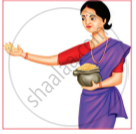 |
| sows the grain |  |
| feeds the birds | 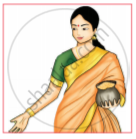 |
Put the given time expressions in the correct columns.
| winter | morning | 2’ o clock | evening | 1947 |
| March | Sunday | 15th August | 4.30 PM | wedding day |
| in | at | on |
Read scene I of the play carefully and answer the question below.
Match the following.
| Sr.No. | CHARACTER | TRAIT |
| a. | Father Wolf | with a grey nose…feeds her four cubs |
| b. | Tabaqui | the big one from Waingunga River with a lame foot |
| c. | Mother Wolf | the chief of the Wolves |
| d. | Shere Khan | begs for meat and thanks for the meal/warns the wolves about the arrival of Shere Khan |
Choose the odd one out.
Why was the teacher annoyed?
Read the advertisement and answer the question given below.

When does the offer end?
Speak and win.
Join in one of the two groups. Choose two characters. Support or oppose any one of the characters. Say some sentences for the one you support and say some sentences against the other one, to win.
| I support | I oppose |
The merchant paid______ to the boatman.
How did Bala help Amma and sisters?
Read the passage 3 times and colour the trees for each time.
Trees help us in many ways. The colour green is calming and heals your worries. By planting and caring for trees, we help improve our surroundings, as they give fresh air. When air is dirty the people of Delhi suffered a lot. But people of Madhubani district in Bihar have shown how art can be used to make our air clean. So that people made paintings on trees to stop people from cutting the trees.

The fir tree was sad ______.
What did the carpenter buy?
Find words from the passage which mean the same as the following.
- a malevolent desire for revenge (para 1)
- tactful (para 2)
- despise (para 3)
