Advertisements
Advertisements
प्रश्न
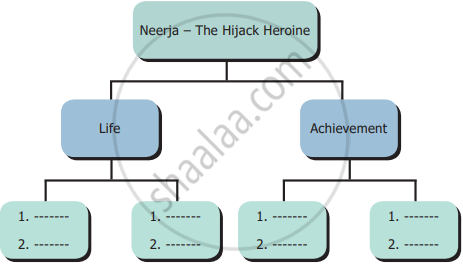
Read the “Story of Self Sacrifice and Bravery” once again and complete the flow chart.
Advertisements
उत्तर
| Neerja - The Hijack Heroine |
| Life | Achievement | ||
| 1. Born on 7th September 1963 in Chandigarh, Punjab. | 1. Modelling and Flight attendants job. |
1. Ashoka Chakra Indias highest honour. |
1. Justice for Crimes Award. |
|
2. Parents: Harish Bhanot And Rama Bhanot Brothers: Akhil and Aneesh |
2. Trained as a Purser and became a Senor flight purser. | 2. A postage stamp issued n her honour in 2004 | 2. Tamgha-e-Insaniyat Award. |
APPEARS IN
संबंधित प्रश्न
Read the following passage and do the activities:
A1 True or False:
Rewrite the following statements and state whether they are ‘true’ or ‘false’.
(i) Mashelkar’s mother did menial work to bring him up.
(ii) Mashelkar’s father died when he was twelve.
(iii) Mashelkar was born in a very rich family.
(iv) Tatas added much value to Mashelkar’s life.
I start with my greatest guru-my mother. I was born in a very poor family and my father died when I was six. We moved to Mumbai and my mother did menial work to bring me up. Two meals a day was a tough challenge. I studied under street lights and I walked barefoot until, I think, I was twelve. I remember when I passed the seventh standard and I wanted to go into the eighth standard, our poverty was such that even to secure 21 rupees for secondary school admission became a big challenge. We had to borrow from a lady, who was a housemaid in Chaupati in Mumbai. That was the tough life I had.
In fact, I remember, my passing the SSC Examination-i.e. 11th standard. Those days it used to be not 10th standard or 12th standard but 11th standard. I stood 11th among 1,35,000 but I was about to leave higher education and find a job. What helped me was the scholarship by Sir Dorab Tata Trust. It was just 60 rupees per month and would you believe that 60 rupees per month from Tatas added so much value to my life that I have been able to stand here today before you to speak to you.
I am on the Board of Tatas now and it is very interesting that the same Bombay House where I used to go to collect that 60 rupees per month now one goes and sits there like a Director on the Board of Tata Motors. The turn that these 40 years have taken is very interesting. It has all been possible because of the chance I got to do higher studies at the insistence of my mother. She gave me the values of my life. She was one of the noblest parents I have met in my life.
So, my greatest guru was my mother. My second guru was Principal Bhave, about whom I made a mention earlier. He taught us Physics. Because it was a poor school, I remember, it had to innovate to convey to the young students the message of Science.
A2 Complete:
Complete the following sentences and write:
(i) Mashelkar was inspired by his greatest guru _______
(ii) Mashelkar studied under _______
(iii) Principal Bhave taught _______
(iv) The scholarship by _______ Trust helped him in higher education.
A3 Find the meaning:
Choose the appropriate meaning of the underlined words from the given alternatives:
(i) We moved to Mumbai and my mother did menial work.
(a) skilled
(b) hard
(c) unskilled
(d) of low status
(ii) Because it was a poor school, it had to innovate to convey to the young students the message of science.
(a) do a cheap experiment
(b) introduce new things
(c) avoid
(d) try hard
(iii) I got to do higher studies at the insistence of my mother.
(a) firm saying
(b) being inspired
(c) being inspected
(d) being instigated
(iv) That was the tough life I had.
(a) difficult
(b) soft
(c) cheap
(d) simple
A4 Match:
Match the following sentences with their tags:
| 'A' | 'B' | ||
| (i) | I stood 11th among 1,35,000 |
(a) | aren’t I? |
| (ii) | I am on the Board of Tatas | (b) | didn’t we? |
| (iii) | It was a poor school | (c) | didn’t I? |
| (iv) | We moved to Mumbai | (d) | wasn’t it? |
A5 Personal Response:
“Mother is the greatest Guru.” Discuss.
Tick the item that is closest in meaning to the following phrase.
to be wound up
There were some reasons why Theseus was initially against but later gave consent for the marriage of Helena with Lysander. Explain.
Read the given extract (Act III)
Complete the following table.
| Sr. No. | Character | Supportive Character | Incident |
| 1. | Dr. Stockmann | (a) ................................. (b) ................................ |
(a) ................................. (b) ................................ |
| 2. | Peter Stockmann | (a) ................................. (b) ................................ (c) ................................. |
(a) ................................. (b) ................................ (c) ................................. |
| 3. | Aslaksen | (a) ................................. (b) ................................ |
(a) ................................. (b) ................................ |
Write about Malti and Rima using the following points:
 |
 |
| Appearance... | Appearance... |
| Studies... | Studies... |
| Singing... | Singing... |
| Attitude to others... | Attitude to others... |
| Weak points... | Weak points... |
Use details from the story and your own imagination when you write the above descriptions.
Look at the number pattern. Fill the blank in the middle of the series or end of the series.
SCD, TEF, UGH, ______, WKL
Why did the farmer have to travel far?
Who shattered the windows?
Fill in the blank

Write the compound words from the picture.
 |
 |
| ______ | |
