Advertisements
Advertisements
प्रश्न
Describe the mental condition of the voyagers on 4 and 5 January.
Advertisements
उत्तर
On January 4 and 5, the voyagers were completely tired after the rigorous practice of continuous pumping. It was on January 4 that they ate their first meal in almost two days. After a short respite, they continued to face bad weather conditions and by the morning of January 5, the situation grew desperate.
The narrator tried to comfort the children. But it is worth noting that in spite of so many difficulties, the children displayed immense fearlessness. Jonathan confessed that they are not afraid to die as long as they all are together. Though this inspired the narrator to fight the sea, by that evening he was sure that their end was fast approaching. It was only because of the moral support of his children that he continued to make efforts.
APPEARS IN
संबंधित प्रश्न
How does Anne criticize the attitude of the grown-ups in her diary?
Write a character sketch of Mrs. Van Daan.
Read the following extract and complete the activities given below :
A1 Compare the old and new house and complete the table :
| Points | Old House | New House |
| Surrounding | razzle-dazzle | – |
| Size of the house | – | big |
I was thirteen, the year we moved to the Cantonment at Allahabad. In stark contrast to the razzle-dazzle of the city’s commercial areas like Katra and Chowk, the Cantonment was a quiet, orderly place with broad tree-lined roads that still carried the names of long-dead Britishers. Our bungalow was on a sleepy by-lane called MacPherson Road. When we first saw it, my brothers and I were delighted. It was by far the biggest house we had ever lived in. The task of furnishing those huge, echoing rooms daunted mother.
“Is a slightly smaller house not available?” she asked father, “We do not have enough curtains for this place. And the furniture seems a little inadequate. Why did they have to plan the kitchen at such a distance from the dining-room? It is like doing a route march. And who is going to help me keep this place clean and dusted?”
Her misgivings and objections were undoubtedly valid. But, seeing our crestfallen faces, she sighed and gave in. We made extravagant promises to help in the household chores. Keep our rooms tidy. Put away our toys and books. She smiled with amused disbelief, her mind already working out how many meters of curtain-cloth would be needed and so on.
A2 Complete :
Complete the following list of objections that the mother had with the new house :
(i) Inadequate _______
(ii) Do not have _______
(iii) Kitchen at a distance from _______
(iv) A very big _______
A3 Personal response:
Do you agree with the objections raised by the mother? Explain.
Read the following passage carefully and do the given activities:
A.1) True or False:
Write the statements and state whether they are true or false:
(i) Those who choose to live well must help others.
(ii) If neighbors grow inferior corn, cross-pollination will steadily improve the quality.
(iii) The farmer grew award-winning corn.
(iv) The reporter discovered that the farmer didn’t share his seed corn with his neighbors.
There once was a farmer who grew award-winning corn. Each year he entered his corn in the state fair where it won a blue ribbon. One year a newspaper reporter interviewed him and learned something interesting about how he grew it. The reporter discovered that the farmer shared his sweet corn with his neighbors. “How can you afford to share your best seed corn with your neighbors when they are entering corn in competition with yours each year?” the reporter asked.
“Why sir”, said the farmer, “didn’t you know? The wind picks up pollen from the ripening corn and swirls it from field to field. If my neighbors grow inferior corn, cross-pollination will steadily degrade the quality of my corn. If I am to grow good corn, I must help my neighbors grow good corn.” He is very much aware of the connectedness of life. His corn cannot improve unless his neighbor's corn also improves. So it is with our lives. Those who choose to live in peace must help their neighbors to live in peace. Those who choose to live well must help others to live well, for the value of a life is measured by the lives it touches.
The lesson for each of us is this: if we are to grow good corn, we must help our neighbors grow good corn.
A.2) Consequences:
Write the consequences:
(i) The farmer shares the corn.
(ii) The farmer doesn’t share the corn.
A.3) Antonyms:
Find out the words opposite in meaning from the passage:
(i) superior x _______
(ii) lost x _______
(iii) improve x _______
(iv) inconstantly x _______
A.4) Language study:
(i) We must help our neighbors. (Replace the modal auxiliary showing advice).
(ii) The wind picks up pollen from ripening corn and swirls it field to field. (Use “not only…….. but also” and rewrite)
A.5) Personal Response:
What do you learn from the story? Suggest a suitable title.
Answer the following question in 200-250 words:
"The best and most beautiful things in the world can't be seen or even touched. They must be felt with the heart." Justify the famous quote of Helen Keller.
|
The energy stored in coal and petroleum originally came to the earth from the sun. The bulk of the present-day supplies was laid down some 200 to 600 million years ago, when tropical conditions were widespread. Lush, swampy forests produced huge trees; warm coastal seas swarmed with microscopic forms of life. When these organisms died, much of their tissue was recycled as it is today — through scavenging and decay. But a significant amount of dead plant and animal material was covered with mud, which prevented complete decomposition. With the passage of time, layer upon layer of the fine sediment was deposited over the once-living material; the sheer weight turned the sediments to rock. Sandwiched between the layers, both coal and petroleum were produced and preserved under pressure. Coal was formed mostly of giant fern-like plants that have only small counterparts today. Coal may still be forming here and there on earth, but conditions are not right for the production of significant quantities. |
Number the points.
The story is divided into pre-war and post-war times. What hardships do you think the girl underwent during these times?
What impression of the character of Iona do you get from this story?
Paul's final bet his family richer but cost him his life. Explain.
What do you understand of the three voices in response to the question 'What does a novel do' ?
Discuss in pairs or in small groups
The description of novels as organisms.
Discuss in groups and share your answer with the class.
Can you name the famous musician in Emperor Akbar’s court, who could perform miracles, when he sang different Ragas?
Write down any two Slogans on 'Gender Equality'.
Using a dictionary/internet note down the main difference between farm and granary.
Read the story and choose the appropriate meaning.
Masterpiece ____________.
Go through the poem and state whether the following statement is true or false.
Planners plan to construct buildings wherever they find a place.
Discuss with your partner the different ideas connoted by the word 'season'.
- _______________________
- _______________________
- _______________________
With the help of the internet and other sources, obtain more information about the critically endangered birds and animals in India. Find the names of their sanctuaries.
Find one more example which shows that a beautiful appearance is not enough.
Find out the different processes by which fabrics are made. Find illustrations and write a few lines on each process.
Comment on the versatility and the aptness of the stage settings, as per the requirement of the play “A Midsummer-Night’s Dream!”
Show the stages in the process in which Krakatoa collapsed and then Anak Krakatoa formed in the course of volcanic eruptions. Use the flowchart given below.
Answer the following question in one sentence.
What examples of man’s progress have been given in the poem?
Can you imagine life without wheels? Try and think of what life would be like if there were no wheels around.
Visit a library:
Read other tales from Shakespeare, for example, Julius Caesar, As You Like It, Macbeth, and The Tempest.
Talk about the good qualities of any one person you do not like. (You need not name the person.)
Read the poem again. Does it have a uniform rhyme scheme throughout?
Write down the rhyme scheme of every stanza separately.
- 1st stanza ______
- 2nd stanza ______
- 3rd stanza ______
- 4th stanza ______.
Which lines are repeated in the poem? What do they mean?
There are many popular lines like:-
- ‘Life is a game - play it well’.
- ‘Life is a journey - keep going ahead’.
Discuss and write down a few such metaphorical lines about ‘life’. You can make them up yourselves.
- ____________________________
- ____________________________
- ____________________________
- ____________________________
- ____________________________
Form groups of 6-8. One person (leader) chooses one item - a picture, a paragraph, or a lesson from any one of the 9th standard textbooks and writes the reference on a slip of paper, and folds it. Others ask him/her questions and try to guess what it is, from his/her answers. Follow the rules given below.
- The maximum number of questions the rest of the group can ask is 20.
- You cannot ask a direct question like ‘What do you have in mind?’
- You can ask ‘Wh-’ questions or ‘Yes/no’ questions.
- The leader has to give truthful answers.
Pick out Archaic words from the poem and give their modern equivalents.
| Archaic Words | Modern Equivalents | |
| (a) | ||
| (b) | ||
| (c) | ||
| (d) | ||
| (e) |
Describe the following in one or two lines.
The first little house of the bird.
Sit quietly for some time. Close your eyes and listen carefully to all the sounds that you hear. Can you guess what sounds they are, who or what is making that sound? Note down what you heard.
Why did Marouckla’s stepmother hate her?
Write other meaningful words that begin/end with gentle-hearted.
List and say whether the following statement agrees with the passage or not.
When you want to make a speech, there’s no need to think about it in advance.
What is a password?
WWW is a short form of World Wide Web.
Find ten other short forms related to ICT (Information and Communication Technology).
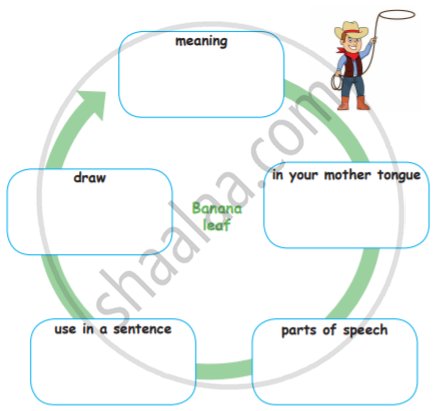
Guess the meaning of the following word.
magnificent
In New York, Mr. Scotti left the plane because he thought he.
What did Granny say about Hamid’s parents?
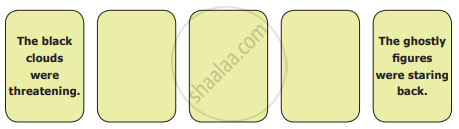
Two scary events from this section are listed here. Write the events that take place in between in the correct order.
What do you infer about speaking with others from this poem?
What challenges does Alice face and how does she overcome them?
Read the following lines and answer the questions.
It’s part of his hours, his days and his years,
Back of his smiles and behind his tears.
What does ‘tears’ mean?
The teacher asked the children to take their seat because______.
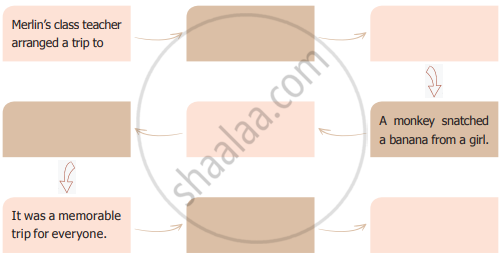
Recall Merlin’s memories and complete the story map.
Find the rhyming word from the poem.
Country - ______.
Vicky’s father decided to change his son’s character.
Try your own.
The pigeon flew away for dry twigs.
Anbu got ______ fish this week.
What were the people excited about?
Who showed love and care to the children?
The sparrow solved the problem with her _____.
When does the world become green?
Does the child in the poem like her nose? Why do you think so?
What did he learn about the birds?
Why is it not advisable to play online games?
Look up the following entries in the Language Study pages given at the end.
- stress
- intonation
- sound
- consonant
- vowel
