Advertisements
Advertisements
प्रश्न
Which language do you use to talk to elderly relatives in your family?
Advertisements
उत्तर
I speak in Hindi to talk to the elderly relatives in my family.
(A model answer has been provided for students' reference. It is strongly recommended that students prepare the answer on their own.)
APPEARS IN
संबंधित प्रश्न
Read the following extract and then do all the activities that follow :
I rain into a stranger as he passed by
“Oh, excuse me please” was my reply.
He said, “please excuse me too; wasn't even watching for you.”
We were very polite, this stranger and I.
We went on out way and we said good-bye.
But at home a different story is told.
How we treat out loved ones, young and old.
Later that day, cooking the evening meal,
My daughter stood beside me very still.
When I turned, I nearly knoked her down.
“Move out of the way,” I said with a frown.
She walked away, her little heart broken.
I didn't realize how harshly I'd spoken.
While I lay awake in bed,
God's still small voice came to me and said,
“While Dealing with a stranger, common courtesy you use,
But children you love, you seem to abuse.”
A1. Order-
The incidents narrated in the extract are arranged in a jumbled manner here, Rearrange them in a proper order as they occur in the extract:
(i) The poet and the stranger went on their way saying good-bye.
(ii) Seeking excuse politely from the stranger, she went her way.
(iii) The poet ran into a stranger on the road.
(iv) The poet yelled at her daughter.
A2. Poetic device:
Make a list of rhyming pairs from the second stanza and note down the rhyme scheme of the same stanza.
A3. Personal Response:
Understanding and politeness are the essentials of out everyday life. Explain your views in brief.
A4. Creativity -
Frame two poetic lines on the following situation using a rhyming pattern with the help of clues given:
“While introducing great personalities, we praise them highly and talk about their qualities, but while speaking
about our friends we may not follow the same trend.”
While introducing great personalities, — a
------------------------------------ — a
But while speaking about our friends, — b
------------------------------------ — b
What do the following utterance indicate?
(i)“I told her, through Daniel ...”
(ii)“It’s a cold,” he said finally through Tsetan.
Discuss the following statement in groups of two pairs, each pair in a group taking opposite points of view.
Reality is what is directly experienced through the senses.
Tick the item that is closest in meaning to the following phrase.
to take issue with
The text is an excerpt from Sesame and Lilies which consists of two essays, primarily, written for delivery as public lectures in 1864. Identify the features that fit the speech mode. Notice the sentence patterns.
Why do you think that the poet has chosen the title ‘Telephone Conversation’? If you were to suggest another title for the poem, what would it be?
Find from the story one word for the following.
the highest-ranking officer in the Municipality of a city/town ______
The writer of the story is William Blake.
The poem expresses feelings of serenity. Pick out expressions from the above poem that express the same.
The drone is given a death sentence because he ______.
Use the letters in the word MATHEMATICIAN to make 4 letters/5 letter and 6 or more letter words, within a time limit fixed by your teacher.
Say WHY. . . . . .
Ramanujan found the number 1729 very interesting.
Read the text and enlist the achievements and honours of Ramanujan, received in England.
Guess the meaning of the following words and phrases:
untold wealth, closest to the Emperor’s heart, grave offence, banish.
Write a short autobiography of any bird or animal of your choice.
Fill in the gap, choosing a word from the bracket to make an appropriate comparison.
(tall / quiet / humble / merry / busy / slippery / fast / sly / slow / big)
as ______ as a fox
Suggest what you would do in the following situation:
Your very close friend has been using a fake social media account to play pranks on others and is not ready to stop in spite of several attempts by you.
Wash your handkerchief clean. Hang it with a peg to dry in the wind. Watch how it flutters.
Antonio’s ships were lost at sea.
How did the students prepare for their stalls/presentations?
What did Mr. Gizare appreciate the most?
Visit a library:
Read the stories of King Arthur and his Knights of the Round Table.
Write the following:
The sights mentioned in the third stanza.
Answer the following question and write in short, why the parody sounds funny.
Is the bee a gentle creature? Is the crocodile gentle?
Complete the following diagram.
Read the following from the Language Study pages:
- adjective clause
- adverb clause
- noun clause
Find one example of each from the passages. (Note the linking word when you do that.)
Fill in the blank choosing the appropriate word/idiom from the lesson.
The ______ solved the mysterious crime.
Write other meaningful words that begin/end with gentle-hearted.
Write other meaningful words that begin/end with anywhere.
List the characters in the play.
Human characters
What does a farmer need most for his fields?
Miranda was brought to the island ____________ years ago.
Look at the following situations the writer was in. He could have avoided the situation and saved himself. Glance through the write up again and comment on what the writer should have done in the following situations.
- Gilson asked the writer to bring a tie.
- On the day of arrival, the writer had no time to think about the tie.
- The writer remembered about the tie when the bus was leaving for the airport.
- The writer walked down in search of the shop.
- The writer rushed out with the tie in a paper bag.
Answer the following question in about 80-120 word.
If you were to live in the Complaining Street, how would you deal with the people who grumble?
Hamid’s granny scolded him for buying iron tongs. Then she understood that Hamid had bought it ______.
What is good or effective communication?
Selvi asked, 'Did they come in an aeroplane?' because she______.
Complete the sentence given below with word/phrase.
The rains came and poured______.
We get water by burning _______.
Vicky pleaded his father to buy a robot.
It keeps the sack in every little______.
Fruits and shadows are free under the _______.
Who is the hero of this story?
The old man put _____ on the mouth of the gourd.
All the children wished to go to the______.
Guess how would the sparrow pull the elephant and the crocodile.
Why relationships are more important than wealth?
The squirrel ran to the _________ tree.
______will often say to be honest.
What will help you say the truth?
Read the passage carefully and answer the following question.
What did the farmer find in the field?
Nithin had many ______toys.
Write the word with same meaning.

chips- ______
Who came to Akbar’s court?
How did the tree help the boy earn money?
Now, read the following passage on “Laughter Therapy” and answer the questions that follow.

- Laughing is an excellent way to reduce stress in our lives; it can help you to cope with and survive a stressful life. Laughter provides full-scale support for your muscles and unleashes a rush of stress-busting endorphins. Since our bodies cannot distinguish between real and fake laughter, anything that makes you giggle will have a positive impact.
- Laughter Therapy aims to get people laughing, in groups and individual sessions and can help reduce stress, make people and employees happier and more committed, as well as improve their interpersonal skills. This laughter comes from the body and not the mind.
- Laughter Yoga (Hasya yoga) is a practice involving prolonged voluntary laughter. It aims to get people laughing in groups. It is practiced in the early mornings in open-parks. It has been made popular as an exercise routine developed by Indian physician Madan Kataria, who writes about the practice in his 2002 book ‘Laugh for no reason'. Laughter Yoga is based on the belief that voluntary laughter provides the same physiological as well as psychological benefits as spontaneous laughter.
- Laughter yoga session may start with gentle warm-up techniques which include stretching, chanting, clapping, eye contact and body movements to help break down inhibitions and encourage a sense of playfulness. Moreover, laughter is the best medicine. Breathing exercises are used to prepare the lungs for laughter followed by a series of laughter exercises that combine a method of acting and visualization techniques. Twenty minutes of laughter is sufficient to augment physiological development.
- A handful of small-scale scientific studies have indicated that laughter yoga has some medically beneficial effects, including cardiovascular health and mood. This therapy has proved to be good for depressed patients. This laughter therapy also plays a crucial role in social bonding.
Answer the following.
a. How does laughter help one to cope with stress?
b. Which word in the text (para 2) means the same as ‘dedicated'?
c. Why do you think voluntary laughter provides the same physiological as well as psychological benefits as spontaneous laughter?
d. ‘Laughter is the best medicine’. Explain.
e. Given below is a set of activities. Which of these are followed in the ‘Laughter Yoga’ technique?
- sitting on the ground with legs crossed
- body movements
- clapping
- closed eyes
- breathing exercises
- chanting
- stretching of arms and legs
- bending backwards
- running/jogging
- eye contact
f. ‘Laughter therapy also plays a crucial role in social bonding’. How?
The passage given below is on Kabbadi. Read the passage and complete the activities that follow.
Kabbadi (கபடி - in Tamil) is a contact team sport that originated in Tamil Nadu, India. It is the national sport of Bangladesh. It is also popular in South Asia and is the state game of the Indian states of Tamil Nadu, Kerala, Andhra Pradesh, Bihar, Haryana, Karnataka, Maharashtra, Punjab, and Telangana.
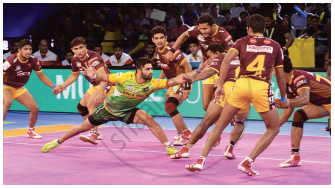
Kabbadi is played between two teams of seven players: the objective of the game is for a single player on offence referred to as a 'raider', to run in to the opposing teams half of a court, tag out as many of their defenders as possible, and return to their own half of the court–all without being tackled by the defenders. Points are scored for each player tagged by the raider, while the opposing team earns a point for stopping the raider. Players are taken out of the game if they are tagged or tackled, but can be 'revived' for each point scored by their team from a tag or tackle. The raider should hold his breath and utter the words like 'kabbadi kabbadi, hututu hututu, chadu kudu' etc. while the opponents try to catch him. If he stops uttering these words, he is considered out.
The game is known by its regional names in different parts of the subcontinent, such as Kabbadi or Chedugudu in Andhra Pradesh, Kabbadi in Kerala and Telangana, Hadudu in Bangladesh, Bhavatik in Maldives, Kauddi or Kabbadi in the Punjab Region, Hu-Tu-Tu in Western India and Hu-Do-Do in Eastern India and Chadakudu in South India. The highest governing body of Kabbadi is the International Kabbadi Federation.
Given below is the visual presentation of the first paragraph.
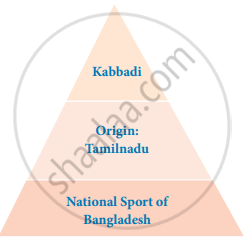
i) Represent the other paragraphs in a visual form of your choice(flow chart, mind-map, pie-chart, etc.).
ii) Choose the correct option.
1. A contact sport usually involves a ______contact between players.
- violent
- gentle
- physical
2. Kabbadi is a game played between ______.
- seven teams of two players
- two teams of seven players
- four teams of seven players
3. A single ______.
- player on offence is referred to as a raider
- offence is referred to as a raider
- raider is an offence by the player
iii) Answer the following.
- How does a raider score points for his team?
- When does a raider concede a point to the opponent team?
- Can a player be revived when he/she is out of the game? Explain your answer.
- Kabbadi is called by different names in different parts of India. Do you know how Pallankuzhi is called in Karnataka, Andhra Pradesh and Kerala?
How can we identify insecure websites?
Read the following passage and do the activities:
A1. Fill in the blanks: (2)
- ______ percent of our daily communication is non-verbal.
- Eye contact is another type of ______ communication.
- Frequent blinking is a sign of the person feeling ______.
- One can readily detect _______.
|
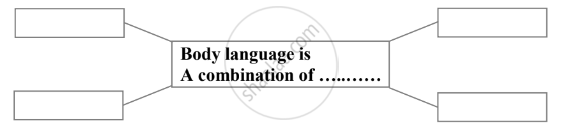
According to some experts, a staggering 93 percent of our daily communication is non-verbal. Facial expressions are easy to decipher. One can readily detect happiness, sadness, anger. Physicians can tell a patient is doing well (or not) by looking at his/her face. Eye contact is another type of non-verbal communication, which can tell a lot about the other person. The eyes convey a range of emotions-happiness, sadness, boredom, surprise, confidence .......... even emotional interest. Staring at someone's forehead may intimidate the recipient, staring at the mouth is sometimes interpretated as a sign of emotional interest. In fact, staring into someone's eyes is a sign of lying, and so is looking away. In certain cultures, lack of eye contact is taken as a sign of respect. If body language is to be defined, it is a combination of facial expression, gestures, eye contact, body movements and posture and voice. Frequent blinking is a sign of the person feeling distressed or uncomfortable. If the pupils are dilated, it ofter indicates interest, even emotional interest. The lips also reflect our body language, and lip biting indicates worry and/or anxiety; tightening of the lips may be an indication of disapproval. Slightly turned-up lips indicate happiness and slightly turned-down lips indicate sadness. |
A2.
A3. Find the antonyms of: (2)
- verbal × ______
- entertaining × ______
- sender × ______
- comfortable × ______
A4. Do as Directed: (2)
- The eyes convey a range of emotions. (Frame a 'Wh' question in order to get the underlined part as answer).
- Physicians can tell about a patient's wellness. (Rewrite using 'able to')
A5. Personal Response: (2)
Non-verbal communication plays an important role in our daily life. Comment.
