Advertisements
Advertisements
प्रश्न
Why do you think that the poet has chosen the title ‘Telephone Conversation’? If you were to suggest another title for the poem, what would it be?
Advertisements
उत्तर
'Different- are We?' could be another suggestion for the title of the poem.
However, the poet has chosen a very appropriate title for the poem - 'Telephonic Conversation'. It refers very aptly to the shallow racism being projected by the conversation between the landlady who is 'white' and the poet who is 'dark'. The telephone symbolises the gap between the two ends of the line, the impossibility for both ends to meet.
APPEARS IN
संबंधित प्रश्न
Answer any three of the following in 30-40 words each:
(a) Why has the poet’s mother been compared to the ‘late winter’s moon’?
(b) The poet says, ‘And yet, for these Children, these windows, not this map, their world.’ Which world do these children belong to? Which world is inaccessible to them?
(c) What was the plea of the folk who had put up the roadside stand?
(d) What will happen to Aunt Jennifer’s tigers when she is dead?
What does the word ‘cardboard’ denote in the poem? Why has this word been used?
|
The energy stored in coal and petroleum originally came to the earth from the sun. The bulk of the present-day supplies was laid down some 200 to 600 million years ago, when tropical conditions were widespread. Lush, swampy forests produced huge trees; warm coastal seas swarmed with microscopic forms of life. When these organisms died, much of their tissue was recycled as it is today — through scavenging and decay. But a significant amount of dead plant and animal material was covered with mud, which prevented complete decomposition. With the passage of time, layer upon layer of the fine sediment was deposited over the once-living material; the sheer weight turned the sediments to rock. Sandwiched between the layers, both coal and petroleum were produced and preserved under pressure. Coal was formed mostly of giant fern-like plants that have only small counterparts today. Coal may still be forming here and there on earth, but conditions are not right for the production of significant quantities. |
Group related points.
You will probably agree that this story does not have breathless adventure and exciting action. Then what in your opinion makes it interesting?
There are intervals of silence in the interaction between the landlady and the prospective tenant. What are the reasons for this?
Find from the story one word for the following.
the highest-ranking official who commands a ship ______
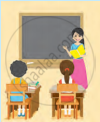
Study the pictures below and note down the differences.

Given below are various professions in column A and in column B, the nature of work in respective professions. Match the columns.
| A | B |
| (i) Anaesthetist | (a) Specialist in the treatment of problems concerning the position of teeth and jaws. |
| (ii) Pharmacist | (b) A person who designs buildings and supervises the process of constructing them. |
| (iii) Orthodentist | (c) A person who is in charge of a newspaper or of a part of a newspaper. |
| (iv) Dermitologist | (d) The medical study of the skin and its diseases. |
| (v) Architect | (e) A person who has been trained to prepare medicines and sell them to the public. |
| (vi) Chartered Accountant | (f) A person whose job is to give drugs which makes the person not feel pain especially in preparation for a medical operation. |
| (vii) Editor | (g) A person who is engaged in the profession of accounting and examining the statements and records of accounts. |
The emperor-bee supervises the building of ______.
Read the following sentence carefully and choose the correct meaning.
Fine feathers don’t make fine birds.
Explain the term plot.
Enlist a few reasons for watching a drama live on the stage.
The characters are a part of the stage setting. How does this reflect when the characters of the play range from the Duke and the Indian boy to the faeries?
Can you imagine life without wheels? Try and think of what life would be like if there were no wheels around.
Present any one of the speeches given above.
Who was Sushruta?
Find the meaning of the following word.
thee
Imagine you are Malti. Write about any one event in the story from Malti’s point of view.
Read: ‘The Listeners’ and ‘Someone’ - poems by Walter de la Mare.
Often the brook speaks of itself as if it is human.
For example, 'I bicker down a valley.'
Find two other examples of the human activities of the brook.
Write in your own words.
Who does the poet invite to join him?
Read: ‘The Psalm of Life’- a poem by H. W. Longfellow.
The table-tennis set was gifted by ______.
Say whether you agree or disagree.
The wolf could not trace Bertha because she was behind a myrtle bush.
What do you notice about the following pairs of words?
- act naturally
- liquid gas
- open secret
- sound of silence
- sweet sorrow
- original copy
- only choice
- growing smaller
Do you know of similar stories in your mother tongue or in other languages? Narrate it in short.
Describe the following in one or two lines.
The world around the bird’s nest.
Listen carefully and write all the words correctly.
You are right. Write it down in the right-hand corner.
Form groups. Discuss how one can be a 'good reader'. Use the points in the above passage in your discussion. Write down the points that show what makes a 'good reader'.
When do the parents feel sorry and become unhappy?
What part did Anne Sullivan play in Helen’s life?
Discuss, why it was considered as an adventurous and dangerous thing to travel in those days?
How did Hamid’s friends show that they enjoyed eating the sweets?
Find a sentence/word from the text which express the following.
Words related to prize.
What did Suresh ask Usha? Why?
What did Usha see while walking to the bazaar?
The wind hurried and passed through the ______
Find out the rhyme scheme employed in the fourth stanza.
Mithali’s mother tongue is Telugu.
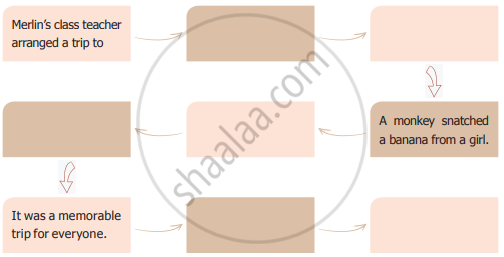
Recall Merlin’s memories and complete the story map.
Work in pair, find answer for the question and share in the class.
Name the seasons mentioned in the poem?
You don’t need ______ and ______ in the Earth.
The girl was badly hurt.
The girl admitted to her brother that she was badly frightened.
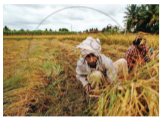
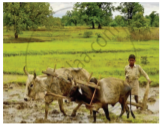
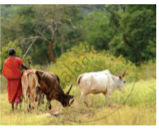
| Mr. Murugan is a farmer. He has a small piece of land and two bulls. He takes good care of his bulls as they help him in farming. Every morning, he takes the bulls for grazing. When it rains he ploughs the land with the bulls. As he has no one to help he starts sowing the seed before sunrise. He irrigates the crop till it grows. He reaps and binds the crop then takes it to thrash the paddy. Finally, with the help of the bulls, he takes the paddy to his house. |
Name the actions of Murugan.
 |
|
 |
|
 |
Where is the key?
Why should we read?
The bird-catcher had a pigeon in his _______.
Meena was transferred to a______.
Try your own.
Where were they going?
Speak and win.
Join in any group. Support or oppose using 4 to 5 sentences to win.
| I support Divya. | I oppose Divya. |
Write the word with same meaning.

chips- ______
Write the word with same meaning.

Torch
What strange things did Alice see?
Although Helen could not hear or see, what kind of girl was she?
Read the passage and write a summary of it. Suggest a suitable title for the summary.
|
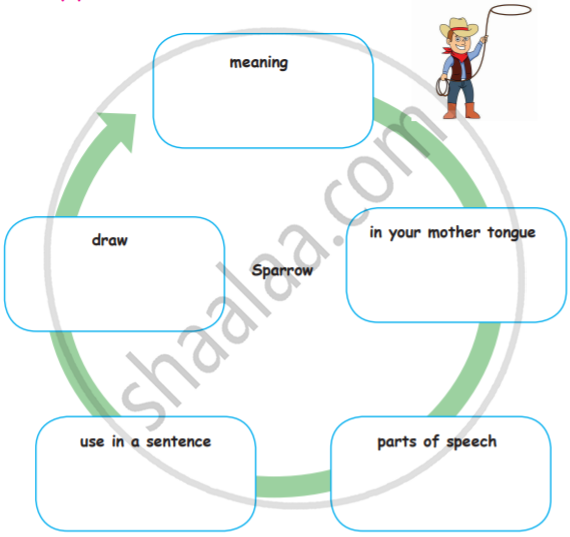
A sparrow is a small bird which is found throughout the world. There are many different species of sparrows. Sparrows are only about four to six inches in length. Many people appreciate their beautiful songs. Sparrows prefer to build their nests in low places-usually on the ground clumps of grass low trees and low bushes. In cities, they build their nests in building nooks or holes. They rarely build their nests in high places. They build their nests out of twigs grasses and plant fibers. Their nests are usually small and well-built structures. Female sparrows lay four to six eggs at a time. The eggs are white with reddish-brown spots. They hatch within eleven to fourteen days. Both the male and female parents care for the young. Insects are fed to the young after hatching. The large feet of the sparrows are used for scratching seeds. Adult sparrows mainly eat seeds. Sparrows can be found almost everywhere where there are humans. Many people throughout the world enjoy these delightful birds. The sparrows are some of the few birds that engage in dust bathing. Sparrows will first scratch a hole in the ground with their feet then lie in it and fling dirt or sand over their bodies with flicks of their wings. They will also bathe in water or in dry or melting snow. Water bathing is similar to dust bathing with the sparrow standing in shallow water and flicking water over its back with its wings also ducking its head under the water. Both activities are social with up to a hundred birds participating at once and are followed by preening and sometimes group singing. |
According to Tagore, when will India get the opportunity to win the gift of freedom?
Write the compound words from the picture.
 |
 |
| ______ | |
Being a bachelor, the stranger had no patience with children.
