Advertisements
Advertisements
प्रश्न
Why do you think that the poet has chosen the title ‘Telephone Conversation’? If you were to suggest another title for the poem, what would it be?
Advertisements
उत्तर
'Different- are We?' could be another suggestion for the title of the poem.
However, the poet has chosen a very appropriate title for the poem - 'Telephonic Conversation'. It refers very aptly to the shallow racism being projected by the conversation between the landlady who is 'white' and the poet who is 'dark'. The telephone symbolises the gap between the two ends of the line, the impossibility for both ends to meet.
APPEARS IN
संबंधित प्रश्न
Answer any four of the following in 30-40 words each:
(a) Why was the peddler amused at the idea of the world being a rattrap?
(b) Why did Gandhiji agree to a settlement of mere 25 percent?
(c) Aunt Jennifer's efforts to get rid of her fear proved to be futile. Comment.
(d) What does Stephen Spender want to be done for the children of the school in a slum?
(e) How did the ten-day-old baby (the future Tiger King) react to the prediction about his future made by the astrologers?
(f) Why was Dr. Sadao not sent abroad along with the troops?
(i) The interest of Maharashtra and that of India should be one for the progress of Maharashtra state, because ................
A1 Web :
Complete the following web with the help of the passage :
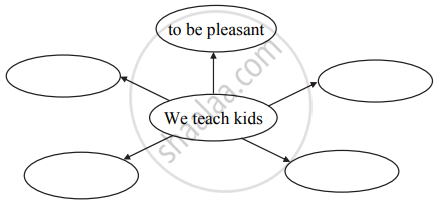
My dictionary tells me that personality is the “Personal or individual quality that makes one person be different and act differently from another.” Personality is, “the total physical, intellectual and emotional structure of an individual, including abilities, interests, and attitudes.”
There are many benefits to having a pleasant personality. There is only one opportunity to make a first impression, and all of us instinctively make decisions or judgments about an individual within the first few seconds of crossing paths. With that in mind, I believe when we teach our kids to smile, to be pleasant and cheerful, to be courteous and respectful of others, to pleasantly respond to requests or questions, we are helping them develop a personality that will open many doors for them. Once the doors are opened, the character will keep them open; but personality, not character, is on display in the first few seconds. Therefore, it’s important to develop a pleasant personality and use it for life.
A2 Personality :
Personality of an individual is recognized by :
(i) _______ (ii) _______
(iii) _______ (iv) _______
A3 Vocabulary :
Find out words for the following from the passage and write:
(i) polite =
(ii) relating to feelings =
(iii) to do anything naturally without thinking =
(iv) a chance to do something =
A4 Complete the following table :
| Noun | Adjective | Adverb |
| – | different | differently |
| Instinct | – | instinctively |
Select any word from the table and use it meaningfully in a sentence of your own.
A5 Personal Response :
Why do you thing, personality development is necessary?
Answer the following in 200-250 words :
Describe Ms. Sullivan's teaching methods?
Answer the following question in 30-40 words:
“The sight of the food maddened him.” What does this suggest? (His First Fight)
Describe the mental condition of the voyagers on 4 and 5 January.
Discuss the following in pairs or in small groups.
Although Paul’s mother liked to be rich she did not approve of betting on horses.
Explain the metaphor in the line: ‘Poets are the mirrors of gigantic shadows that futurity casts on the present’.
'New Literature' is a misnomer for the wealth of the Indian Literary tradition. How does G. N. Devy explain this?
How does 'A Munda song' show that the perspective of the tribal mind towards the girl child is different from that of [other ] mainstream communities?
Many sentences and paragraphs in the excerpt begin with the word ‘And’. To what extent does this contribute to the rhetorical style of the lecture?
Read the following statement and mark those that apply to you.
I have cordial relationships with all but I cannot connect with anyone.
Fill in the blank.
“Hybrids need more _____________”, said Devu Handa.
Discuss with your partner and complete the web, highlighting the sad and gloomy aspects of life mentioned in the first part of the poem.

Fill in the gaps in the table of Degrees of Comparison.
| Positive | Comparative | Superlative | |
| (1) | ____________ | ____________ | oldest |
| (2) | ____________ | healthier | ____________ |
| (3) | near | ____________ | ____________ |
| (4) | ____________ | finer | ____________ |
| (5) | ____________ | ____________ | earliest |
| (6) | small | ____________ | ____________ |
| (7) | ____________ | faster | ____________ |
| (8) | high | ____________ | ____________ |
Read the passage and answer the following question:
Who designed the PVC medal?
Comment on the given statement after reading the given dialogue -
And if we get him itself, nothing but abuse on our heads for it from the people, and maybe from our own relations -
you may begin like this
We do not think about society at large _________________________________________________.
The characters are a part of the stage setting. How does this reflect when the characters of the play range from the Duke and the Indian boy to the faeries?
List five questions from the play which can be answered with 'yes' or 'no'.
List the names of body parts used in the passage.
Answer in your own words.
What did the ancestor from 1910 wish to do instead of making his bed?
Find the names of the exotic musical instruments and animals mentioned in the poem.
Form groups of 5-8. This passage tells us only what the compère says. Try to visualize and write what the other people on the dais must have said in their speeches (Write only the main points.)
- The School Principal
- The Chief Guest
- The Art teacher who offered a vote of thanks
From any collection of classic poetry or the internet, find another famous poem by Robert Frost titled ‘Stopping by the Woods on a Snowy Evening’. Try to understand the symbolism used in that poem in 8-10 lines.
Write other meaningful words that begin/end with springtime.
In what way can we help to reduce or minimize waste generation?
Discuss the issue in groups of 4 or 5 and note down all good suggestions.
Resolve to follow them yourself. Some have been given below for your reference.
- Don’t waste food.
- Take as much as you want but finish everything that’s on your plate.
- Don’t throw away broken or half-used things. Repair them and use them.
- Avoid things which can be used only once.
For example: thermocol (polysterene) cups, plastic glasses, etc. - Reuse!
- Recycle!
Write in short how the travellers crossed the first ditch.
How do we come to know that Kasim was a generous man?
Show the major events in the story of Pheidippides on a ‘time-line’.
Would you like to be a netizen?
Answer the following question in about 80 – 100 word.
Describe the journey of life as depicted in the poem by Henry Van Dyke.
Where was the author when he heard the noise?
What story did grandfather tell them about the haunted hill?
How should you speak with old people?
How does Alice feel after all these changes?
He exercised with Louise every day.
Did he hire Kiouni? Why?
What qualities of Mr. Phileas Fogg are highlighted in this extract? Support your answer with suitable examples.
What did Amma mean when she said tomatoes, ladies' fingers and corn came from other countries?
Raj did not buy______.
Describe Gulliver’s encounter with the army of Blefuscu.
Read the lines and answer the questions given below.
Spring is pretty
but short and sweet
when you can smell the grass
from your garden seat
- How does the poet describe the spring season?
- Which line tells you that the garden is fresh?
- Who does ‘you’ refer to?
Name the planets the poet flies through.
What is Amar Jawan Jyoti?
Which place was the last stand of the Indian army?
Pick out the rhyming words from the poem and write.
| Mars | |
| time | |
| be |
The brown sparrow laid ________eggs.
______always stays to the last in our needs.
Where were they going?
Jana and her family moved to the village _______ ago.
What should we vow for?
Secondly the greedy merchant is ready to offer______.
Why did the greedy merchant get angry?
Choose the word with same meaning.
Kingdom- ______
Match with the opposite gender.
| 1. | prince | bridegroom |
| 2. | hero | princess |
| 3. | bride | heroine |
Which creatures wake up in the morning before the child does?
What did he learn about the birds?
When should we not water the plants?
Why did he go there?
