Advertisements
Advertisements
प्रश्न
Why did the narrator of the story want to forget the address?
Advertisements
उत्तर
The narrator went to the house of the lady who had kept many valuable items of her mother during the war days. The address of the lady helped her in searching out the house of the lady. But now she wanted to forget the address as after visiting the house of the lady she found how the belongings of her mother were kept in a strange manner. These had lost all their emotional value for the narrator. The narrator now lived in a small rented room. She had no place to keep all these things. The lady treated her very insolently. She even refused to recognise her. She did not let her come into the house. That was why she wanted to forget that address.
APPEARS IN
संबंधित प्रश्न
Answer any three of the following in 30-40 words each:
(a) Why has the poet’s mother been compared to the ‘late winter’s moon’?
(b) The poet says, ‘And yet, for these Children, these windows, not this map, their world.’ Which world do these children belong to? Which world is inaccessible to them?
(c) What was the plea of the folk who had put up the roadside stand?
(d) What will happen to Aunt Jennifer’s tigers when she is dead?
Briefly comment on:
“As a Buddhist, he told me, he knew that it didn’t really matter if I passed away, but he thought it would be bad for business.”
Identify the common characteristics shared by tribal communities all over the world.
How does Forster use the analogy of Scheherazade to establish his point ?
How does the nightingale's song plunge the poet into a state of ecstasy?
Which two sayings about God are conveyed through the poem 'The Plate of Gold'?
- God helps those, who help themselves.
- God loves those, who love their fellow beings.
- God loves those, who give away their wealth, to please Him.
- Service to mankind is service to God.
When a poet/writer attempts to describe something in words, so that it appeals to our five senses (sight, smell, hearing, touch, taste) he/she has used a device called Imagery.
For example: ‘a host of golden daffodils’.
‘to a chasm, deep and vast and wide’.
Go through other poems in your textbook or other books and find outlines that contain Imagery. Write them down along with the name of the poem and line/stanza number.
Read the lesson and name the following.
The First successful Cardiac Surgeon ______
Proverbs associated with the word season: for eg: Make hay while the sun shines.
- _________________________
- _________________________
Form pairs and decide whether the following statements are those of a Great Indian Bustard or not.
| Statements | Great Indian Bustard | Some Other Bird |
| (a) I am the heaviest flying bird in India. | ||
| (b) I am known as Maldhok or Hoom in Marathi. | ||
| (c) I live in mountainous regions. | ||
| (d) I don’t like grasshoppers or beetles. | ||
| (e) We don’t believe in building nests. | ||
| (f) Our chick stays with the mother for a period of nearly one year. | ||
| (g) I am the State bird of Maharashtra. | ||
| (h) We have been pushed away from more than 90 percent of our home regions. |
Find one more example which shows that a beautiful appearance is not enough.
Form groups and discuss what must have happened to the handkerchief. Write the story in your own words.
Define drama.
There are some dialogues that are short, but quite effective. They give us enjoyment and add beauty to the main story. Find some more from the text.
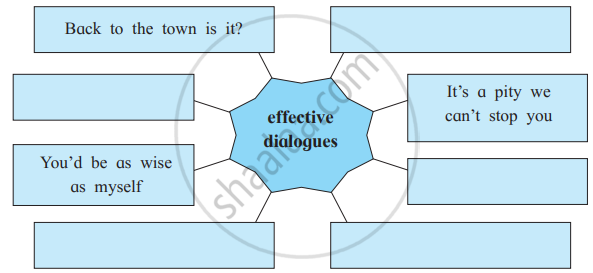
Comment on the given statement after reading the given dialogue -
I wouldn’t be in your shoes if he rewards me ten times as much. People generally fall victim to incentives. Some people stick to values. They _________________.
The description of the character is given below. Identify the character from the play. Find some sentences which support your choice.
He is smart as well as brave.
Form groups and hold debates on the following topics. Make bulleted lists of points in favour of the topic (pros) and those against it (cons). (3-6 points each)
You should admit your mistakes.
Write about the various wheel-like objects you see at home, in school, and on the road.
Choose any one of the seven States. Find more information about it and prepare a leaflet or brochure to invite people to visit it.
Write a short note on the following:
Care of animals in the regime of Emperor Ashoka
Bassanio borrowed money from Shylock in Antonio’s name.
Read: ‘Last Chance to See’ by Douglas Adams and Mark Carwardine.
Read the passage and name the following.
He persuaded Helen to elope with him.
Think and answer:
Does the last line make you happy or sad? Why?
Think of a play/skit which you have seen enacted on the stage and which has impressed you. Write the following details about it.
| Name of the play/skit: | ______________ |
| Important characters: | ______________ |
| Any famous actors/actresses: | ______________ |
| Theme: | ______________ |
| Climax: | ______________ |
| Ending: | ______________ |
| Use of lights and special effects if any: | ______________ |
| Use of background music and sound effects if any: | ______________ |
| Use of sets: | ______________ |
| The costumes, make up, etc. of the characters: | ______________ |
| How well the actors present the play and behave on the stage: | ______________ |
| Your own opinion about the play: | ______________ |
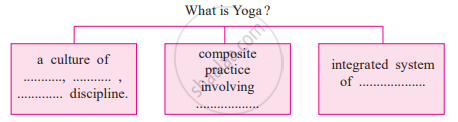
Complete the following diagram.
Pick out the line that means:
Sing in such a manner:
Say whether you agree or disagree.
The children showed disinterest even in the bachelor’s story-telling, throughout.
Read: ‘The Open Window’ by H. H. Munro (Saki).
What did Gopal Bhand say he was doing?
List and say whether the following statement agrees with the passage or not.
In a discussion, you should share your ideas with others.
Write other meaningful words that begin/end with stepmother.
Which event in the story tells us that the scarecrow was intelligent?
Give an instance that shows the pathetic condition of the young bird.
Read the following passage and answer the questions that follow.
BUNGEE-JUMPING
Bungee jumping is an activity that involves jumping from a tall structure while connected to a long elastic cord. The tall structure is usually a fixed object, such as a building, bridge or crane; but it is also possible to jump from a movable object, such as a hot-air-balloon or helicopter, that has the ability to hover above the ground. The thrill comes from the freefalling and the rebound. When the person jumps, the cord stretches, and the jumper flies upwards again as the cord recoils and continues to oscillate up and down until all the kinetic energy is dissipated.
Jumping Heights, located in Mohan Chatti village, in Rishikesh has been rated as one of the most preferred bungee jumping destinations in India at a height of 83 meters. It is the only place in India where bungee jumping can be done from a fixed platform. This is also India’s only fixed platform Bungee- performed from a professional cantilever, to separate it from entertainment parks, and create instead, an extreme adventure zone. The Bungee has been designed by David Allardice of New Zealand.
The Cantilever platform is built over a rocky cliff over-looking the river Hall, a tributary of River Ganges. Bungee-ing amidst the vastness of nature lends the experience an absolutely breathtaking quality. Jumping heights is well known for its safety measures and experienced staff. It costs around Rs 2500 per jump, a bit expensive, but totally worth the experience. The Bungee jumping experience has been set amidst the astoundingly stunning landscape of Rishikesh. To Bungee jump, one must be at least 12 years and should weigh between 40-110 kg.
Questions
- What is Bungee Jumping?
- Can Bungee be performed from a movable object? How?
- When do you think Bungee becomes thrilling?
- What is the experience when one falls off the platform?
- Where is the Bungee jumping point located in India?
- What is the minimum age to Bungee jump?
Look at the following situations the writer was in. He could have avoided the situation and saved himself. Glance through the write up again and comment on what the writer should have done in the following situations.
- Gilson asked the writer to bring a tie.
- On the day of arrival, the writer had no time to think about the tie.
- The writer remembered about the tie when the bus was leaving for the airport.
- The writer walked down in search of the shop.
- The writer rushed out with the tie in a paper bag.
Read the lines and answer the questions.
They are of all forms and shapes
They all have an excellent ending
What do have an excellent ending?
Read these lines and answer the questions given below.
Our lays are of cities whose lustre is shed,
Here ‘Lays’ means______
Rearrange the following jumbled sentences in the correct order.
- Payal’s house was a home for abandoned animals.
- It was a small ball of brown and grey.
- She found an owlet in one corner.
- Payal’s mother picked her up gently.
- Payal’s mother opened the carton.
- One day they got a carton.
What does the tamarind give?
When did Usha Rani start playing Kabaddi?
Geetha madam couldn’t stop the children running out of the train because they ______.
We do not really see the landscape from a normal train because the______.
It ploughs soil before _________.
Jaswant was captured alive.
Vicky pleaded his father to buy a robot.
What did the hen-pigeon whisper?
The old man is _____.
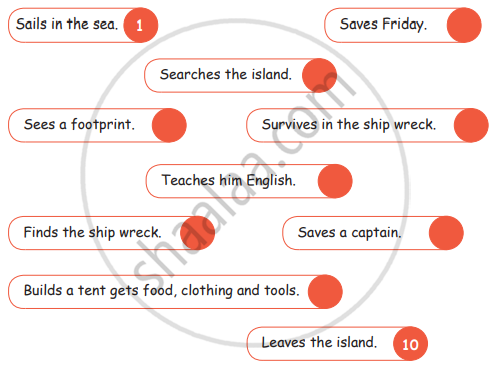
Arrange the actions of Robinson by numbering from 1 to 10.
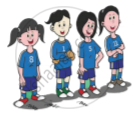
Write the events won by these players.
 |
______ |
 |
______ |
 |
______ |
Match the following.
| 1. | Pablo | Inspector |
| 2. | Velayudham | old man |
| 3. | Sreejith | dog |
Fill in the blank
He is rich ______ he looks simple.
Guess how would the sparrow pull the elephant and the crocodile.
______ lies stretching in the river.
What was the reason behind Nandhini’s dullness?
Leafcutter ants can carry leaves that weigh ______ times of their body weight.
At the end of the festival , Kamali and Senthil saved______.
What does Amma often say?
Why was Chris worried?
