Advertisements
Advertisements
प्रश्न
'The Address' is a story of human predicament that follows war. Comment
Advertisements
उत्तर
The phenomenon of war brings lot of suffering for human beings. It brings with it death and destruction. It kills the feelings of love and sympathy. The story Address is based on this theme. The narrator's mother leaves all her valuable things with an acquintance during the war. The mother dies and many years later, the narrator comes to the woman to have a look at her mother's belongings. But the woman shows no human feelings towards her. Rather, she behaves in a very hard hearted manner. She doesnot even let the narrator come in and sit a while. She closes the door. Thus, we find that war leaves the world desolate not only on the physical level but also on the emotional and spiritual level.
APPEARS IN
संबंधित प्रश्न
Answer any four of the following in 30-40 words each:
(a) Why was the peddler amused at the idea of the world being a rattrap?
(b) Why did Gandhiji agree to a settlement of mere 25 percent?
(c) Aunt Jennifer's efforts to get rid of her fear proved to be futile. Comment.
(d) What does Stephen Spender want to be done for the children of the school in a slum?
(e) How did the ten-day-old baby (the future Tiger King) react to the prediction about his future made by the astrologers?
(f) Why was Dr. Sadao not sent abroad along with the troops?
Read the following passage carefully and do the given activities:
A.1) True or False:
Write the statements and state whether they are true or false:
(i) Those who choose to live well must help others.
(ii) If neighbors grow inferior corn, cross-pollination will steadily improve the quality.
(iii) The farmer grew award-winning corn.
(iv) The reporter discovered that the farmer didn’t share his seed corn with his neighbors.
There once was a farmer who grew award-winning corn. Each year he entered his corn in the state fair where it won a blue ribbon. One year a newspaper reporter interviewed him and learned something interesting about how he grew it. The reporter discovered that the farmer shared his sweet corn with his neighbors. “How can you afford to share your best seed corn with your neighbors when they are entering corn in competition with yours each year?” the reporter asked.
“Why sir”, said the farmer, “didn’t you know? The wind picks up pollen from the ripening corn and swirls it from field to field. If my neighbors grow inferior corn, cross-pollination will steadily degrade the quality of my corn. If I am to grow good corn, I must help my neighbors grow good corn.” He is very much aware of the connectedness of life. His corn cannot improve unless his neighbor's corn also improves. So it is with our lives. Those who choose to live in peace must help their neighbors to live in peace. Those who choose to live well must help others to live well, for the value of a life is measured by the lives it touches.
The lesson for each of us is this: if we are to grow good corn, we must help our neighbors grow good corn.
A.2) Consequences:
Write the consequences:
(i) The farmer shares the corn.
(ii) The farmer doesn’t share the corn.
A.3) Antonyms:
Find out the words opposite in meaning from the passage:
(i) superior x _______
(ii) lost x _______
(iii) improve x _______
(iv) inconstantly x _______
A.4) Language study:
(i) We must help our neighbors. (Replace the modal auxiliary showing advice).
(ii) The wind picks up pollen from ripening corn and swirls it field to field. (Use “not only…….. but also” and rewrite)
A.5) Personal Response:
What do you learn from the story? Suggest a suitable title.
Complete the call-outs:
A.1)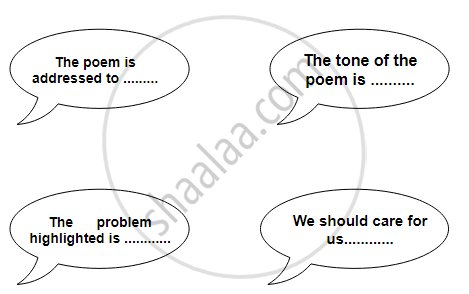
Our world is an institution
Of environmental pollution
We choose not to care
For our future generations
And I for one am guilty
For buying the hundreds of electronic gadgets
That attracts the industries to produce like maggots
environmental pollution is at the heart of our planet
The forests are dying
Wildlife is crying
Millions of fish are dying
Mother earth is sighing
Tell me is it right
That we sleep well at night
Replenishing ourselves
For tomorrow’s greedy fight
Overcrowded trains
Overloaded brains
Where is the light? What is our plight?
While the river break their banks
And greedy industries play their polluted pranks.
A.2) Find the examples that show that we do not care for our future generation
A.3) Match:
Match the lines in Column ‘A’ with the figures of speech in Column ‘B’:
| Column ‘A’ | Column ‘B’ | ||
| (i) | Our world is an institution | (a) | Personification |
| (ii) | Mother earth is sighing | (b) | Simile |
| (c) | Metaphor |
Answer the following question in 200-250 words:
"The best and most beautiful things in the world can't be seen or even touched. They must be felt with the heart." Justify the famous quote of Helen Keller.
Mention three reasons why the author’s grandmother was disturbed when he started going to the city school.
Identify the phrases and lines that indicate distance between father and son.
List the steps taken by the captain
(i) to protect the ship when rough weather began.
(ii) to check the flooding of the water in the ship.
Why did the narrator of the story want to forget the address?
How does G. N. Devy bring out the importance of the oral literary tradition?
Read the extract 'Being Neighborly' and complete the following statement:
Jo entered the old stone house carrying _______________.
Answer in your own words.
Why did the old man have no need to build the bridge, across the chasm?
Make a list of the preparations made for an assault on Tiger Hill.
Throughout the last week of June 1999, 18 Grenadiers ____________.
Find proof from the poem for the following.
The struggle of the cherry tree for survival.
The cherry tree has inspired the poet to compose the poem. Such poems, describing Nature or aspects of Nature are called ‘Nature poems’. Find out some expressions from the poem that bring out the elements of the beauty of Nature.
Which two sayings about God are conveyed through the poem 'The Plate of Gold'?
- God helps those, who help themselves.
- God loves those, who love their fellow beings.
- God loves those, who give away their wealth, to please Him.
- Service to mankind is service to God.
Correct the following statement.
The last leaf was a real leaf that survived.
The poem is a Petrarchan Sonnet. The poem is divided into two parts -
- An Octave
The first part comprising eight lines. - A sestet
The second part comprising six lines.
Read the first four lines of the poem. The rhyme scheme is a b b a. Read the rhyme scheme for the next four lines. It is a b b a. Now read the first three lines of the sestet and note the rhyme scheme. It is c d c. The rhyme scheme of the last three lines is d c d. This is the common design of a Petrarchan Sonnet.
This is a Petrarchan Sonnet. Complete the given table by giving examples from the poem.
| Features | Examples / Lines |
| Objects used | |
| Praise/blames | |
| Metaphor | |
| Simile | |
| Personification | |
| Number of lines | |
| Rhyme scheme |
Form pairs and decide whether the following statements are those of a Great Indian Bustard or not.
| Statements | Great Indian Bustard | Some Other Bird |
| (a) I am the heaviest flying bird in India. | ||
| (b) I am known as Maldhok or Hoom in Marathi. | ||
| (c) I live in mountainous regions. | ||
| (d) I don’t like grasshoppers or beetles. | ||
| (e) We don’t believe in building nests. | ||
| (f) Our chick stays with the mother for a period of nearly one year. | ||
| (g) I am the State bird of Maharashtra. | ||
| (h) We have been pushed away from more than 90 percent of our home regions. |
Read and prepare a small presentation in about 100 to 150 words on the ideas of any two philosophers given below.
- Sant Dnyaneshwar
- Gautam Buddha
- Aurobindo Ghosh
- Kahlil Gibran
- Socrates.
Compare the features of a comedy and tragedy.
State the difference between poetry and drama.
Find out the different processes by which fabrics are made. Find illustrations and write a few lines on each process.
Find sentences from the play related to the given points.
Loyalty in Irish Nationalism:
- Maybe Sergeant you’ll be on the side of the country yet.
- ____________________________
- ____________________________
- ____________________________
Discuss and write 1-2 lines about the following,
Why Bushi told Yonamine not to travel at night.
Form pairs. Discuss and prepare a list of things that can be and will be done in future. (5 things) Spot the modal verbs in your answer.
Write a short note on the following:
Care of animals in the regime of Emperor Ashoka
An activity:
Speak fast, think faster! Form groups of 4-6. Discuss each of the following topics. Then each person in the group should choose a topic and speak about it for one minute. Try to say as many sentences as you can in that time
What is not likely to happen or will never happen...
‘It won’t rain in the classroom... I won’t ever see a live dinosaur... The sun will never set in the east...’ etc.
Write all the instances of the mischief done by Mr. Nobody.
List the various things that the Lethargarians do or want to do. Can you sum up all of it in one word or phrase?
How do you behave with your classmates? Write about your attitude and behaviour in the appropriate column.
Some actions:
- Ask others for help
- Refuse help
- Judge others by their appearance
- Judge others by their accent
| Always | Sometimes | Never |
| ____________ | ____________ | ____________ |
| ____________ | ____________ | ____________ |
| ____________ | ____________ | ____________ |
Prepare similar word chains using the following ideas.
waterbody - pool ____________.
Choose the appropriate phrase to insert in the gap, to make the sentence meaningful. Use the appropriate form of the verb.
The minister ______ his personal body-guards.
The poet uses words to create pictures or 'images' in the reader’s mind. For example, 'And sparkle out among the fern.'
Write down other lines that create images or pictures in your mind. (Any 3)
Write in your own words.
In which professions is a person forced to stay away from his home/ homeland for a long time? Try to guess why the poet is forced to stay away from his home?
Correct the following sentence and rewrite it.
Jesus had actually visited Papa Panov only once on Christmas Eve.
Listen carefully and guess how the sentence would end.
When the teacher read the answer papers, she was ______.
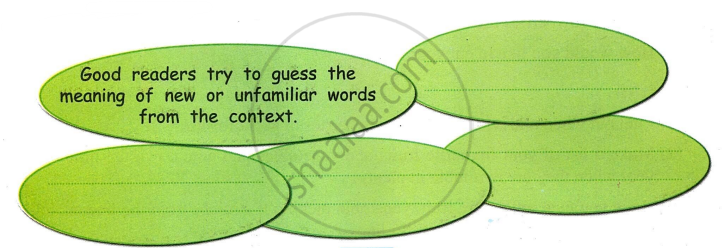
Form groups. Discuss how one can be a 'good reader'. Use the points in the above passage in your discussion. Write down the points that show what makes a 'good reader'.
Who was the first person to withdraw cash from the ATM?
Read the comic strip and answer the following question.
Which website do you often access? Why?
They may have______ in______.
- soft
- vain
- fear
- joy
- love
- heard
- toiled
- mild
- good
- sand
- life
- harsh
Read these lines and answer the question given below.
The laughter and beauty of women long dead;
Explain the meaning of the above line.
Describe what the author saw when he went back to the island.
What is the difference between this toy train and a normal train?
Complete the sentence given below with word/phrase.
The buffalo ______ in the hole.
Name the planets the poet flies through.
We don’t use _________ in the soil.
Why don’t we use chemicals?
Arrange the pictures by using numbers.

Choose the correct option from the given homophones.
You should never ______ to your parents.
Write the rhyming word.
face - ______.
Mother nature gives everything for all ______.
_______ is our culture.
How will you treat your guest?
They use ______ as bait.
Who is the hero of this story?
Choose the correct answer.

Where did Kani see the old cracked cup?
What will help you say the truth?
Read the passage 3 times and colour the medal each time.
The school was decorated for the Annual Sports Day. The children came to the running track to cheer the runners. The next event was 800 meters running. Megala was in the race. She wanted to win the race, but the other runners were district and divisional winners. The race started. All had to finish two laps. At the end of the first lap, Megala was in the fifth place. Suddenly, she fell on the ground. Everyone ran to help her. But before that she got up and started to run. All children and teachers cheered her. She had come last, but the headmaster gave her a special prize.

When should we not water the plants?
