मराठी
तामिळनाडू बोर्ड ऑफ सेकेंडरी एज्युकेशनएस.एस.एल.सी. (इंग्रजी माध्यम) इयत्ता ७

Identify the character/speaker. One side makes you big, the other side makes you small. - English

Advertisements
Advertisements

प्रश्न

Identify the character/speaker.

One side makes you big, the other side makes you small.

एक शब्द/वाक्यांश उत्तर
Advertisements

उत्तर

One side makes you big, the other side makes you small- Green Caterpillar

shaalaa.com
Reading Skills
  या प्रश्नात किंवा उत्तरात काही त्रुटी आहे का?
पाठ 1.3: Alice in Wonderland - Read and Understand [पृष्ठ १०९]

APPEARS IN

सामाचीर कलवी English - Term 2 Class 7 TN Board
पाठ 1.3 Alice in Wonderland
Read and Understand | Q A. 4. | पृष्ठ १०९

संबंधित प्रश्‍न

Read the following passage and do the activities: 
B1  Match: 
Match the areas given in Column ‘A’ with the description of Mehendi design given in Column ‘B’: 

  'A'   'B"
(i) North African (a) A mix of Indo-Pakistani and Arabic design 
(ii) Indian  (b) Delicate loops and curves, paisleys, teardrops
(iii) Arabic  (c) Geometrical images
(iv) South Asian  (d) Local textiles, paintings, and architecture


Henna comes from the leaves of the plant Lawsonia inertias. The plant grows in hot and dry climes and is native to North Africa, the Indian subcontinent and the Middle East. The leaves of the plant are dried and crushed to powder. Various additives such as coffee decoction, tea, lime juice, Mehendi and eucalyptus oil are mixed with the henna powder to increase the potency of the dry, this also helps to bind the powder to a paste-like consistency. The mixture is applied through cones in intricate patterns depending on the region of use.
 Album of Patterns
 Four major styles can be found in the vast dictionary of Mehendi designs. Earlier the application was restricted to hand and feet, but the adoption of Mehendi by different cultures throughout the world has seen experimentation on different body parts including the neck naval and back.
 North African patterns rely on geometrical images to trace the shape of hands and feet, Arabic designs borrow heavily from local textiles, paintings, and architecture. These are more spaced out, to allow the design to stand out boldly from the skin parts left untouched by henna. The Indian style comprises of delicate loops and curves, paisleys, teardrops and flowers that give a dainty filigreed glow-like effect. Though intricate patterning is the name of the game today, this trend took off in India only during the 20th century. The patterns preferred by the South Asian countries are mixed with Indo-Pakistani and Arabic design schemes. Chinese and Celtic symbols now find a place in the vast repertoire of Mehendi designs as well. 

B2  Complete:
Complete the following and write:
(i) The procedure before applying henna _______
(ii) The reasons for using additives _______
(iii) The suitable climatic conditions for the henna plant _______
(iv) Mehendi is used on _______

B3  Find words:
Look at the following description and find out proper words from the passage and write:
(i) Existing naturally in the place : - n _______
(ii) Consist of something: - c _______
(iii) Delicate decoration made from gold, silver and copper wire: - f _______
(iv) Substance that is added in small quantity : - a _______ 

B4  Language study:
Fill in the blanks with suitable subordinators given in the box:

as well as, so that, however, which

(i) The mixture is applied through cones in intricate patterns _______ depend on the region of use.
(ii)
The intricate pattern is the name of the game of today _______, this trend took off in India, recently.
(iii)
North African pattern relies on geometrical images ______ they can trace the shape of hands and feet.
(iv)
The patterns preferred by the South Asian countries are mixed with Indo-Pakistani _______ Arabic design schemes. 

B5  Personal Response:
Which Mehendi design do you like? Why?


Does the poem talk of an exclusively personal experience or is it fairly universal?


Give reasons for the following statement.
Tibetan mastiffs were popular in China’s imperial courts.


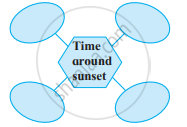
Think, choose and fill up the labels with what a 'sunrise' symbolizes.

(jewellery / art / hope / birth / anger / new opportunities / good manners / inspiration / new achievements / happiness / misery / bright moments / new aims / money / new surprises)


An activity:
Speak fast, think faster! Form groups of 4-6. Discuss each of the following topics. Then each person in the group should choose a topic and speak about it for one minute. Try to say as many sentences as you can in that time

What is not likely to happen or will never happen...

‘It won’t rain in the classroom... I won’t ever see a live dinosaur... The sun will never set in the east...’ etc.


Read the passage. Underline the new words. Guess their meaning from the context. Verify it from a good dictionary.


Write what the poet is doing. 
Does the poet like the experience? 
Write the line which tells us about it.


Rearrange the jumbled sentences and write them in the correct order.

  • But Hamid bought a pair of tongs.
  • Granny Ameena felt proud of her grandson.
  • Hamid’s friends bought different toys of their choice.
  • Hamid proudly compared his tongs with a brave tiger.
  • Hamid had less money than his friends.
  • Granny Ameena was worried as he had to go to the Eidgah alone.

Look at the picture and Choose the correct word.


Who brought us to this world?


Share
Notifications

Englishहिंदीमराठी


      Forgot password?
Use app×