'The Address' is a story of human predicament that follows war. Comment
Advertisements
Question
'The Address' is a story of human predicament that follows war. Comment
Advertisements
Solution
The phenomenon of war brings lot of suffering for human beings. It brings with it death and destruction. It kills the feelings of love and sympathy. The story Address is based on this theme. The narrator's mother leaves all her valuable things with an acquintance during the war. The mother dies and many years later, the narrator comes to the woman to have a look at her mother's belongings. But the woman shows no human feelings towards her. Rather, she behaves in a very hard hearted manner. She doesnot even let the narrator come in and sit a while. She closes the door. Thus, we find that war leaves the world desolate not only on the physical level but also on the emotional and spiritual level.
APPEARS IN
RELATED QUESTIONS
Helen's statement, "We worked hard and faithfully, yet we did not quite reach our goal" tells us about her failure to achieve the goal at the Wright-Humason School in New York City. What was the goal that she failed to achieve there?
Answer the following question in 120-150 words:
What kind of life did Silas lead at Lantern Yard?
Answer any three of the following in 30-40 words each:
(a) Why has the poet’s mother been compared to the ‘late winter’s moon’?
(b) The poet says, ‘And yet, for these Children, these windows, not this map, their world.’ Which world do these children belong to? Which world is inaccessible to them?
(c) What was the plea of the folk who had put up the roadside stand?
(d) What will happen to Aunt Jennifer’s tigers when she is dead?
Briefly explain the following statement from the text.
“You need some interaction to cause a transition.”
How is humour employed to comment on the pains that the author took to get his watch set right.
What is the central argument of the speaker?
'New Literature' is a misnomer for the wealth of the Indian Literary tradition. How does G. N. Devy explain this?
In English, the peacock is associated with pride. ‘As proud as a peacock’ is a commonly used simile. With what qualities is the peacock associated with the literature of your language?
What were the concepts that Kumudini Lakhia represent through Duvidha, Atah Kim and panch Paras?
Think and answer in your own words in your notebook.
Does the poem urge us to protect only worms? What is the general message conveyed through this poem?
Read other poems by Leigh Hunt, especially 'Abou Ben Adhem'.
Compare the messages in that poem with those in 'The Plate of Gold'. What do you observe?
Behrman was a hard-hearted person.
Think and answer in your own words.
'Beauty' in stanza 5 to 6 can refer to a beautiful maiden as well as nature itself. Explain when and how nature ‘dances’ and also 'smiles'.
Pick out three lines that create an image in your mind of bees busy at work.
Refer to a good dictionary that carries phonetic transcriptions printed next to words. The word below is familiar to you. Copy the phonetic transcription from the dictionary and say it aloud as you write.
work ........
Say WHY. . . . . .
Hardy invited Littlewood for a discussion.
Answer the following question in short.
Why did Pundit Shahane visit Vijaynagar?
Select the correct options :
A Midsummer-Night’s Dream is a ___________________.
- poetic drama
- comedy of errors
- a comedy based on fantasy
- a character play
- a revenge tragedy
- belongs to realm of dreams
Answer the following question in one sentence.
What does the title of the poem say?
Answer the following question in one sentence.
What would he do if he had the power to do it?
The wheel, which was probably invented more than 6000 years ago, is thought of as one of the greatest technological advances made by man. Why do you think the wheel is so important in human civilization?
Draw word webs for the following. Begin with the given word and go on writing as many other words associated with it, as you can. Use these words to write other related words to form a word web.

Read each invitation carefully, keeping in mind the list of eight questions given below. Note the answers in your notebook. Verify that the formal invitation ‘A’ covers all the eight points. Now see which of these eight points are covered in the other invitations ‘B’, ‘C’ and ‘D’. Put tickmarks against the points that are covered.
- A formal invitation
- An oral invitation
- A notice
- Another oral invitation
- Who is sending/giving the information?
- What is the programme?
- What is the name of the project?
- Who will inaugurate it?
- Who will preside over the function?
- What time will the function start?
- Where will it take place?
- How many names get mentioned in the invitation?
| Points | A | B | C | D |
| (1) | ✓ | |||
| (2) | ✓ | |||
| (3) | ✓ | |||
| (4) | ✓ | |||
| (5) | ✓ | |||
| (6) | ✓ | |||
| (7) | ✓ | |||
| (8) | 6 |
Complete the following sentence with reference to the passage.
At the back rose the high peak of Mount Ida, from which _______________.
Write about how you take care of your books.
Describe a crocodile in your own words.
Answer in your own words.
What did Neel realise from his encounter with his ancestors?
Rewrite in your own words.
One event from the story.
Read the poem and answer the following.
What are the two different ways of eating strawberries?
Guess the meaning of the following word.
barefoot
Find out how the following game is played.
Badminton
If you were to grow very tiny like a Lilliputian, what are the things you would like to do? Write about any three of these things.
- Form groups of 5–8. Then make pairs of groups. Decide which group will be hosts and which will be guests. Arrange mock parties in the classroom so that the roles of hosts and guests can actually be played out.
- Later on, hold groupwise discussions on how your party went. Make lists of the tips you followed and those you forgot to follow.
What does 'Rangaawali' mean?
What is used to make Rangoli designs?
Do you think that the young seagull’s parents were harsh to him? Why?
____________ had provided Prospero formerly with books and provisions.
Identify the character or speaker.
I was Duke of Milan, and you were a princess.
What was the grandfather wearing?
Why did the governments of India, America and Pakistan – honour Neerja?
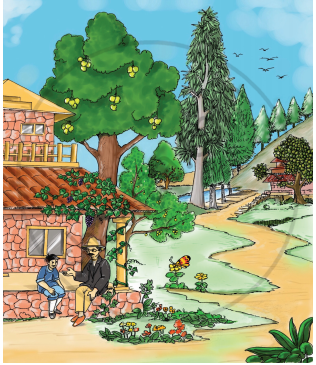
Listen to your teacher read the first part of the story. Many things described in the story can be seen in the picture. Find and name them.
Why did the girl scream?
Which planet has rings around it?
______is a Do It Yourself kid.
Recite the poem ‘Mother Nature’.
Answer using Yes or No and pick sentence from the story to support your answer.
Did Robinson’s ship sink?
What did the archer want to show to the crowd?
Amir switched off the fan wheFalsen he walked out.
What are things that we can save? Why should we save them?
Moles dig ______ to catch earth worms.
Why did the king want a leader who knows to grow a plant?
Whose word are these? Name the character.
“We do not have money to buy anything.”
Choose the word with same meaning.
Foot hills- ______
Nithin had many ______toys.
The Delhi government did not allow blind children to study Science after ____________.
What do you think birds say to each other in the morning?
Why does the poet feel that the nose is a funny thing?
What did the carpenter buy?
What did Pinocchio say in the end?
On the basis of your understanding of the given passage, make notes in any appropriate format.
The Sherpas were nomadic people who first migrated from Tibet approximately 600 years ago, through the Nangpa La pass and settled in the Solukhumbu District, Nepal. These nomadic people then gradually moved westward along salt trade routes. During 14th century, Sherpa ancestors migrated from Kham. The group of people from the Kham region, east of Tibet, was called “Shyar Khamba”. The inhabitants of Shyar Khamba, were called Sherpa. Sherpa migrants travelled through Ü and Tsang, before crossing the Himalayas. According to Sherpa oral history, four groups migrated out of Solukhumbu at different times, giving rise to the four fundamental Sherpa clans: Minyagpa, Thimmi, Sertawa and Chawa. These four groups have since split into the more than 20 different clans that exist today
Sherpas had little contact with the world beyond the mountains and they spoke their own language. AngDawa, a 76-year-old former mountaineer recalled “My first expedition was to Makalu [the world’s fifth highest mountain] with Sir Edmund Hillary’’. We were not allowed to go to the top. We wore leather boots that got really heavy when wet, and we only got a little salary, but we danced the Sherpa dance, and we were able to buy firewood and make campfires, and we spent a lot of the time dancing and singing and drinking. Today Sherpas get good pay and good equipment, but they don’t have good entertainment. My one regret is that I never got to the top of Everest. I got to the South Summit, but I never got a chance to go for the top.
The transformation began when the Sherpa Tenzing Norgay and the New Zealander Edmund Hillary scaled Everest in 1953. Edmund Hillary took efforts to build schools and health clinics to raise the living standards of the Sherpas. Thus life in Khumbu improved due to the efforts taken by Edmund Hillary and hence he was known as ‘Sherpa King’.
Sherpas working on the Everest generally tend to perish one by one, casualties of crevasse falls, avalanches, and altitude sickness. Some have simply disappeared on the mountain, never to be seen again. Apart from the bad seasons in 1922, 1970 and 2014 they do not die en masse. Sherpas carry the heaviest loads and pay the highest prices on the world’s tallest mountain. In some ways, Sherpas have benefited from the commercialization of the Everest more than any group, earning income from thousands of climbers and trekkers drawn to the mountain. While interest in climbing Everest grew gradually over the decades after the first ascent, it wasn’t until the 1990s that the economic motives of commercial guiding on Everest began. This leads to eclipse the amateur impetus of traditional mountaineering. Climbers looked after each other for the love of adventure and “the brotherhood of the rope” now are tending to mountain businesses. Sherpas have taken up jobs as guides to look after clients for a salary. Commercial guiding agencies promised any reasonably fit person a shot at Everest.
