Advertisements
Advertisements
Question
What are the unpleasant aspects of the human condition that the poet wants to escape from?
Advertisements
Solution
While the poet is celebrating his new found happiness in the nightingale's song, he is thrown into much deeper thought. Keats commiserates with the human for the sorrow and all the unpleasantness that one has to go through in one's life. The poet wishes to escape from all these. He wishes to fly away to the bird and drown himself in the ecstasy of its humming. Keats realises the truth of human life. He renounces and learns that this world can serve nothing more than momentary pleasures to humans and rest all is a sham and has pain. All the materialistic gains have pain rooted in them and he wants to break free from them. He lists out various intricacies and obstacles. He tells the bird, who has never experienced fever, weariness, fret; who never sits like men and groans while palsy shakes a few, those sad folks with those last few gray hairs. How youth fades and grows pale, thin, and dies with time. He grieves for this world where nothing is permanent. The poet wishes to escape from all these aspects of our physical world and wants to see the other world where true happiness lies, where the spiritual bliss awaits him.
APPEARS IN
RELATED QUESTIONS
Attempt in 120‒150 words a character sketch of Miss Sullivan.
Answer the following question in 120-150 words :
Mrs. Hall is greedy but efficient in her business.
Attempt a character sketch of Mrs. Hall.
Read the following extract of the poem and complete the activities given below :
B1 State which of the following statements are
True or False :
(i) The elderly are nearest to our own exalted personality.
(ii) The elderly are those persons whose growth is stunted.
(iii) We should know our elderly people well, in order to receive guidance.
(iv) The elderly hold on to the frivolous aspects of life.
Elderly people should be around us. Justify.
(b) abb
(c) abba
Answer the following question in 200-250 words:
Helen had a great love for animals and birds. Write about this aspect of her character.
The story is divided into pre-war and post-war times. What hardships do you think the girl underwent during these times?
This short story revolves around a single important event. Discuss how the narrative is woven around this central fact.
What was the importance of the watch to the author?
What were the lessons of life learnt in her younger days that Kumudini carried into her adult life?
Read the extract and state whether the following statement is true or false. Correct the false statement.
Growing in abundance is more important than the quality of the crop.
Answer in your own words.
What did Revathi discover about her balsam plants?
Using a dictionary/internet note down the main difference between self-reliant and self-assured.
Read the poem below and fill in the gaps, choosing appropriate pairs of rhyming words, to make them meaningful.
|
Little things Little drops of water, Thus the little minutes, Little deeds of kindness, |
(love - above / sand - land / be - eternity)
‘Never mind faded forests, Austin’. The word ‘faded’ means to become dim or faint. The word describes the forests that have become faint or dim in appearance. Now go through the poem again and complete the table.
| Describing word | Object | Explanation |
| 1. faded | forests | The forests have become faint or dim in appearance. |
| 2. silent | ||
| 3. unfading | ||
| 4. bright |
‘Dull would he be of soul who could pass by.’
This line of the poem can be rewritten as:
'He would be of a dull soul.'
The figure of speech is known as ‘Inversion’.
Find out one more example of Inversion from the poem.
The tongue justifies the possession of the spectacles on behalf of the nose. Pick up the expressions from the poem that argues in favour of the Nose and complete the following web diagram.

How do we help animals and birds?
Answer the following question in short.
On what condition did Tenali Raman agree to take up the challenge?
Find at least five other Akbar and Birbal stories and share them with your friends. Make a list of the stories collected by the entire class. Put your list in alphabetical order.
Read the given words and share with your friend what comes to your mind.

Comment on the given statement after reading the given dialogue -
But when I saw a man in trouble, I could never help trying to set him out of it.
Its human to help others. Here the statement tells us that ____________________________.
Name the type of fabric closely associated with Mahatma Gandhi, the Father of the Nation. Why did Gandhiji want all of us to use this fabric?
Add ten more words to the list on your own. Each of the component words must be meaningful.
Write a short note on the following:
Prince Siddharth’s protected life.
Read the poem : ‘Where lies the land...’ by A. C. Clough.
Read the passage and name the following.
She was the wife of King Menelaus.
Read each invitation carefully, keeping in mind the list of eight questions given below. Note the answers in your notebook. Verify that the formal invitation ‘A’ covers all the eight points. Now see which of these eight points are covered in the other invitations ‘B’, ‘C’ and ‘D’. Put tickmarks against the points that are covered.
- A formal invitation
- An oral invitation
- A notice
- Another oral invitation
- Who is sending/giving the information?
- What is the programme?
- What is the name of the project?
- Who will inaugurate it?
- Who will preside over the function?
- What time will the function start?
- Where will it take place?
- How many names get mentioned in the invitation?
| Points | A | B | C | D |
| (1) | ✓ | |||
| (2) | ✓ | |||
| (3) | ✓ | |||
| (4) | ✓ | |||
| (5) | ✓ | |||
| (6) | ✓ | |||
| (7) | ✓ | |||
| (8) | 6 |
Discuss:
In the story, human settlements are mentioned but not cities or villages. Why is it so?
List the adverbs/adverbial phrases used in the passage.
Which of the words and phrases in the poem will you use in a realistic description?
Put a tick mark against the ones you will use.
- little
- shining tail
- golden scale
- cheerful
- grin
- claws
- gently smiling
- jaws
Who said the following, to whom, and when?
“He dwells within a cave of Himalaya.”
Guess the meaning of the following word.
water-logged
Describe Gulliver’s walk around the city.
What was Ariel ordered to do with the people on the ship?
Give two reasons why Miranda was so concerned about Ferdinand.
Read the data below and answer the following question.
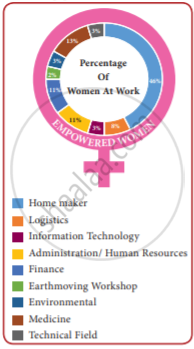
Choose the correct answer.
What is the difference between the percentage of women working in logistics and Medicine?
| soft | vain | fear | joy | love | heard | toiled | mild | good | sand | life | harsh |
The ______, the______, which it may bring.
Take a stanza from the poem. Write it in the blanks and find the rhyme scheme.
| Lines from the poem | Rhyme scheme (a/b/c/d) |
Have you ever had a strange dream? Share your dream in the class.
Activity
It’s fun to help out in the kitchen. You can even practice reading aloud when reading the recipe. And you can learn a little math by figuring out how to measure. Here are a few fun items to make that are “Alice” themed.
Can a courageous man be defeated? Why?
Identify the speaker/character.
Stop ship. Drop anchor. Quick!
Narrate the story based on the story map
Name the tools the farmer brought out. What did he do with them?
The poor farmer’s crop was______.
Find the rhyming word from the poem.
Language - ______.
Which place was the last stand of the Indian army?
It keeps the sack in every little______.
Anitha's friends wanted a______ robot in their houses.
Choose the correct option from the given homophones.
The wind ______off the leaves.
Write the correct form for the present perfect tense.
They ______ (start) playing.
Uthaman was skilled in _____.
Divide the following word.
butter
Muthu collected ______ from every house.
Why did Bala go to Chennai with his father?
Write the word with same meaning.

eraser- ______.
Write the word with same meaning.

Torch
What subject did he like the most?
Match with the opposite gender.
| 1. | prince | bridegroom |
| 2. | hero | princess |
| 3. | bride | heroine |
What did he make out of it?
Read the passage and write the summary of it. Suggest a suitable title to your summary.
|
King Krishnadeva Raya would perform heavy exercises every morning. He regularly applied oil on his body and thereafter worked out till all the oil came out with the sweat. This was followed by a long ride on his horse. Once the king started leading a sedentary lifestyle, and he stopped exercising. He no longer went horse-riding either. The king overate and as a result grew fat and heavy. The king‟s temperament also underwent a sea change. Noticing this, the royal physicians cautioned the king against the ill effects of overeating and explained to him the risks posed by obesity. They advised the king to regulate his diet, exercise, and take care of his health. The repeated advice he got from the physicians to eat less made him so angry that one day he announced a reward for anyone who could find him an easy cure. But there was one condition: those who failed would have their heads off. None dared to advise the king in this regard. The situation became precarious and as usual Tenali Raman was approached by the courtiers for a remedy. Tenali heard the problem and assured the courtiers of a viable solution. The next day, an astrologer predicted that the king had only a month left to live. When the king came to know of this, he was furious. The astrologer was ordered by the king to be imprisoned for a month so that his prediction could be put to test and so the hapless forecaster was sent to prison. |
