Advertisements
Advertisements
प्रश्न
What are the unpleasant aspects of the human condition that the poet wants to escape from?
Advertisements
उत्तर
While the poet is celebrating his new found happiness in the nightingale's song, he is thrown into much deeper thought. Keats commiserates with the human for the sorrow and all the unpleasantness that one has to go through in one's life. The poet wishes to escape from all these. He wishes to fly away to the bird and drown himself in the ecstasy of its humming. Keats realises the truth of human life. He renounces and learns that this world can serve nothing more than momentary pleasures to humans and rest all is a sham and has pain. All the materialistic gains have pain rooted in them and he wants to break free from them. He lists out various intricacies and obstacles. He tells the bird, who has never experienced fever, weariness, fret; who never sits like men and groans while palsy shakes a few, those sad folks with those last few gray hairs. How youth fades and grows pale, thin, and dies with time. He grieves for this world where nothing is permanent. The poet wishes to escape from all these aspects of our physical world and wants to see the other world where true happiness lies, where the spiritual bliss awaits him.
APPEARS IN
संबंधित प्रश्न
We know that chimps are intelligent because
Read the following extract of the poem and complete the activities given below :
B1 State which of the following statements are
True or False :
(i) The elderly are nearest to our own exalted personality.
(ii) The elderly are those persons whose growth is stunted.
(iii) We should know our elderly people well, in order to receive guidance.
(iv) The elderly hold on to the frivolous aspects of life.
Elderly people should be around us. Justify.
(b) abb
(c) abba
Answer the following question in 200-250 words:
"The best and most beautiful things in the world can't be seen or even touched. They must be felt with the heart." Justify the famous quote of Helen Keller.
Notice these expression in the text. Infer their meaning from the context.
careered down
Look for pictures in newspapers and magazines that depict the urban civic problems discussed in the text. Cut them out and pin them to the text at appropriate places.
Look for a story, a poem and a newspaper article on environment conservation and see how the style of each is different from the other.
An acrostic is a poem or a write· up in which the first letter of each line forms a word. when it is read vertically.
For example,
Faithful
Reliable
Inspiring
Encouraging
Noble
Dedicated
With your benchmate / group, complete the acrostic of BELIEVE and FAITH.
(Please note that the words / phrases should be more or less related to the topic. You can use a thesaurus.)
Be certain of
E ......................
L ......................
I ......................
E ......................
V ......................
E ......................
F ......................
A ......................
I ......................
T ......................
H ......................
Pick out words from the poem to fill in the web diagram. They should be related to the theme in the web.

Read the story and complete the following.
When Revathi played her favourite raga, the plants began to move because, ____________.
The special thread for kite - flying is sharpened by adding sugar and glass pieces.
Read different stories about intelligent ministers of kings, whose judgments helped to bring about law and order in society. For example - Birbal, Tenalirama, etc. Write 5 such stories in your notebook.
Expand the idea inherent in the following proverb:
A Bad workman blames his tools.
Read the following phrase and use it in a sentence of your own in proper form.
To voice something
Pick out dialogue of Tenali Raman that proves that he had the following quality.
Wit and wisdom
Discuss in groups and think about it.
Mention three occasions on which you have made someone else angry. What made that person angry? Can you avoid such things in the future?
Write a useful ‘ad’ for the importance of games, drinking enough water, your own school.
‘Smart Answers’: Form a large group. Each person asks the next one a question to get him to say ‘yes’ or ‘no’. He/She can use appropriate statements, requests, or even other questions as a response. But if he/she says ‘yes’ or ‘no’, he/she is out. Otherwise, he/she continues the game. Questions cannot be repeated.
Shylock demanded a pound of Antonio’s flesh.
To whom is the poem addressed?
Write a short note on the following:
Sujata’s offering
Discuss what makes the following sentences funny.
- Your wasted time will be refunded.
- There was no highway attached to the booth.
Write about the sights you may see from a bus or an airplane. You may write it in the form of a short poem.
Identify one example of a main clause and one example of a dependent clause from the content below:
Troy was filled with the sight of leaping flames and the sound of shouting and the noise of weapons and the cries of weeping women. The sleeping Trojans sprang out of their beds, but they were taken by surprise. Their enemies were right inside their walls, and many of the Trojans were killed before they could put on their armour and seize their weapons.
A bright light lit up the night sky as palaces and houses, temples and towers, went up in flames. The Trojans fought as well as they could, but it was all in vain. Old King Priam was killed with all his brave sons. Hector’s wife and his old mother and sister were carried off as slaves by the conquerors. Their fate was in contrast to Helen’s when King Menelaus rushed through the city, looking for her, and found her in her palace. She hung her head in shame and sorrow as she faced her former husband. Her voice was choked with emotion and she could not speak. But Menelaus forgave her and she went back with him, for it was only Aphrodite who had turned her heart away from her home and her husband and her child.
When morning came, nothing was left of the proud, rich city that had resisted attack for ten years.
Answer in your own words.
Why does a mother tell Neel about his Grandpa?
Find from the Internet and write down.
From which play is this song extracted?
Why is Great January annoyed with Holena and her mother? Does he help them?
Make groups. One person in the group chooses an announcement. Everyone in the group reads that announcement silently but carefully and closes their books. Then that person presents the announcement, changing one of the details in the announcement. Others spot the change. For example, you might say ‘red’ key chain instead of ‘blue’ in the last announcement.
List and say whether the following statement agrees with the passage or not.
When you want to make a speech, there’s no need to think about it in advance.
Write what the goldfish does.
Guess the meaning of the following word.
pleasing
Make a collection of Rangoli motifs and patterns.
Write about each motif or pattern in your own words -
it could just be a label or a description or some information or comment.
Read the following lines from the poem and answer the question that follow.
Let me but live my life from year to year,
With forward face and unreluctant soul;
- Whom does the word ‘me’ refer to?
- What kind of life does the poet want to lead?
Answer the following question in about 80 – 100 word.
Describe the journey of life as depicted in the poem by Henry Van Dyke.
Why did Prospero set Ferdinand a severe task to perform?
Look at the following expressions from the text. With the help of your teacher rewrite them in standard English. One has been done for you.
| 1. ‘Musta got away – whatt’d he like? | Must got away - what was he like?’ |
| 2. ‘Looky here, Joe | |
| 3. ‘No sign o’ nothing’ | |
| 4. ‘Back t’ the lines ye goodaam | |
| 5. ‘What was the idea of all them cops tarryhootin’ round the house last night. |
Why did Alice follow the rabbit?
Can courage be developed suddenly? Why?
Sea turtles come to rest on land.
Read these lines and answer the questions given below.
And welcomes little fishes in
With gently smiling jaws!
- Who welcomes the fish? Why?
- Which line tells you that the crocodile is hungry?
The boy was so inspired by Mithali that he was happy for his sister to play cricket.
The dry earth soaked up the moisture as a hungry puppy laps up milk. It means______.
Amuthan locked the door behind him.
What did Nilavan see through the window?
How do we keep our integrity?
The scene is set inside a thick forest and it is nearing dusk. Relate this time frame with the behaviour of the animals in the forest.
Vicky decided to______ the robot at the end.
Where is the key?
What does Megalai do with elders?
Write the rhyming word.
Bird - ______.
Some words sound the same but their spelling and meaning are different. Such words are called homophones. There are many homophones.
Why was the fish floating on top?
Why did Uthaman become angry with the old man?
Pick and write the adverbs to complete the sentence.
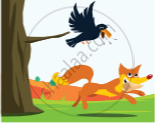
A jackal cheated the crow ______.
Who were the friends referred in the story?
What should we vow for?
Divya loved solving _______.
Senthil bought a ______ from his savings.
Kamali gave her savings to______.
Why should a fisher wait?
