Advertisements
Advertisements
प्रश्न
‘The Tale of Melon City’ has been narrated in a verse form. This is a unique style which lends extra charm to an ancient tale. Find similar examples in your language. Share them in the class.
Advertisements
उत्तर
‘The Tale of Melon City’ is a narrative poem. It is an ancient tale told in verse. Vikram Seth uses all poetic devices to create special effects. The whole poem runs in rhyming couplets. The last word of each line rhymes with the second. The poet adopts a narrative style of story-telling. But it is the use of humour and irony that creates a special effect in the poem.
The poem introduces us to a ‘just’ and ‘placid’ king. Both the adjectives are ironical. The irony is that the king is neither of the two. He is neither ‘just’ nor ‘placid’. His exaggerated sense of justice is the reflection of his personality. He is whimsical. The arch is too low and bangs his crown off when he rides under it. The king takes it as a ‘disgrace’. Then starts the summoning of the people to be hanged. But he is easily influenced and convinced and lets every one go scot-free. He falls in his own trap. His exaggerated sense of justice leads him to his own death.
Again it is quite humorous that an idiot chooses the next king. He names a melon. The crowning of a melon with respect and ceremony sounds quite humorous. But it is ironical as well. The irony is that the people care little if they are ruled by a man or a melon. Even when the king was alive he was no better than a melon. A melon was the right substitute for such a whimsical and idiotic king.
APPEARS IN
संबंधित प्रश्न
We sang our school fight song dozens of times – en route to Arlington National cemetery, and even on an afternoon cruise down the Potomac River. We visited the Lincoln Memorial twice, once in day – light, the second time at dusk. My classmates and I fell silent as we walked in the shadows of those 36 marble columns, one for every state in the Union that Lincoln laboured to preserve. I stood next to Frank at the base of the 19 foot seated statue. Spotlights made the white Georgian marble seem to glow. Together we read famous words from Lincoln’s speech at Gettysburg remembering the most bloody battle in the war between the status : “………….we here highly resolve that these dead shall not have died in vain – that this nation, under God, shall have a new birth of freedom………..”
As Frank motioned me into place to take my picture, I took one last look at Lincoln’s face. He seemed alive and so terribly sad.
The next morning I understand a little better why he wasn’t smiling. “Clifton,” a chaperone said, “could I see you for a moment?”
(1) When did the boys visit Lincoln Memorial?
(2) What made the Georgian marble glow?
(3) What did the words: “………. We here highly resolve that these dead shall not have died in vain – that this nation, under God, shall have a new birth of freedom …………” remind them?
(4) Do you believe in building memorials? What kind should they be, if your answer is ‘yes’? If no, give reasons why you do not believe in memorials?
Answer any four of the following in 30 − 40 words each:
(a) "It is his karam, his destiny." What is Mukesh's family's attitude towards their situation?
(b) What were the terms of the indigo contract between the British landlords and the Indian peasants?
(c) How will 'keeping quiet' protect our environment?
(d) Which objects of nature does Keats mention as sources of joy in his poem, 'A Thing of Beauty'?
(e) Why did the Tiger King decide to get married?
(f) What was Sadao's father's dream for him? How did Sadao realise it?
Discuss in groups plays or films with a strong message of social reform that you have watched.
Identify instances in the story that show the business acumen of Ramanand.
Discuss in pairs or in small groups.
People with foibles are often not conscious of them.
Identify the common characteristics shared by tribal communities all over the world.
Many sentences and paragraphs in the excerpt begin with the word ‘And’. To what extent does this contribute to the rhetorical style of the lecture?
No trees except the one which grows and seethes in one's dreams'– why is the phrase 'grows and seethes' used?
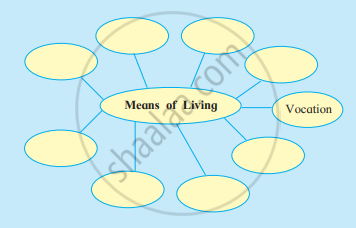
Pick out words that refer to ‘means of living’ and fill them in the Web.
(profession/recreation/occupation/job/ pastime/employment/hobby/career/entertainment/mission/trade/buisness/sports/retirement/placement)
Pick out some sentences from the lesson that convey a general truth.
Correct the following statement.
The real ivy leaf did not fall off at all.
Go through the poem and state whether the following statement is true or false.
Planners take public consent for the alterations they make in the old structures of the city.
Select any four zoo animals mentioned in the poem. Imagine they are able to talk in English. Compose a dialogue among the four animals discussing their discomfort and illnesses.
Pick out the statements which aptly depict the theme of the poem.
- In the poem, the speaker memorises the past.
- In ‘The Planners’ the poet describes the unstoppable force of modernisation.
- The poet talks about the replacement of natural environment by the concrete jungle.
- The poet proposes to stop modernisation.
- The poet laments helplessly.
Say WHY. . . . . .
Mother agreed to send Ramanujan to England.
Guess the meaning of the following words and phrases:
untold wealth, closest to the Emperor’s heart, grave offence, banish.
Ask your parents to show you TV programs on animals, wildlife and conservation on channels like the following:
DD National, National Geographic, Discovery, and Animal Planet.
What do fairy-tale witches do?
Visit a library:
Read the biographies of other Indian Saints. Share at least one story from their life with your friends. What message does it contain?
What changes in the stage setting would you suggest.
Enact the ad by playing the roles of Didi and her relatives. One more child acts as the salesman of ‘Hemagauri’ and presents the text given in white letters in pink bubbles.
Answer the following question in one sentence.
What does the title of the poem say?
How did the students prepare for their stalls/presentations?
Read the following sentence aloud. Write who said it and to whom.
“What! ... how ! ... That’s impossible! ”
Form groups. Discuss the first two paragraphs. Try to present their content in the form of a series of conversations among the volunteers and the villagers.
Write the meaning of doth.
Present Mr. Wilson’s story as it would be shown in a comic strip. Write what picture you will show in each frame along with the dialogues. Write the dialogue with the help of the story. Examples:
 |
 |
 |
Find the meaning of the following word.
delicious
Read the word. Write the words that combine to make it.
anywhere
Discuss how you will measure the worth of a friend.
Find a word that has a similar meaning.
happily
Identify the character or speaker.
He was the chief of all spirits.
Answer the question in a paragraph of about 100 – 150 word.
Write a detailed character sketch of Prospero.
What did the Bodwells think when they heard the mother shout.
Based on your reading, rearrange the following sentences in the correct sequence.
- Since all her methods failed, finally she gave him a pain-killer.
- He told his aunt that Peter had no aunt, so he gave him the medicine.
- The pain-killer triggered adverse reactions on Peter.
- It jumped out of the open window.
- Tom was dull and depressed.
- This incident upset Aunt Polly and she questioned him.
- But, Tom gave that painkiller to the cat Peter.
- So, Aunt Polly tried different types of remedies on him.
What do the people do when the festival of Music is celebrated?
Read Section – III (para 1 and 4) and answer the following questions.
Paragraph 1
1. Who listened to the chipping sound of the chisel? ______
2. Who was working with the hammer and chisel? ______
Paragraph 4
1. Who was staring? ______
2. Who was the young stone carver? ______
3. What was he working on? ______
Read these lines and answer the questions given below.
Where the voice of the wind calls our wandering feet
Whose ‘Wandering feet’ is referred to here?
Fill in the table
| Problems Faced By Mr. Fogg And His Team | Solution |
| The train stopped in the middle of the forest. | |
| They couldn’t hire the elephant. | |
| They were in need of an elephant driver. |
Identify the speaker/character.
A man fell into the sea. Please save him.
Turtles come ashore to lay eggs
What are the two reasons the author gives for the plants moving towards grandfather?
Complete the sentence given below with word/phrase.
The wild dogs came to the spot to catch______.
Try your own.

Why did Santhosh forget to watch television or play video games?
Be humble like a _____.
Match the actions with the picture.
| mixes for community food service |  |
| sows the grain |  |
| feeds the birds |  |
How can we make our nation proud?
Jaswant managed to kill _________ Chinese soldiers.
Where did Anitha go?
What is your hobby?
Why did the bird catcher need fire?
Match the rhyming words.
| 1. share | dare |
| 2. bread | rest |
| 3. care | needs |
| 4. deeds | ahead |
| 5. zest | bear |
Leafcutter ants drink______.
What did the leader see on the river?
Kamali gave her savings to______.
Before going to bed that night, Chris gave his new teacher a ______.
What did Nasruddin boast about?
Who said – “Oh, my ears and whiskers? How late it’s getting!”
On the basis of your understanding of the given passage, make notes in any appropriate format.
The Sherpas were nomadic people who first migrated from Tibet approximately 600 years ago, through the Nangpa La pass and settled in the Solukhumbu District, Nepal. These nomadic people then gradually moved westward along salt trade routes. During 14th century, Sherpa ancestors migrated from Kham. The group of people from the Kham region, east of Tibet, was called “Shyar Khamba”. The inhabitants of Shyar Khamba, were called Sherpa. Sherpa migrants travelled through Ü and Tsang, before crossing the Himalayas. According to Sherpa oral history, four groups migrated out of Solukhumbu at different times, giving rise to the four fundamental Sherpa clans: Minyagpa, Thimmi, Sertawa and Chawa. These four groups have since split into the more than 20 different clans that exist today
Sherpas had little contact with the world beyond the mountains and they spoke their own language. AngDawa, a 76-year-old former mountaineer recalled “My first expedition was to Makalu [the world’s fifth highest mountain] with Sir Edmund Hillary’’. We were not allowed to go to the top. We wore leather boots that got really heavy when wet, and we only got a little salary, but we danced the Sherpa dance, and we were able to buy firewood and make campfires, and we spent a lot of the time dancing and singing and drinking. Today Sherpas get good pay and good equipment, but they don’t have good entertainment. My one regret is that I never got to the top of Everest. I got to the South Summit, but I never got a chance to go for the top.
The transformation began when the Sherpa Tenzing Norgay and the New Zealander Edmund Hillary scaled Everest in 1953. Edmund Hillary took efforts to build schools and health clinics to raise the living standards of the Sherpas. Thus life in Khumbu improved due to the efforts taken by Edmund Hillary and hence he was known as ‘Sherpa King’.
Sherpas working on the Everest generally tend to perish one by one, casualties of crevasse falls, avalanches, and altitude sickness. Some have simply disappeared on the mountain, never to be seen again. Apart from the bad seasons in 1922, 1970 and 2014 they do not die en masse. Sherpas carry the heaviest loads and pay the highest prices on the world’s tallest mountain. In some ways, Sherpas have benefited from the commercialization of the Everest more than any group, earning income from thousands of climbers and trekkers drawn to the mountain. While interest in climbing Everest grew gradually over the decades after the first ascent, it wasn’t until the 1990s that the economic motives of commercial guiding on Everest began. This leads to eclipse the amateur impetus of traditional mountaineering. Climbers looked after each other for the love of adventure and “the brotherhood of the rope” now are tending to mountain businesses. Sherpas have taken up jobs as guides to look after clients for a salary. Commercial guiding agencies promised any reasonably fit person a shot at Everest.
