‘The Tale of Melon City’ has been narrated in a verse form. This is a unique style which lends extra charm to an ancient tale. Find similar examples in your language. Share them in the class.
Advertisements
Question
‘The Tale of Melon City’ has been narrated in a verse form. This is a unique style which lends extra charm to an ancient tale. Find similar examples in your language. Share them in the class.
Advertisements
Solution
‘The Tale of Melon City’ is a narrative poem. It is an ancient tale told in verse. Vikram Seth uses all poetic devices to create special effects. The whole poem runs in rhyming couplets. The last word of each line rhymes with the second. The poet adopts a narrative style of story-telling. But it is the use of humour and irony that creates a special effect in the poem.
The poem introduces us to a ‘just’ and ‘placid’ king. Both the adjectives are ironical. The irony is that the king is neither of the two. He is neither ‘just’ nor ‘placid’. His exaggerated sense of justice is the reflection of his personality. He is whimsical. The arch is too low and bangs his crown off when he rides under it. The king takes it as a ‘disgrace’. Then starts the summoning of the people to be hanged. But he is easily influenced and convinced and lets every one go scot-free. He falls in his own trap. His exaggerated sense of justice leads him to his own death.
Again it is quite humorous that an idiot chooses the next king. He names a melon. The crowning of a melon with respect and ceremony sounds quite humorous. But it is ironical as well. The irony is that the people care little if they are ruled by a man or a melon. Even when the king was alive he was no better than a melon. A melon was the right substitute for such a whimsical and idiotic king.
APPEARS IN
RELATED QUESTIONS
We sang our school fight song dozens of times – en route to Arlington National cemetery, and even on an afternoon cruise down the Potomac River. We visited the Lincoln Memorial twice, once in day – light, the second time at dusk. My classmates and I fell silent as we walked in the shadows of those 36 marble columns, one for every state in the Union that Lincoln laboured to preserve. I stood next to Frank at the base of the 19 foot seated statue. Spotlights made the white Georgian marble seem to glow. Together we read famous words from Lincoln’s speech at Gettysburg remembering the most bloody battle in the war between the status : “………….we here highly resolve that these dead shall not have died in vain – that this nation, under God, shall have a new birth of freedom………..”
As Frank motioned me into place to take my picture, I took one last look at Lincoln’s face. He seemed alive and so terribly sad.
The next morning I understand a little better why he wasn’t smiling. “Clifton,” a chaperone said, “could I see you for a moment?”
(1) When did the boys visit Lincoln Memorial?
(2) What made the Georgian marble glow?
(3) What did the words: “………. We here highly resolve that these dead shall not have died in vain – that this nation, under God, shall have a new birth of freedom …………” remind them?
(4) Do you believe in building memorials? What kind should they be, if your answer is ‘yes’? If no, give reasons why you do not believe in memorials?
Answer any three of the following in 30-40 words each:
(a) Why has the poet’s mother been compared to the ‘late winter’s moon’?
(b) The poet says, ‘And yet, for these Children, these windows, not this map, their world.’ Which world do these children belong to? Which world is inaccessible to them?
(c) What was the plea of the folk who had put up the roadside stand?
(d) What will happen to Aunt Jennifer’s tigers when she is dead?
Complete the following table :
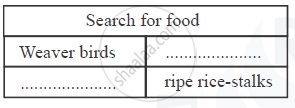
Answer the following in 200-250 words :
Describe the relationship between Anne and Margot?
|
The energy stored in coal and petroleum originally came to the earth from the sun. The bulk of the present-day supplies was laid down some 200 to 600 million years ago, when tropical conditions were widespread. Lush, swampy forests produced huge trees; warm coastal seas swarmed with microscopic forms of life. When these organisms died, much of their tissue was recycled as it is today — through scavenging and decay. But a significant amount of dead plant and animal material was covered with mud, which prevented complete decomposition. With the passage of time, layer upon layer of the fine sediment was deposited over the once-living material; the sheer weight turned the sediments to rock. Sandwiched between the layers, both coal and petroleum were produced and preserved under pressure. Coal was formed mostly of giant fern-like plants that have only small counterparts today. Coal may still be forming here and there on earth, but conditions are not right for the production of significant quantities. |
Number the points.
Briefly explain the following statement from the text.
“You neither travelled to the past nor the future. You were in the present experiencing a different world.”
The story is called ‘The Adventure’. Compare it with the adventure described in ‘We’re Not Afraid to Die...’
How does Shelley's attitude to science differ from that of Wordsworth and Keats?
What do the references to the birds and animals made in the poem suggest?
Identify the lines that reveal the critical tone of the poet towards the felling of the tree.
How did Kumudini react to her mother's death?
Discuss the following in pairs or in small groups.
Kumudini Lakhia's life is an inspiring illustration of the emancipation of women.
Read the extract and state whether the following statement is true or false. Correct the false statement.
Newer hybrid crops have a great appetite for chemicals.
Answer in your own words.
What explanation did he give to the fellow-pilgrim for his thoughtful deed?
Breeding worms to use them to convert organic waste into fertilizer is called Vermiculture or vermicomposting.
Find out more about Vermiculture and how you can carry out the same in your garden/backyard, to fertilize your plants at home.
Pick out a word from the poem to complete the sentence meaningfully.
She ______ (bargained) with the hawker to reduce the price.
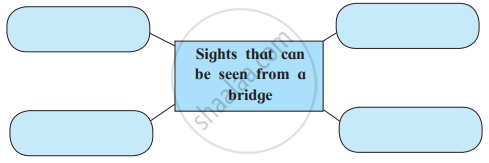
You might have visited a bridge. Complete the web describing the sights you could see from the bridge.
Birbal thought Akbar was greater than God.
What would happen if children didn’t go to school? Discuss the question in groups of 5-8 and prepare a short composition on it.
Read aloud the speech in which Thiruvalluvar explains how the fabric was made. Present the process in the form of a chart. Draw pictures for the chart and label them.
Answer the following question in one sentence.
What should human beings do in order to make progress?
Write about the various wheel-like objects you see at home, in school, and on the road.
What were the three things that Sushruta discovered?
Visit a library:
Read other tales from Shakespeare, for example, Julius Caesar, As You Like It, Macbeth, and The Tempest.
Start a collection of new and interesting words. Write the words in colored ink on cards of equal size and arrange them in alphabetical order. Try to use the words in your writing or conversation from time to time.
Fill in the following blanks with reference to the poem.
'In time of rain when spring and life are ______, the butterflies lift ______ wings to catch a ______ cry and trees put forth ______ leaves to sing in ______ beneath the sky as ______ boys and girls too ______ singing down the roadway'.
Gather information about your favourite great historical personality. You may use the internet. You may also gather photographs, pictures, etc. Prepare a collage using the pictures, inspirational quotes, and a brief description of the person’s importance. Hold an exhibition of your collages in the classroom.
Answer the following question and write in short, why the parody sounds funny.
Is the bee a gentle creature? Is the crocodile gentle?
Answer in your own words.
What chores did the boys from 1000 CE and 1st Century CE, do on their farms/fields?
Colour, sound, and images from nature add to the beauty of a poem: 'Tartary' is a perfect example of the above. Pick outlines that contain –
- Colour
- Sound
- Images from nature
Write in your own words.
How does the poet describe his home in the second stanza?
Fill in the blank choosing the appropriate word/idiom from the lesson.
The ______ solved the mysterious crime.
Find the meaning of the following word.
rated
Form groups of four or five.
Try to find the answers to the following questions through observation and by talking to your teachers, parents and others. Discuss your answers in the group.
- How is waste generated?
- How is it removed or cleared?
- How can we help in the task of clearing or removing garbage?
Who is a ‘netizen’?
Choose a word that has at least four letters in it. Imagine that it is a short form. Write the name /phrase /words it stands for.
For example, STEP : Sunday and Thursday Evening Programmes.
Read the following line from the poem and answer the question that follow.
So let the way wind up the hill or down, O'er rough or smooth, the journey will be joy: Still seeking what I sought when but a boy, New friendship, high adventure, and a crown,
- How is the way of life?
- How should be the journey of life?
- What did the poet seek as a boy?
Read the comic strip and answer the following question.
Can we read and access the information free of cost?
ashen – pale
His face was ashen.
Why was the elephant owner happy with the deal?
What did Raj buy?
What happened to Dr. Karmugilan in the story?
The scene is set inside a thick forest and it is nearing dusk. Relate this time frame with the behaviour of the animals in the forest.
Robot asked Vicky to sell him to an ______ master.
What robot will you make? Why?
Vicky decided to ______ the robot at the end.
Raju loves______.
Whose hospitality is described in the poem?
Why did he grow crops?
Circle the animals which are in the voyage.

Tenzin’s family first lived in ______.
What is the main idea of the text?
Jana saw a _______ behind her.
The squirrel ran to the _________ tree.
Are you the first to protect the nature?
Do you think Ani will be a good leader? Why?
Match the rhyming words.
| 1. | say | fall |
| 2. | go | day |
| 3. | all | grow |
______ was helpful for his father to drive out the wild animals.
Recite the poem The Painter with correct intonation.
What is the main idea of the story?
