Advertisements
Advertisements
Question
|
The energy stored in coal and petroleum originally came to the earth from the sun. The bulk of the present-day supplies was laid down some 200 to 600 million years ago, when tropical conditions were widespread. Lush, swampy forests produced huge trees; warm coastal seas swarmed with microscopic forms of life. When these organisms died, much of their tissue was recycled as it is today — through scavenging and decay. But a significant amount of dead plant and animal material was covered with mud, which prevented complete decomposition. With the passage of time, layer upon layer of the fine sediment was deposited over the once-living material; the sheer weight turned the sediments to rock. Sandwiched between the layers, both coal and petroleum were produced and preserved under pressure. Coal was formed mostly of giant fern-like plants that have only small counterparts today. Coal may still be forming here and there on earth, but conditions are not right for the production of significant quantities. |
Number the points.
Advertisements
Solution
- Storage of energy from sun in coal and petroleum
- Deposit of bulk supplies 200-600 million years ago
- Abundance of microscopic forms of life in tropical conditions
- Death of microscopic life forms leading to recycling through decay
- Prevention of total decomposition by significant amount of dead plants and animals being covered with mud
- Hardening of sediments, over the years, led to rock-formation
- Production of coal, petroleum by compression of matter between rocks
- Unsuitability of present-day conditions for coal-formation
APPEARS IN
RELATED QUESTIONS
There were many reasons for Helen Keller's embittered childhood. What were they and how were they overcome?
How did Helen benefit when Dr. Graham Bell accompanied her to the World Fair?
Answer the following question in 120-150 words :
Mrs. Hall is greedy but efficient in her business.
Attempt a character sketch of Mrs. Hall.
Answer the following in 120-150 words :
Within a few days of his arrival in Iping, people became suspicious of Griffin. Why?
Answer any three of the following in 30-40 words each:
(a) Why has the poet’s mother been compared to the ‘late winter’s moon’?
(b) The poet says, ‘And yet, for these Children, these windows, not this map, their world.’ Which world do these children belong to? Which world is inaccessible to them?
(c) What was the plea of the folk who had put up the roadside stand?
(d) What will happen to Aunt Jennifer’s tigers when she is dead?
How would you say ‘a dilapidated drum’ in your language?
Tick the statement that is true.
The story hinges on a particular historical event.
Briefly explain the following statement from the text.
“The lack of determinism in quantum theory!”
What does the phrase ‘as if he were on needles’ mean? Can you think of another phrase with a similar meaning substituting the word ‘needles’?
What impression would you form of a state where the King was 'just and placid'?
How does Kumudini Lakhia describe her guru Ramgopal's influence on her?
Make sentence of your own using the following expression.
bargain:
Think and answer in your own words in your notebook.
Does the poem urge us to protect only worms? What is the general message conveyed through this poem?
‘Dull would he be of soul who could pass by.’
This line of the poem can be rewritten as:
'He would be of a dull soul.'
The figure of speech is known as ‘Inversion’.
Find out one more example of Inversion from the poem.
Think deeply and write. Is the poet really discouraging the youth from becoming vets? Explain your response.
Read the lesson and name the following.
The First surgeon to perform operations ______
Proverbs associated with the word season: for eg: Make hay while the sun shines.
- _________________________
- _________________________
Answer the following question in short.
What was Pundit Shahane’s claim as a scholar?
Read the passage and answer the following question:
What is seen on the obverse and reverse of the PVC medal?
Read the given extract (Act III)
Match column A with column B.
| Sr.No. | A | B |
| 1. | Dr. Thomas Stockmann | Opportunist |
| 2. | Katherine | Vulnerable |
| 3. | Peter Stockmann | Honest and upright |
| 4. | Petra | Coward |
| 5. | Hovstad | timid but supportive |
| 6. | Billing | Cuinng and corrupt |
| 7. | Aslaksen | Courageous |
Discuss the question after you have seen a presentation of the ‘ad’.
What does the ad tell you?
The wheel, which was probably invented more than 6000 years ago, is thought of as one of the greatest technological advances made by man. Why do you think the wheel is so important in human civilization?
Visit a library:
Find and read the biography of your favourite scientist.
Complete the following sentence with reference to the passage:
The king was determined to prevent his beloved son from ____________.
What do the following event/action tell us about the characters? Discuss.
Arthur agreed to bring Sir Kay a sword at once.
Form groups. Discuss the first two paragraphs. Try to present their content in the form of a series of conversations among the volunteers.
Prepare similar word chains using the following ideas.
size - small _______________.
From the play, find all the words that are related to the following:
knowledge and learning
Add other related words you know to the list.
Form groups of 4-5. Read the following sentences aloud. Using your imagination and with the help of group discussion, write other situations in which the sentences can be used.
- The outcome: disappointment and anger.
- The hour of battle had sounded
- What a chase!
- This was our chance, .........
Rohan desperately wished for ______.
Name the following.
Did not let the passes go waste.
Show the major events in the story of Pheidippides on a ‘time-line’.
What is the world wide web?
How did Zigzag communicate with the Krishnans?
Hamid’s friends are ______
Read the lines and answer the questions.
They are of all forms and shapes
They all have an excellent ending
What do have an excellent ending?
What do you think is going to happen next?
Neerja passed on the warning in a code to the pilots because she______.
Read the following lines and answer the questions.
It isn’t an instantaneous thing
Born of despair with a sudden spring
- What does ‘it’ refer to?
- What does ‘born of despair mean’?
Read the following article about the amazing similarities between the assassination of John F. Kennedy and Abraham Lincoln; then underline the passive forms.
Abraham Lincoln was elected to Congress in 1846. Voters elected John F. Kennedy to Congress in 1946.
Lincoln was elected president in 1860. Voters elected Kennedy president in 1960.
Both men were particularly concerned with civil rights.
Both wives lost their children while living in the White House.
Lincoln was shot on a Friday. Someone shot Kennedy on a Friday.
Lincoln was shot in the head. The gunman shot Kennedy in the head.
Lincoln’s secretary was called Kennedy. Kennedy’s secretary was called Lincoln.
Lincoln was assassinated by a Southerner. A Southerner assassinated Kennedy.
Lincoln was succeeded by a Southerner named Johnson. A Southerner named Johnson succeeded Kennedy.
Andrew Johnson, who succeeded Lincoln, was born in 1808.
Lyndon Johnson, who succeeded Kennedy, was born in 1908.
John Wilkes Booth, who assassinated Lincoln, was born in 1839. Lee Harvey Oswald, who assassinated Kennedy, was born in 1939.
Both assassins were known by their three names and both names are composed of fifteen letters.
Lincoln was shot at a theatre named “Ford”. The gunman shot Kennedy in a car called a “Lincoln” that the company Ford made.
Booth ran from the theatre and was caught in a warehouse. Oswald ran from a warehouse and the police caught him in a theatre.
Booth was assassinated before his trial. Someone assassinated Oswald before his trial.
Read the comic strip again. Make groups of four and frame some questions on what you have read. Each group should ask a question in turns. You cannot repeat the same question. The team which asks more questions is the winner.
e.g:
- Which are the foreign vegetables mentioned?
- What was sad for Columbus?
Find out the idiom that relates to ‘whatever the circumstances’, from the first paragraph.
What was the girl determined to do? Why?
How did the cavalry officers look? What happened to them finally?
What was his master’s advice?
They fed fish with______.
______always stays to the last in our needs.
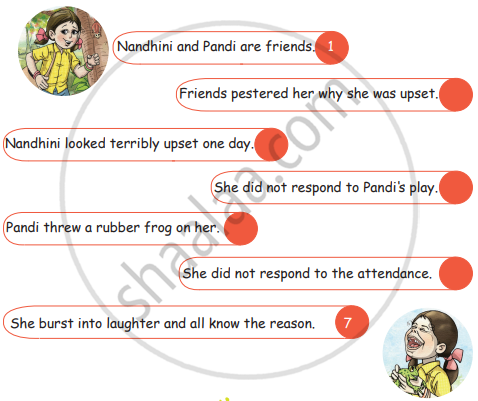
Number the actions of Pandi and Nandhini in order.
Kani and Teddy were in the garden at _____.
Why did Kani run to the kitchen?
Tenzin’s family first lived in ______.
What will you do if you have a gold plate?
Let us learn a few more word by joining the dots. Join the dots and fill the table below.
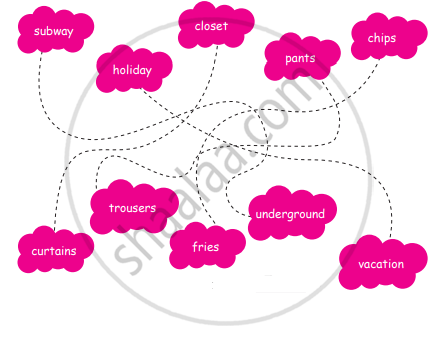
| subway | |
| holiday | |
| closet | |
| pants | |
| chips |
How does she move the brush?
______ is a great risk to the environment.
Which problem do you think you can solve with art? How?
Why did the headmaster give Megala a special prize?
Why does the poet feel that the nose is a funny thing?
Where did they go to buy books?
Write compound word using the pictures.
 |
+ |  |
| ____________ | ||
