Advertisements
Advertisements
प्रश्न
|
The energy stored in coal and petroleum originally came to the earth from the sun. The bulk of the present-day supplies was laid down some 200 to 600 million years ago, when tropical conditions were widespread. Lush, swampy forests produced huge trees; warm coastal seas swarmed with microscopic forms of life. When these organisms died, much of their tissue was recycled as it is today — through scavenging and decay. But a significant amount of dead plant and animal material was covered with mud, which prevented complete decomposition. With the passage of time, layer upon layer of the fine sediment was deposited over the once-living material; the sheer weight turned the sediments to rock. Sandwiched between the layers, both coal and petroleum were produced and preserved under pressure. Coal was formed mostly of giant fern-like plants that have only small counterparts today. Coal may still be forming here and there on earth, but conditions are not right for the production of significant quantities. |
Number the points.
Advertisements
उत्तर
- Storage of energy from sun in coal and petroleum
- Deposit of bulk supplies 200-600 million years ago
- Abundance of microscopic forms of life in tropical conditions
- Death of microscopic life forms leading to recycling through decay
- Prevention of total decomposition by significant amount of dead plants and animals being covered with mud
- Hardening of sediments, over the years, led to rock-formation
- Production of coal, petroleum by compression of matter between rocks
- Unsuitability of present-day conditions for coal-formation
APPEARS IN
संबंधित प्रश्न
Answer the following question in 150-200 words:
Attempt a character sketch of Mr. Gilman.
Talk to your partner about the following.
Would you agree that the author’s grandmother was a person strong in character? If yes, give instances that show this.
What was the reason for young Paul's restlessness at the beginning of the story? How did it find expression?
Discuss in small groups.
Poetry and science are incompatible.
Read the extract 'Being Neighborly' and complete the following statement:
To Jo, the fine house seemed like ______.
Read the extract and state whether the following statement is true or false. Correct the false statement.
The aroma of the ‘desi’ rice would spread around the village.
Find from the story one word for the following.
a very narrow passage between buildings ______
Think and answer in your own words.
What exactly does the speaker in the poem crave for?
Make a list of the preparations made for an assault on Tiger Hill.
Bofors guns _____________.
Breeding worms to use them to convert organic waste into fertilizer is called Vermiculture or vermicomposting.
Find out more about Vermiculture and how you can carry out the same in your garden/backyard, to fertilize your plants at home.
Say WHY. . . . . .
Ramanujan found the number 1729 very interesting.
Write a short autobiography of any bird or animal of your choice.
Visit a library:
This story is a fable. Find two more fables. Share them with your friends.
Comment on the given statement after reading the given dialogue -
I wouldn’t be in your shoes if he rewards me ten times as much. People generally fall victim to incentives. Some people stick to values. They _________________.
Explain the following statement with reference to the context.
You ought to be ashamed of yourself.
Find, in your science textbook, the topics of the stalls handled by students of VI A.
(Write the page number.)
What do the following events/actions tell us about the characters? Discuss.
Sir Ector kneeled before Arthur.
Correct the following sentence using facts from the passage.
The great heroes avoided one another.
Read: ‘The Listeners’ and ‘Someone’ - poems by Walter de la Mare.
The table-tennis set was gifted by ______.
Say whether you agree or disagree.
The children would have behaved well on the train if their aunt had scolded them harshly.
Say whether you agree or disagree.
The wolf could not trace Bertha because she was behind a myrtle bush.
Read the following words aloud and copy them in your notebook.
- idle
- enough
- exclaimed
- commotion
- astounded
- antics
- wander
- wielding
Why did Holena and her mother go out in the snow themselves?
If you were to grow very tiny like a Lilliputian, what are the things you would like to do? Write about any three of these things.
In what way can we help to reduce or minimize waste generation?
Discuss the issue in groups of 4 or 5 and note down all good suggestions.
Resolve to follow them yourself. Some have been given below for your reference.
- Don’t waste food.
- Take as much as you want but finish everything that’s on your plate.
- Don’t throw away broken or half-used things. Repair them and use them.
- Avoid things which can be used only once.
For example: thermocol (polysterene) cups, plastic glasses, etc. - Reuse!
- Recycle!
What examples of plentiful things does the poet give?
Find out the difference between the fingerspelling method, sign language and Braille.
Guess the meaning of the following word.
finely
Read the following passage and answer the questions that follow.
BUNGEE-JUMPING
Bungee jumping is an activity that involves jumping from a tall structure while connected to a long elastic cord. The tall structure is usually a fixed object, such as a building, bridge or crane; but it is also possible to jump from a movable object, such as a hot-air-balloon or helicopter, that has the ability to hover above the ground. The thrill comes from the freefalling and the rebound. When the person jumps, the cord stretches, and the jumper flies upwards again as the cord recoils and continues to oscillate up and down until all the kinetic energy is dissipated.
Jumping Heights, located in Mohan Chatti village, in Rishikesh has been rated as one of the most preferred bungee jumping destinations in India at a height of 83 meters. It is the only place in India where bungee jumping can be done from a fixed platform. This is also India’s only fixed platform Bungee- performed from a professional cantilever, to separate it from entertainment parks, and create instead, an extreme adventure zone. The Bungee has been designed by David Allardice of New Zealand.
The Cantilever platform is built over a rocky cliff over-looking the river Hall, a tributary of River Ganges. Bungee-ing amidst the vastness of nature lends the experience an absolutely breathtaking quality. Jumping heights is well known for its safety measures and experienced staff. It costs around Rs 2500 per jump, a bit expensive, but totally worth the experience. The Bungee jumping experience has been set amidst the astoundingly stunning landscape of Rishikesh. To Bungee jump, one must be at least 12 years and should weigh between 40-110 kg.
Questions
- What is Bungee Jumping?
- Can Bungee be performed from a movable object? How?
- When do you think Bungee becomes thrilling?
- What is the experience when one falls off the platform?
- Where is the Bungee jumping point located in India?
- What is the minimum age to Bungee jump?
Share a memorable trip from your life
Give two reasons why Miranda was so concerned about Ferdinand.
Who used the zither and how?
Read the incident again and answer the following question.
What did Gilson want the writer to bring for him?
Identify the speaker/character.
‘Come in, Zigzag, come in dear!’
Read the story again and write how these character reacted in these situation:
You’re both quite mistaken.
Dr. Krishnan ........…………………….
Mrs. Krishnan……....…………………
Why did Dr. Ashok’s cousin call him?
Read the data below and answer the following question.
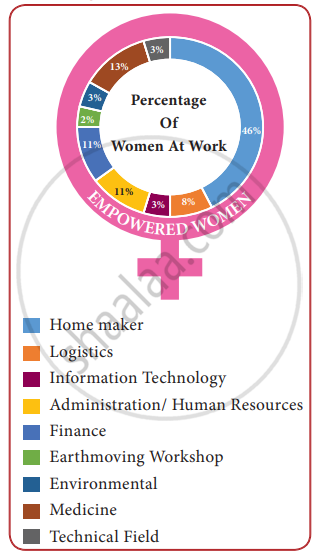
Choose the correct answer.
What is the data about?
What did Usha see while walking to the bazaar?
What is good or effective communication?
Read the lines and answer the questions.
There are many legends based on their heroic exploits
a legacy of tales which have been told with much adroit
- What does ‘heroic exploits’ mean?
- What are legends?
If you are a flight attendant how will you deal with the hijackers?
Read the lines and answer the question given below.
And ever again, in the wink of an eye,
Painted stations whistle by
- ‘In the wink of an eye’ means very quickly. Explain ‘painted stations whistle by’.
Why did the family move to Patna?
Read the events of the story. They are in the wrong order. Put them in the correct order.
| 1. And it charged straight at the cavalry officers on horseback. |
| 2. And so she flew onto the back of the cow. |
| 3. So everybody panicked and made a general rush to safety |
| 4. The startled cow charged off in fear |
| 5. She applied brakes, but was thrown off the cycle. |
| 6. Just then she saw a lone cow in the middle of the road. |
| 7. Finally the cow fell into a ditch and dislodged the girl. |
| 8. The girl cried out in delight as she overtook her brother on her cycle. |
Why don’t we use chemicals?
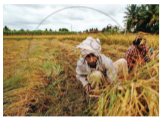
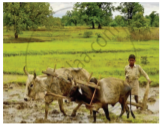
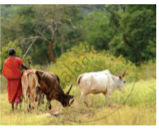
| Mr. Murugan is a farmer. He has a small piece of land and two bulls. He takes good care of his bulls as they help him in farming. Every morning, he takes the bulls for grazing. When it rains he ploughs the land with the bulls. As he has no one to help he starts sowing the seed before sunrise. He irrigates the crop till it grows. He reaps and binds the crop then takes it to thrash the paddy. Finally, with the help of the bulls, he takes the paddy to his house. |
Name the actions of Murugan.
 |
|
 |
|
 |
What robot will you make? Why?
Look at the picture and Choose the correct word.

Fruits and shadows are free under the _______.
All the children wished to go to the______.
______helped Bujju to reach his family.
In early days, Amir left the tap opened.
Leafcutter ants grow fungus.
Why it is important for people to live without boundaries?
Match the words with similar meaning.
| truck | subway |
| underground | lorry |
| tap | wallet |
| purse | faucet |
What happens when the day is over?
What did he claim to know?
Why did the child in the poem like looking at the pictures?
