Advertisements
Advertisements
प्रश्न
Discuss the following in pairs
Behind the public face of the people in various occupations is a whole saga of personal suffering and joy which they wish to share with others.
Advertisements
उत्तर
Like Iona, every human has a portion of his/her heart unexplored. They guard it stealing it from everyone and yet they long for it to be uncovered; sharing it all with a companion, a friend, a mate. A human, like a diamond, has many facets. The face people wear in public is just one of those facets. There is a child inside everyone, a male in every female and a female in every male, unknown, hidden. They keep them locked inside and yet crave to share it with someone. This world of today, where we all are much wiser and practical and much busier, get little time to spend and share the inner self of ours with someone. The true face behind us all is shielded carefully and it longs to be known, understood. We all hold our souls back yet we wish to share our dark secrets with someone. Our sufferings, our joys, our desires, our hidden self. And in this modern world, few find that true mate with whom they can share their personal joys and sufferings, which they keep locked away in their hearts.
APPEARS IN
संबंधित प्रश्न
Read the following passage carefully and complete the activities given below:
B.1) Order :
Rearrange the following sentences in proper order:
(i) Hanmant joined engineering.
(ii) Hanmant got his Diploma and secured a job in Philips.
(iii) Hanmant migrated to Pune when he was in class VI.
(iv) Hanmant took up a painting job to earn.
Hanmant Gaikwad was born in Koregaon in Satara district.
“My native place is Rahimatpur, around 10 km from Koregaon. My father was a clerk in the court and we lived in a small, rented house.”
Hanmant was a brilliant student especially good in mathematics. When he was in class six, the family shifted to Pune. They lived in Phugewadi near Dapodi in a tiny one-room house-10 by 10 feet. At this point, Hanmant realized the difference between himself and those who had money.
Hanmant was then studying at Modern High School. He needed one rupee to buy a bus ticket to and from the everyday. Even that was hard to come by.
Despite the hardships, Hanmant secured 88% in class 10. Hanmant completed his diploma and joined Philips as a trainee. But he wasn’t happy with the work he got there.
The natural choice for a diploma engineer is to go for a B.Tech. But engineering colleges charge hefty fees. At the time, the family’s only source of income was a teacher’s salary of Rs. 2,300 a month……….
And then I decided to also do some earning. “Khud Ka Kamana Chalu Kiya”.
Hanmant took up painting jobs and quickly discovered it was excellent business.
The young engineering student paid his own fees from the third year onwards. But his lifestyle remained frugal.
Life was getting better, but Hanmant had his sights set higher. In the final year of engineering, he was attracted to the writings of Swami Vivekananda.
“I felt Ki Kuch Alag Karna hai. What should I do, I did not know but in 1993 I formed an organization-Bharat Vikas Pratisthan.”
B.2) Complete :
|
Hardships faced by Hanmant Gaikwad |
B.3) Rewrite the following sentence choosing the appropriate word/s for the underlined word/s :
(i) His lifestyle remained frugal:
(a) simple
(b) meager
(c) extravagant
(ii) Despite hardships, Hanmant secured 88% in class X:
(a) In spite of
(b) Regarding
(c) Affected
(iii) Hanmant took up painting jobs:
(a) assumed
(b) to continue
(c) accepted
(iv) Hanmant had his sights set higher:
(a) looked ahead
(b) lofty ambitions
(c) looked above
B.4) Do as Directed
(i) Hanmant secured 88% in class X. ( Begin the sentence as-88%....................)
(ii) In the final year of engineering, he was attracted towards the writings of Swami Vivekananda. (Frame a ‘Wh-question’ to get the underlined part as the answer.)
B.5) “Today’s hardships lead to tomorrow’s success”-Justify.
Read the following extract and do the given activities:
B.1) Fill in the Balloons with suitable ideas from the poem:
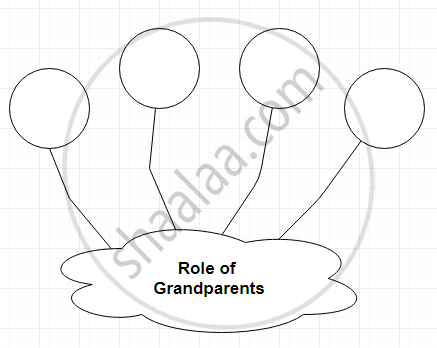 “Oh, the value of the elderly! How could anyone not know?
They hold so many keys, so many things they can show.
We all will read the other side this I firmly believe
And the elderly are closest oh what clues we could retrieve.
For their characters are closest to how we’ll be on high.
They are the ones most developed, you can see it if you try.
They’ve let go of the frivolous and kept things that are dear
The memories of so sweet, of loved ones that were near.
As a nation, we are missing our greatest true resource,
To get to know our elders and let them guide our course.”
B.2) Find Evidence:
Pick out the line from the extract which supports the given ideas:
(i) The elders have many things to share.
(ii) Everybody knows the value of elderly people.
(iii) The elderly people have vast experience.
(iv) The elderly people are a boon to the nation.
B.3) Write a pair from the extract that rhymes with the given word:
| Fear | ........................... | .......................... |
Notice these expression in the text. Infer their meaning from the context.
salt flats
The story is called ‘The Adventure’. Compare it with the adventure described in ‘We’re Not Afraid to Die...’
The story revolves around characters who belong to a tribe in Armenia. Mourad and Aram are members of the Garoghlanian family. Now locate Armenia and Assyria on the atlas and prepare a write-up on the Garoghlanian tribes. You may write about people, their names, traits, geographical and economic features as suggested in the story.
If you were to write about these issues today what are some of the incidents, examples and problems that you would think of as relevant?
Is drama a good medium for conveying a social message? Discuss.
Discuss in groups plays or films with a strong message of social reform that you have watched.
How has the author linked the symbol of the rocking-horse to Paul's triumphs at the races?
The following common word is used in a different sense in the poem. Guess what it means.
What, according to Ruskin, are the limitations of the good book of the hour?
What are the unpleasant aspects of the human condition that the poet wants to escape from?
Little creatures in nature can also be your teachers. Think and write what we can learn from the following.
Bees:
State whether the following statement is True or False. Correct the false statement by finding evidence from the poem to support your remark.
The poem has an underlying message about the importance of trees.
Fill in the elements that you find in the drama script of ‘A Battle to Baffle.'
Characters:
- Background Scene:
- Crisis:
- Steps taken to resolve the crisis:
- Climax:
- The end:
Apart from the children, no other human beings are mentioned in the poem. However, many natural elements are shown to act like persons. Name them and also write what they do.
Read the poem aloud. Recite any stanza of your choice from memory.
Comment on the versatility and the aptness of the stage settings, as per the requirement of the play “A Midsummer-Night’s Dream!”
Find 2/4 expressions of humour from the extract.
Find four words ending with ‘-ous’ from the story.
Can you add three more words ending with ‘-ous’ to this list?
Complete the following sentence with reference to the passage:
Gautama, the Buddha, was born over two thousand five hundred years ago, as ______.
Write about what you would like to do if ‘Time’ was your friend.
Start a collection of new and interesting words. Write the words in colored ink on cards of equal size and arrange them in alphabetical order. Try to use the words in your writing or conversation from time to time.
Think and answer:
Are the boys and girls happy that it is raining?
Form groups of 4. Find all the references to the time given in the passage. Then make a chart to show the events described in the passage along with the time when they occur. Example:
| All night long: | The crew stayed on their feet. |
| Near midnight: | ________________________ |
| At 12.53: | ________________________ |
(Use as many lines as you need.)
List 5 of the sounds that you like.
Read the poem and answer the following.
What are the two different ways of eating strawberries?
List and say whether the following statement agrees with the passage or not.
You should look at the person you are talking to.
What is the ‘Internet’?
List all the pairs of antonyms you find in the passage.
Answer the following question in about 100-150 word.
Narrate the extensive search operation made by the policemen in the house.
What are the three rules given by the bird?
Identify the speaker/character.
‘Even though I clearly said no!’
An Anagram is a word or a phrase formed by rearranging the letters of a different word or phrase, typically using all the original letters exactly once.
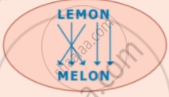
Now try to solve these anagrams
| 1. | ELBOW | |
| 2. | SECTION | |
| 3. | VIEWER | |
| 4. | RIPPLES | |
| 5. | NEEDLESS |
Complete the following table with information from the anecdote about Mr. Scotti’s short trip.
| Name | Nicholas Scotti |
| Occupation | |
| Reason for his trip | |
| Means of transport | |
| Destination |
Hamid’s friends are ______
According to the author the tendril was moving towards grandfather because it______.
Why did the crowd gather by the side of the pond?
When did the richest farmer get upset? Why?
What is the setting of the story?
Why does the poet fly out of the universe?
A ________ dies for the nation.
How can we make our nation proud?
Read scene I of the play carefully and answer the question below.
Who is about to go on a hunt? Do the wolves panic on his arrival? Explain.
What robot will you make? Why?
Arrange the pictures by using numbers.

Look at the picture and Choose the correct word.

Look at the picture and Choose the correct word.

Where was the old man sleeping?
Welcome guests to win everyone’s _____ in life’s race.
Why do we ask questions?
People ran off when the seawater receded.
What was the reason behind Nandhini’s dullness?
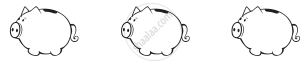
Read the passage three times on your own. Colour a Piggy bank each time you read.
Piggy bank is a coin box used by children. The real use of a piggy bank is to store coins. Piggy banks look like pigs. They come in many shapes and sizes. In Tamil, they are known as Hundial. It is a red, mud pot. We can drop the coins into the pot. Once the pot is full, we must break the pot and use the coins. Start saving with your hundial today!
The king looked for a______.
Name the animal and sound it makes.
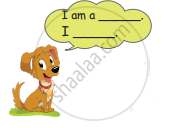
Write the word with same meaning.

post- ______
Write the correct word.
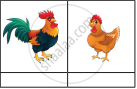
| rooster, king, hen, tiger, queen, tigress. |
How did the jackal become blue?
