Advertisements
Advertisements
प्रश्न
The ending of the story is an instance of irony. Suppose Paul had not died at the end, how would you have reacted to the story?
Advertisements
उत्तर
It is true that a tragedy digs a deeper mark than a happy ending. It causes an emotional catharsis in the audience. Had the story had a happy ending it would have been pleasant, however, the reader would not have felt the emotions and passion that drove Paul to his inevitable climax. Yet some may find it not justified to have killed the boy at the end of the story that went so well with Paul achieving what he wanted all the while, money, and love both. He sacrificed his life to bring to his mother what his father couldn't and thus proved to be worthy of her affection, which hungered for. However, one can not have all the happiness in the world. They say that God is cruel when he gives us something, he gives it to us only with one hand while taking away with the other our most cherished possession. So, it can not be said that the death of Paul was justified or another way round; however, it is ironic. Had he lived to post the Derby win, who knows what shape the story might have taken? Maybe what happens for some good yet it would have brought the story to a happy ending had Paul lived.
APPEARS IN
संबंधित प्रश्न
Read the following passage carefully and complete the activities given below:
B.1) Order :
Rearrange the following sentences in proper order:
(i) Hanmant joined engineering.
(ii) Hanmant got his Diploma and secured a job in Philips.
(iii) Hanmant migrated to Pune when he was in class VI.
(iv) Hanmant took up a painting job to earn.
Hanmant Gaikwad was born in Koregaon in Satara district.
“My native place is Rahimatpur, around 10 km from Koregaon. My father was a clerk in the court and we lived in a small, rented house.”
Hanmant was a brilliant student especially good in mathematics. When he was in class six, the family shifted to Pune. They lived in Phugewadi near Dapodi in a tiny one-room house-10 by 10 feet. At this point, Hanmant realized the difference between himself and those who had money.
Hanmant was then studying at Modern High School. He needed one rupee to buy a bus ticket to and from the everyday. Even that was hard to come by.
Despite the hardships, Hanmant secured 88% in class 10. Hanmant completed his diploma and joined Philips as a trainee. But he wasn’t happy with the work he got there.
The natural choice for a diploma engineer is to go for a B.Tech. But engineering colleges charge hefty fees. At the time, the family’s only source of income was a teacher’s salary of Rs. 2,300 a month……….
And then I decided to also do some earning. “Khud Ka Kamana Chalu Kiya”.
Hanmant took up painting jobs and quickly discovered it was excellent business.
The young engineering student paid his own fees from the third year onwards. But his lifestyle remained frugal.
Life was getting better, but Hanmant had his sights set higher. In the final year of engineering, he was attracted to the writings of Swami Vivekananda.
“I felt Ki Kuch Alag Karna hai. What should I do, I did not know but in 1993 I formed an organization-Bharat Vikas Pratisthan.”
B.2) Complete :
|
Hardships faced by Hanmant Gaikwad |
B.3) Rewrite the following sentence choosing the appropriate word/s for the underlined word/s :
(i) His lifestyle remained frugal:
(a) simple
(b) meager
(c) extravagant
(ii) Despite hardships, Hanmant secured 88% in class X:
(a) In spite of
(b) Regarding
(c) Affected
(iii) Hanmant took up painting jobs:
(a) assumed
(b) to continue
(c) accepted
(iv) Hanmant had his sights set higher:
(a) looked ahead
(b) lofty ambitions
(c) looked above
B.4) Do as Directed
(i) Hanmant secured 88% in class X. ( Begin the sentence as-88%....................)
(ii) In the final year of engineering, he was attracted towards the writings of Swami Vivekananda. (Frame a ‘Wh-question’ to get the underlined part as the answer.)
B.5) “Today’s hardships lead to tomorrow’s success”-Justify.
|
The energy stored in coal and petroleum originally came to the earth from the sun. The bulk of the present-day supplies was laid down some 200 to 600 million years ago, when tropical conditions were widespread. Lush, swampy forests produced huge trees; warm coastal seas swarmed with microscopic forms of life. When these organisms died, much of their tissue was recycled as it is today — through scavenging and decay. But a significant amount of dead plant and animal material was covered with mud, which prevented complete decomposition. With the passage of time, layer upon layer of the fine sediment was deposited over the once-living material; the sheer weight turned the sediments to rock. Sandwiched between the layers, both coal and petroleum were produced and preserved under pressure. Coal was formed mostly of giant fern-like plants that have only small counterparts today. Coal may still be forming here and there on earth, but conditions are not right for the production of significant quantities. |
Group related points.
Look for pictures in newspapers and magazines that depict the urban civic problems discussed in the text. Cut them out and pin them to the text at appropriate places.
How do you distinguish between information gathering and insight formation?
Explain the line:
She makes too much steam–you want to hang the monkey wrench on the safety valve!
Poetry and science are incompatible.
Guess the types of hardships they must have faced in their childhood and youth.
Say why the speaker of the poem wishes to be a-
hawker
The best punishment is ‘forgiveness’. Discuss the sentence in light of the text you have read. You can make use of the following points.
(a) Forgiveness provides an opportunity to change the behaviour.
(b) Forgiveness leads to repentance.
(c) A person may commit a mistake/crime impulsively or under the force of strong emotions.
(d) ________________________
(e) ________________________
Some poets do not use uniformity in rhyming words, nor a steady rhythm. Such poems with no uniformity in rhyme, rhythm, length of lines or stanzas are called Free Verse. Walt Whitman, Ezra Pound, T.S. Eliot, Rabindranath Tagore are some famous poets who have composed poems in Free Verse.
A quick glance at the poem ‘Vocation' reveals that the style used by Tagore is Free Verse.
Now turn the pages of your textbook and see if you can find other poems in Free Verse.
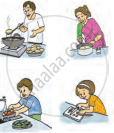
Now write what you observe in the following two pictures.

A small thought, put in action, led to a great achievement. Pick out the lines from the beginning and end of the poem and explain their significance.
Compare and contrast the two opposing human feelings as expressed by the poet.
You have heard the proverb ‘Plan your work, work your plan’. It means - ________________.
Find out from a vet or from a website, what precaution a vet has to take when he/she is called to treat wild, dangerous animals?
Make point-wise notes of the same.
Answer the following question in short.
What do you learn about Pundits of Vijaynagar?
With the help of the internet and other sources, obtain more information about the critically endangered birds and animals in India. Find the names of their sanctuaries.
Form groups and discuss the following statements, in the context of the extract.
‘If he is indeed wise, he does not bid you to enter the house of his wisdom, but rather leads you to the threshold of your own mind’ Kahlil Gibran.
Prove with the theme of the play/extract that the deeper human emotion which profoundly interested Shakespeare was jealousy.
Answer the following question in one sentence.
What examples of man’s progress have been given in the poem?
Now, talk to your friends or elders; refer to books and read about all the objects on which wheels are used. List them. (How many did you miss out on in your first list? Why?)
Apart from the stone, how many things go into the soup?
Who is the speaker in the poem?
Write a short note on the following:
Sujata’s offering
Read the passage and answer the following:
Which book is introduced in the passage?
Read the passage. Underline the new words. Guess their meaning from the context. Verify it from a good dictionary.
Write about Malti and Rima using the following points:
 |
 |
| Appearance... | Appearance... |
| Studies... | Studies... |
| Singing... | Singing... |
| Attitude to others... | Attitude to others... |
| Weak points... | Weak points... |
Use details from the story and your own imagination when you write the above descriptions.
Write about how you take care of your books.
These two passages are examples of a short introduction to works of art - a short review. They cover the following points:
- The creator
- The theme or subject matter
- Type of art
- Individual style
- Presentation techniques
- Its effect on viewers
- Message or interpretation
Compare the points with those you used for a book review and the review of a play. Present the comparison in the form of a chart.
| Book Review | Review of a play | Review of a painting |
Pick out three examples of interrogation (rhetorical questions) from the poem.
Explain in your own words the point that each one makes.
| Interrogation | Explanation |
| (1) | |
| (2) | |
| (3) |
Say whether you agree or disagree.
The children showed disinterest even in the bachelor’s story-telling, throughout.
Guess the meaning of the following word.
novel
Guess the meaning of the following word in the poem.
lined
Ask your parents or other grown-ups to show you some used notes. Observe them carefully. Have they been used properly? Write your observations.
Guess the meaning of the following word.
magnificent
What were the various sounds the brothers heard when they went downstairs?
Why did Chulong catch the bird?
Write about Hamid in one or two sentences.
What values did the child learn?
We should learn to ______questions.
- ask
- answer
- discard
What did Mr. Fogg mean by, ‘it was foreseen’?
Identify the speaker/character.
Wake up, child.
The turtles use their flippers and make a hollow for their nests.
What made Grandfather plant saplings on the rocky island?
_______ broke out in the near by villages.
Find the rhyming word from the poem.
Language - ______.
Try your own.
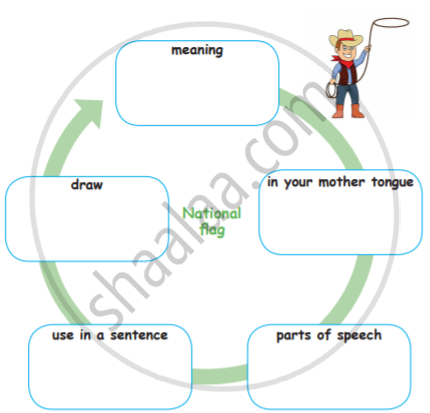
Who asked the Robot to charge the phone?
Name the character or speaker.
"You want me to strain my back?"
What did Anitha eat in the expo?
How does Raju help his mother?
Do you love to seek answers to the questions?
Divide the following word.
man
Fill in the blank
He is rich ______ he looks simple.
Meena studied in ______ standard.
What do you save? Why it is needed?
Who was Nokomis?
Why did the child in the poem like looking at the pictures?
Collect the outer coverings of fast food items. Discuss the following points in groups and then write your observations in your notebook.
- Ingredients
- Manufactured by
- Net weight
- Veg or Non-veg
- Recipe
- Nutrition facts
- MRP
- Mfg date
- Website
- Other instructions, if any
