Advertisements
Advertisements
प्रश्न
How did the author feel about her mother's passion to make her a dancer?
Advertisements
उत्तर
The author did not feel comfortable about her mother's passion to make her a dancer. The author tells us that her mother discovered in her the innate ability to dance. This motivated the author's mother to make her a dancer. The author tells us that it was the film industry that ignited interest in her mother to make her a dancer. The author says that she never wanted to be a dancer. She describes how troublesome it was for her to travel to her dance teacher's house. The author felt as though she was compelled to learn dance. She felt as if dancing was thrust upon her.
When the author was sent to study in Queen Mary's college in Lahore, she at first thought that she would not have to learn dance. But she considers it to be unfortunate that her mother sent a dance teacher, Radhelal Misra along with her. In a word, the author did not experience anything good about her mother's passion to make her a dancer.
APPEARS IN
संबंधित प्रश्न
How did the air raids disrupt the Dutch public life?
How did a story book, 'Little Lord Fauntleroy' open a window of knowledge to Helen and help to shape her career?
The black kite may start a fire because
What do elephants do to prevent water from evaporating ?
Read the following passage and do the activities:
B1 Match:
Match the areas given in Column ‘A’ with the description of Mehendi design given in Column ‘B’:
| 'A' | 'B" | ||
| (i) | North African | (a) | A mix of Indo-Pakistani and Arabic design |
| (ii) | Indian | (b) | Delicate loops and curves, paisleys, teardrops |
| (iii) | Arabic | (c) | Geometrical images |
| (iv) | South Asian | (d) | Local textiles, paintings, and architecture |
Henna comes from the leaves of the plant Lawsonia inertias. The plant grows in hot and dry climes and is native to North Africa, the Indian subcontinent and the Middle East. The leaves of the plant are dried and crushed to powder. Various additives such as coffee decoction, tea, lime juice, Mehendi and eucalyptus oil are mixed with the henna powder to increase the potency of the dry, this also helps to bind the powder to a paste-like consistency. The mixture is applied through cones in intricate patterns depending on the region of use.
Album of Patterns
Four major styles can be found in the vast dictionary of Mehendi designs. Earlier the application was restricted to hand and feet, but the adoption of Mehendi by different cultures throughout the world has seen experimentation on different body parts including the neck naval and back.
North African patterns rely on geometrical images to trace the shape of hands and feet, Arabic designs borrow heavily from local textiles, paintings, and architecture. These are more spaced out, to allow the design to stand out boldly from the skin parts left untouched by henna. The Indian style comprises of delicate loops and curves, paisleys, teardrops and flowers that give a dainty filigreed glow-like effect. Though intricate patterning is the name of the game today, this trend took off in India only during the 20th century. The patterns preferred by the South Asian countries are mixed with Indo-Pakistani and Arabic design schemes. Chinese and Celtic symbols now find a place in the vast repertoire of Mehendi designs as well.
B2 Complete:
Complete the following and write:
(i) The procedure before applying henna _______
(ii) The reasons for using additives _______
(iii) The suitable climatic conditions for the henna plant _______
(iv) Mehendi is used on _______
B3 Find words:
Look at the following description and find out proper words from the passage and write:
(i) Existing naturally in the place : - n _______
(ii) Consist of something: - c _______
(iii) Delicate decoration made from gold, silver and copper wire: - f _______
(iv) Substance that is added in small quantity : - a _______
B4 Language study:
Fill in the blanks with suitable subordinators given in the box:
| as well as, so that, however, which |
(i) The mixture is applied through cones in intricate patterns _______ depend on the region of use.
(ii) The intricate pattern is the name of the game of today _______, this trend took off in India, recently.
(iii) North African pattern relies on geometrical images ______ they can trace the shape of hands and feet.
(iv) The patterns preferred by the South Asian countries are mixed with Indo-Pakistani _______ Arabic design schemes.
B5 Personal Response:
Which Mehendi design do you like? Why?
Identify the phrases and lines that indicate distance between father and son.
Briefly comment on:
The purpose of the author’s journey to Mount Kailash.
This short story revolves around a single important event. Discuss how the narrative is woven around this central fact.
Explain the contradiction in the similies, ‘Like a child from the womb, like a ghost from the tomb’.
Try rewriting the lecture as a formal essay and examine Forster’s statement: 'since the novel is itself often colloquial, it may possibly withhold some of its secrets from the graver and grander streams of criticism’.
What facet of political life does the behaviour of Ajamil illustrate?
Find from the story one word for the following.
the highest-ranking officer in the Municipality of a city/town ______
Make groups and discuss the following:
What inspired them to spend the best part of their lives to research and share their findings?
Read the poem and write 3 qualities of the following.
Where do we find all types of wild animals in urban areas?
Read the lesson and name the following.
The First successful Cardiac Surgeon ______
Answer the following question in short.
Why was Tenali Raman taken to the court in a palanquin?
Do as directed. (Make sure you do not change the meaning and tense of the sentence).
I am proud of you. (Rewrite using the noun form of the underlined word).
Find at least two things from the poem that show the following:
The atmosphere is pleasant.
Read the description of the Kabaddi match and do the following:
Choose any one event and draw a diagram to show what happened.
Read the following sentence carefully and choose the correct meaning.
The Peacock had a gorgeous tail like no other bird.
Write short note on the following:
The 1883 eruption
Show the three categories of volcanoes using the following tree diagram structure.
Answer the following question in one sentence.
What does the man who misses all the fun do?
Write a conversation between a donkey and a dog.
Recite the poem with proper rhythm and intonation.
Explain the idea of ‘Conservation of Nature through Livelihood’ briefly, using the example given here.
Prepare similar word chains using the following ideas.
| rain | drizzle | ______ | ______ | ______ |
| wind | breeze | ______ | ______ | ______ |
| sunshine | warm | ______ | ______ | ______ |
| waterbody | pool | ______ | ______ | ______ |
| size | big | ______ | ______ | ______ |
| size | small | ______ | ______ | ______ |
There were no human settlements on the moon.
Rearrange the following in their proper order as in the poem. Write the serial number against each line:-
(a) The Ostad sang the Malkous Raga enchantingly.
(b) Akbar followed Tansen, dressed miserably.
(c) I request you to sing such a song that will I experience unmatched joy.
(d) Ostad was nowhere to be seen.
(e) O Divine Teacher, please gift us the joy of your song.
(f) One day, the singer sang Deepak Raga in the court.
(g) Akbar expressed his wish to meet the Teacher.
(h) He experienced heavenly delight.
(i) Tansen sings to please the earthly king but Ostad devotes his songs to God.
(j) She sang Raga Malhar, which had a cooling effect.
Describe the following in one or two lines.
The world around the bird’s nest.
Guess the meaning of the following word.
magnificent
Make a collection of Rangoli motifs and patterns.
Write about each motif or pattern in your own words -
it could just be a label or a description or some information or comment.
Where was the author when he heard the noise?
What made the reporter gaze at the author?
Complete the following table with information from the anecdote about Mr. Scotti’s short trip.
| Name | Nicholas Scotti |
| Occupation | |
| Reason for his trip | |
| Means of transport | |
| Destination |
Based on your reading, rearrange the following sentences in the correct sequence.
- Since all her methods failed, finally she gave him a pain-killer.
- He told his aunt that Peter had no aunt, so he gave him the medicine.
- The pain-killer triggered adverse reactions on Peter.
- It jumped out of the open window.
- Tom was dull and depressed.
- This incident upset Aunt Polly and she questioned him.
- But, Tom gave that painkiller to the cat Peter.
- So, Aunt Polly tried different types of remedies on him.
Write the name of the toys against each picture.

Read the letter again and write a few lines on each of the following.
- things that the coach taught….
- transformation in the child……..
- things that amazed the writer……..
Female Olive Ridleys come ashore at night to lay eggs.
Try your own.
He offered _______ to his daughters.
______is a Do It Yourself kid.
Try your own.
Choose the correct option from the given homophones.
The wind ______off the leaves.
The bird-catcher had a pigeon in his _______.
Anbu got ______ fish this week.
What did the archer want to show to the crowd?
Write the rhyming word.
goat
Choose the best answer.
Suddenly there was a______.
Why did Meena call the official 'Appa'? Do you think we need to be a family to care for others?
Why did Jana have a nightmare?
Why was the tree called 'The Mother Tree'?
Join the word with the correct prefix.
| paid | un |
| send | dis |
| able | re |
| continue | pre |
Nithin's mom said that Bala's father is a ______ magician.
Let us learn a few more word by joining the dots. Join the dots and fill the table below.
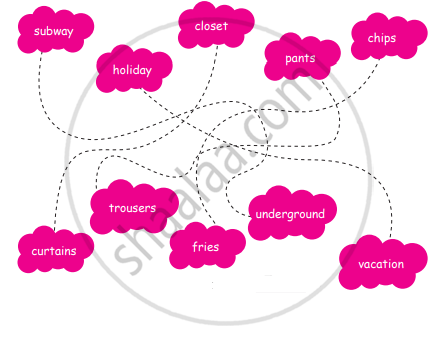
| subway | |
| holiday | |
| closet | |
| pants | |
| chips |
Chris enjoyed doing all sorts of things except, writing and ______.art
What would you have done if your grandmother would have slipped?

Who was Hiawatha?
On the basis of your understanding of the given passage, make notes in any appropriate format.
The Sherpas were nomadic people who first migrated from Tibet approximately 600 years ago, through the Nangpa La pass and settled in the Solukhumbu District, Nepal. These nomadic people then gradually moved westward along salt trade routes. During 14th century, Sherpa ancestors migrated from Kham. The group of people from the Kham region, east of Tibet, was called “Shyar Khamba”. The inhabitants of Shyar Khamba, were called Sherpa. Sherpa migrants travelled through Ü and Tsang, before crossing the Himalayas. According to Sherpa oral history, four groups migrated out of Solukhumbu at different times, giving rise to the four fundamental Sherpa clans: Minyagpa, Thimmi, Sertawa and Chawa. These four groups have since split into the more than 20 different clans that exist today
Sherpas had little contact with the world beyond the mountains and they spoke their own language. AngDawa, a 76-year-old former mountaineer recalled “My first expedition was to Makalu [the world’s fifth highest mountain] with Sir Edmund Hillary’’. We were not allowed to go to the top. We wore leather boots that got really heavy when wet, and we only got a little salary, but we danced the Sherpa dance, and we were able to buy firewood and make campfires, and we spent a lot of the time dancing and singing and drinking. Today Sherpas get good pay and good equipment, but they don’t have good entertainment. My one regret is that I never got to the top of Everest. I got to the South Summit, but I never got a chance to go for the top.
The transformation began when the Sherpa Tenzing Norgay and the New Zealander Edmund Hillary scaled Everest in 1953. Edmund Hillary took efforts to build schools and health clinics to raise the living standards of the Sherpas. Thus life in Khumbu improved due to the efforts taken by Edmund Hillary and hence he was known as ‘Sherpa King’.
Sherpas working on the Everest generally tend to perish one by one, casualties of crevasse falls, avalanches, and altitude sickness. Some have simply disappeared on the mountain, never to be seen again. Apart from the bad seasons in 1922, 1970 and 2014 they do not die en masse. Sherpas carry the heaviest loads and pay the highest prices on the world’s tallest mountain. In some ways, Sherpas have benefited from the commercialization of the Everest more than any group, earning income from thousands of climbers and trekkers drawn to the mountain. While interest in climbing Everest grew gradually over the decades after the first ascent, it wasn’t until the 1990s that the economic motives of commercial guiding on Everest began. This leads to eclipse the amateur impetus of traditional mountaineering. Climbers looked after each other for the love of adventure and “the brotherhood of the rope” now are tending to mountain businesses. Sherpas have taken up jobs as guides to look after clients for a salary. Commercial guiding agencies promised any reasonably fit person a shot at Everest.
