Advertisements
Advertisements
प्रश्न
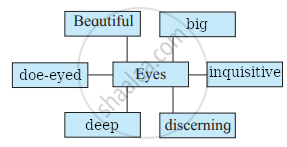
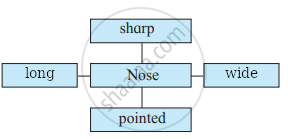
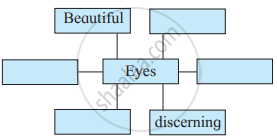
Complete the web with the help of adjectives used to describe eyes and nose in all respects. Two are done for you.

Advertisements
उत्तर


APPEARS IN
संबंधित प्रश्न
Read the passage given below and answer the questions that follow:
The term dietary fibres refers collectively to indigestible carbohydrates present in plant foods. The importance of these dietary fibres came into the picture when it was observed that the people having diet rich in these fibres, had low incidence of coronary heart disease, irritable bowel syndrome, dental caries and gall stones.
The foodstuffs rich in these dietary fibres are cereals and grains, legumes, fruits with seeds, citrus fruits, carrots, cabbage, green leafy vegetables, apples, melons, peaches, pears etc.
These dietary fibres are not digested by the enzymes of the stomach and the small intestine whereas most of other carbohydrates like starch and sugar are digested and absorbed. The dietary fibres have the property of holding water and because of it, these get swollen and behave like a sponge as these pass through the gastrointestinal tract. The fibres add bulk to the diet and increase transit time in the gut. Some of these fibres may undergo fermentation in the colon.
In recent years, it has been considered essential to have some amount of fibres in the diet. Their beneficial effects lie in preventing coronary heart disease, and decreasing cholesterol level. The fibres like gums and pectin are reported to decrease postprandial (after meals) glucose level in blood. These types of dietary fibres are recommended for the management of certain types of diabetes. Recent studies have shown that the fenugreek (Methi) seeds, which contain 40 per cent gum, are effective in decreasing blood glucose and cholesterol levels as compared to other gum containing vegetables.
Some dietary fibres increase transit time and decrease the time of release of ingested food in colon. The diet having less fibres is associated with colon cancer and the dietary fibres may play a role in decreasing the risk of it.
The dietary fibres hold water so that stools are soft, bulky and readily eliminated. Therefore high fibre intake prevents or relieves constipation.
The fibres increase motility of the small intestine and the colon and by decreasing the transit time there is less time for exposure of the mucosa to harmful toxic substances. Therefore, there is a less desire to eat and the energy intake can be maintained within the range of requirement. This phenomenon helps in keeping a check on obesity. Another reason in helping to decrease obesity is that the high-fibre diets have somewhat lower coefficients of digestibility.
The dietary fibres may have some adverse effects on nutrition by binding some trace metals like calcium, magnesium, phosphorus, zinc and others and therefore preventing their proper absorption. This may pose a possibility of nutritional deficiency especially when diets contain marginal levels of mineral elements. This may become important constraints on increasing dietary fibres. It is suggested that an intake of 40 grams dietary fibres per day is desirable.
(Extracted from ‘The Tribune’)
(a) On the basis of your reading of the above passage make notes on it in points only, using recognizable abbreviations wherever necessary. Also suggest a suitable title. (5)
(b) Write a summary of the above in about 80 words. (3)
Read the extract given below and answer the questions that follow:
That for themselves a cooling covert make
"Gainst the hot season; the mid forest brake,
Rich with the sprinkling of fair musk-rose blooms;
..................
(a) Identify the poem and the poet.
(b) What is the role of the clear rills?
(c) How has the mid forest brake become rich?
(d) Name the figure of speech in 'cooling covert'.
Orangutans use big leaves during a downpour because
Describe the changing relationship between the author and his grandmother. Did their feelings for each other change?
Have you known someone like the author’s grandmother? Do you feel the same sense of loss with regard to someone whom you have loved and lost?
How does the insertion of dialogue in the story contribute to its interest?
Discuss in pairs
Ruskin's insistence on looking intensely at words, and assuring oneself of meaning, syllable by syllable – nay, letter by letter.
Discuss in pairs or in small groups
'Our daily life reflects a double allegiance to 'the life in time' and 'the life by values'.
Read the following statement and mark those that apply to you.
I make friends easily.
Rearrange the letters to make meaningful words, occurring in the poem.
- clearmis ____________
- sowmid ____________
- gearuoc ____________
- rissupser ____________
- tabyue ____________
- madres ____________
- laveu ____________
- downre ____________
What strong qualities possessed by them, could have helped them achieve success and fame, all over?
Answer in your own words.
What message does the poem convey to all of us?
The word 'report' means -
(a) Give a spoken or written account of something.
(b) Cover an event or subject as a journalist or reporter.
Say the following word aloud and put the stress mark on the stressed syllable.
crea-tures
Guess the meaning of the following words and phrases:
untold wealth, closest to the Emperor’s heart, grave offence, banish.
Fill in the gap, choosing a word from the bracket to make an appropriate comparison.
(tall / quiet / humble / merry / busy / slippery / fast / sly / slow / big)
as ______ as a mouse.
List all the words specially used in the game of Kabaddi.
Wash your handkerchief clean. Hang it with a peg to dry in the wind. Watch how it flutters.
Describe the following with the help of the story.
Thiruvalluvar
The consequences of Oberon’s jealousy for Titania are comic rather than tragic. Comment.
Read the given extract (Act III)
Match column A with column B.
| Sr.No. | A | B |
| 1. | Dr. Thomas Stockmann | Opportunist |
| 2. | Katherine | Vulnerable |
| 3. | Peter Stockmann | Honest and upright |
| 4. | Petra | Coward |
| 5. | Hovstad | timid but supportive |
| 6. | Billing | Cuinng and corrupt |
| 7. | Aslaksen | Courageous |
Discuss the following question after you have seen a presentation of the ‘ad’.
Why does Didi say ‘No party for me!’?
What time is being described in the poem?
Complete the following sentence with reference to the passage:
He realised that making the body suffer was not ____________.
There were no human settlements on the moon.
Prepare charts for each one of the asanas described in the passage. Use the following points:
- Name (in English, in your mother tongue)
- Meaning in English
- General information
- Steps and pictures
- Benefits
Choose the appropriate phrase to insert in the gap, to make the sentence meaningful. Use the appropriate form of the verb.
Before we do the experiment in the Laboratory, let me ______ you all about it.
Form groups. Discuss how one can be a 'good reader'. Use the points in the above passage in your discussion. Write down the points that show what makes a 'good reader'.

Name the following.
Third-time winners of the Olympic gold medal for hockey.
Discuss how you will measure the worth of a sports event.
What is meant by 'Honour the white cane'?
Find out what 'Braille' is.
Rearrange the following sentences in a coherent order.
- He ordered Ariel to torment the inmates of the ship.
- Miranda was attracted by Ferdinand and had more concern towards him.
- Prospero and Miranda came to an island and lived in a cave.
- Prospero forgave them and restored his dukedom, Milan.
- He raised a violent storm in the sea to wreck the ship of his enemies.
- Prospero wanted to test Ferdinand and gave a severe task to perform.
- Using his powers, Prospero released the good spirits from large bodies of trees.
- The King of Naples, and Antonio the false brother, repented the injustice they had done to Prospero.
- Ariel was instructed to bring Ferdinand, the prince of Naples to his cave.
- Ferdinand was the second human whom Miranda had seen after her father
‘Finally the day had come’. Here the day refers to ______.
Read the letter again and write a few lines on each of the following.
- things that the coach taught….
- transformation in the child……..
- things that amazed the writer……..
What do you think is going to happen next?
Read these lines and answer the question given below.
The laughter and beauty of women long dead;
Explain the meaning of the above line.
If you are a flight attendant how will you deal with the hijackers?
Read these lines and answer the questions given below.
And welcomes little fishes in
With gently smiling jaws!
- Who welcomes the fish? Why?
- Which line tells you that the crocodile is hungry?
According to the author the tendril was moving towards grandfather because it______.
Merlin was thrilled when the school arranged the trip because ______.
Gulliver took the small creatures in his hand and crushed them.
Nilavan unknowingly started the space shuttle.
Jaswant decided to stay in his post.
Where did Anitha go?
Who will be the fortunate?
They fed fish with______.
What was the age of Robinson Crusoe when he left for sea?
What made him frightened?
Choose and write the adverbs to complete the sentence.

She won the game _____
The official's family visited the rehabilitation centre for ______ years.
Parents help us to overcome our______.
Kani took Teddy out for a ____.
The squirrel ran to the _________ tree.
Speak and win.
Join in any group. Support or oppose using 4 to 5 sentences to win.
| I support Divya. | I oppose Divya. |
What did the children buy with money they have?
What was Farhan's father's advice to his son?
Where did the rabbit go?
Read the following passage and answer the questions that follow:
The Stationmaster’s Supreme Sacrifice by Sanchari Pal (Adapted)
- Thirty-three years ago, on the night of December 2, 1984, Bhopal was hit by a catastrophe that had no parallel in the world’s industrial history. An accident at the Union Carbide pesticide plant in Bhopal had released almost 30 tons of a highly toxic gas called methyl isocyanate, turning the city into a vast gas chamber. The result was a nightmare; more than 600,000 people were exposed to the deadly gas cloud that left thousands dead and many more breathless, blind and in agonizing pain. Few people know that during the Bhopal gas tragedy a heroic stationmaster risked his own life to save others.
- On the evening of December 3, 1984, Ghulam Dastagir was settling down in his office to complete some pending paperwork. This work kept him in his office till 1am in the night, when he emerged to check the arrival of the Gorakhpur Mumbai Express. As he stepped on to the platform, the deputy stationmaster felt his eyes burn and a queer itching sensation in his throat. He did not know that poisonous fumes leaking from Union Carbide’s pesticide factory were stealthily enveloping the railway station.
- Beginning to choke, Dastagir did not know then that twenty-three of his railway colleagues, including his boss, station superintendent Harish Dhurve, had already died. It was later reported that Dhurve had heard about the deadly gas and had immediately tried stopping the movement of trains passing through Bhopal before collapsing in his office chamber. His suddenly worsening health and years of experience told Dastagir that something was very wrong. Though he did not fully comprehend what was happening, he decided to act immediately when he did not get any response from the station master. He alerted the senior staff at nearby stations, like Vidisha and Itarsi, to suspend all train traffic to Bhopal.
- However, the jam-packed GorakhpurKanpur Express was already standing at the platform and its departure time was 20 minutes away. Listening to his gut instinct, Dastagir summoned his staff and told them to immediately clear the train for departure. When they asked if they should wait until the order to do so came from the head office, Dastagir replied that he would take complete responsibility for the train’s early departure. He wanted to ensure that the train left immediately, without any delay. His colleagues later recalled that Dastagir could barely stand and breathe as he spoke to them. Breaking all rules and without taking permission from anyone, he and his brave staff personally flagged off the train.
- But Dastagir’s work was not done. The railway station was filling up with people, desperate to flee the fumes. Some were gasping, others were vomiting, and most were weeping. Dastagir chose to remain on duty, running from one platform to another, attending, helping and consoling victims. He also sent an SOS to all the nearby railway offices, asking for immediate medical help. As a result, four ambulances with paramedics and railway doctors arrived at the station. It was winter and the gas was staying low to the ground, a thick haze poisoning everything in its path. Besieged by hordes of suffering people, the station soon resembled the emergency room of a large hospital. Dastagir stayed at the station, steadfastly doing his duty, knowing that his family was out there in the ill-fated city. That day all he had for his protection was a wet handkerchief on his mouth.
- Ghulam Dastagir’s devotion to duty saved the lives of hundreds of people. However, the catastrophe didn’t leave him unscathed. One of his sons died on the night of the tragedy and another developed a lifelong skin infection. Dastagir himself spent his last 19 years shuttling in and out of hospitals; he developed a painful growth in the throat due to prolonged exposure to toxic fumes. When he passed away in 2003, his death certificate mentioned that he was suffering from diseases caused as a direct result of exposure to MIC (Methyl Isocyanate) gas. A memorial has been built at platform No.1 to pay tribute to those who sacrificed their lives in the line of duty on the fateful night of December 3, 1984. However, Ghulam Dastagir, who died later, is not one of them. A forgotten hero whose sense of duty and commitment saved countless lives, Dastagir’s story deserves to be recognized and remembered by our fellow countrymen.
- Why was the accident at Union Carbide unparalleled in the world’s industrial history?
- How was Dastagir affected by the poisonous gas?
- What was the action taken by the station superintendent?
- How did Dastagir and his staff break rules?
- What was the cause of Dastagir’s death?
- Find words from the passage which mean the opposite of the following.
- safeguard (para 1)
- common or familiar (para 2)
- prompt (para 4)
- cause (para 6)
Being a bachelor, the stranger had no patience with children.