Advertisements
Advertisements
प्रश्न
Although Paul's mother liked to be rich she did not approve of betting on horses.
Advertisements
उत्तर
Paul's mother foolishly wished to be rich and yet was not able to achieve or materialise her desire. She blamed it on her husband for being unlucky. However, she was one of those humans who do not tread as per their cloth. She was used to a lavish lifestyle and blamed her husband and misfortune for low income. Yet there was one thing appreciable about her that she was against gambling. She did remark in her conversation with her brother that she had seen her family members pursuing it and how it led to their fall. She advised her son to not indulge in it and made him promise that he will not think about racing horses anymore.
APPEARS IN
संबंधित प्रश्न
What was Mr. Otto Frank's major contribution to the world?
Read the following extract and answer the questions given below:
If you do not get lowered in your own eyes
While you raise yourself in those of others,
If you do not give in to gossips and lies
Rather heed them not, saying, 'who bothers?'
You may be the person I am looking for.
If you crave not for praise when you win
And look not for sympathy while you lose,
If cheers let not your head toss or spin
And after a set-back, you offer no excuse,
You may be the person I and looking for.
(1) What should be your reaction towards gossips and lies?
(2) Who are your role models? Why?
(3) Give the rhyming pairs of words from the first stanza.
(4) Which line is repeated in this extract and what is its effect?
How do chimps drink water from the waterholes?
Answer the following question in 200-250 words:
Helen had a great love for animals and birds. Write about this aspect of her character.
Notice these expression in the text. Infer their meaning from the context.
cairn of rocks
Briefly explain the following statement from the text.
“You neither travelled to the past nor the future. You were in the present experiencing a different world.”
Briefly explain the following statement from the text.
Gangadharpant could not help comparing the country he knew with what he was witnessing around him.
What were the voices that Paul heard? Did they lead him to success in the real sense?
How have the three passions contributed to the quality of Russell's life?
Comment on the use of the phrase ‘fresh-peeled voice’.
Who said to whom and when / why?
| Who said | To whom? | When / why? | |
| ......the world is full of inequalities. | |||
| I want to do something interesting. | |||
| It is against the will of God. | |||
| Our home is full of love....... | |||
| ...... we can affirm along with United Nations that men and women are equal. |
Paraphrase the poem in your own simple language. Write it down in your notebook.
State whether the following statement is True or False. Correct the false statement by finding evidence from the poem to support your remark.
The poem has an underlying message about the importance of trees.
How do we help animals and birds?
Form groups and discuss what must have happened to the handkerchief. Write the story in your own words.
Discuss the following question after you have seen a presentation of the ‘ad’.
How many times is the name Krispy Krunchy repeated in the ad? Why?
Write a useful ‘ad’ for the importance of games, drinking enough water, your own school.
Think carefully for a minute.
Jog your memory and recall all the things/objects on which you have seen wheels. Write them down
Choose any one of the seven States. Find more information about it and prepare a leaflet or brochure to invite people to visit it.
Expand the following ideas in a paragraph or two:-
Where there is a will, there is a way.
Expand the following ideas in a paragraph or two:- Courage and resourcefulness are the keys to overcome problems.
Rewrite the poem in the form of a prose passage.
What did Mr. Gizare appreciate the most?
What is your favourite time of the day? Describe it in detail.
Complete the following sentence with reference to the passage.
They may be composed and sung or recited for many years before __________________.
The Emperor says he had realised earlier that Abdul has great talent. Does this tally with his actions? Give your opinion.
Rohan had finished ______ rounds of the tree before Mrs. Groover discovered him.
Who said the following, to whom, and when?
“As you desire, Huzoor.”
Listen carefully and guess how the sentence would end.
When the students saw the question paper, they were ______.
Do you agree with the poet’s thoughts? Why?
Do you think that the young seagull’s parents were harsh to him? Why?
What are the three rules given by the bird?
Write a paragraph on ‘The Grumble Family’ and their attitude towards other folks.
Answer the following question in about 80-120 word.
If you were to live in the Complaining Street, how would you deal with the people who grumble?
What do Tamil Nadu folk dances and folk arts represent?
Based on your reading, rearrange the following sentences in the correct sequence.
- Since all her methods failed, finally she gave him a pain-killer.
- He told his aunt that Peter had no aunt, so he gave him the medicine.
- The pain-killer triggered adverse reactions on Peter.
- It jumped out of the open window.
- Tom was dull and depressed.
- This incident upset Aunt Polly and she questioned him.
- But, Tom gave that painkiller to the cat Peter.
- So, Aunt Polly tried different types of remedies on him.
Teachers help me to learn ______ things.
- new
- bad
- difficult
Write the names of the characters in this story.
1. ______ 2. ______ 3. ______
Imagine you are a marketing executive for a company in a specific industry (toothpaste, soup, hair care products, automobiles, etc) and are developing a product with a brand name that refers to a character from the story.
For example: You want to sell bandages that have little pictures of Don Quixote on them. Your company’s name is Kure-All and you decide to call them “Kure-All Quixote Bandages”.
The slogan might be: “Had a tough day with windmills? When you take a fall, use Kure-All.”
You can use exciting words, a catchy new slogan and a jingle among other things to promote sales of your item.
When did the garden become a happy place for the author?
Find out the idiom that relates to ‘whatever the circumstances’, from the first paragraph.
Identify the speaker/character.
They somehow managed to put him on the platform.
Did Tabaqui receive a warm welcome from the pack of wolves? How do you know?
Match the dialogue to the character.
| "I will do all the work myself." |  |
| "First, you charge my battery." |  |
| "I have bought you a robot." |  |
What wins the hearts?
Name the character or speaker.
“How did I win the competition with a single stroke?”
Why was the fish floating on top?
Will you solve a mystery with friends? Why?
The official and his wife liked______.
Parents never let us get ______.
What is the main idea of the text?
Why did Jana’s friends stop her from going near the tree?
Choose the word with same meaning.
Foot hills- ______
Choose the word with same meaning.
Kingdom- ______
Choose the correct one.
Elephant

Nithin had many ______toys.
The fir tree was sad ______.
Circle the words where you get a zzzzz sound. One is done for you.
| honeybees | |||
| price | prize | maze | face |
| rice | rise | blaze | fizz |
| lazy | lacy | busy | racy |
| raise | rays | race | ace |
| chase | this | these | frosty |
Read the following passage and do the activities:
A1. Fill in the blanks: (2)
- ______ percent of our daily communication is non-verbal.
- Eye contact is another type of ______ communication.
- Frequent blinking is a sign of the person feeling ______.
- One can readily detect _______.
|
According to some experts, a staggering 93 percent of our daily communication is non-verbal. Facial expressions are easy to decipher. One can readily detect happiness, sadness, anger. Physicians can tell a patient is doing well (or not) by looking at his/her face. Eye contact is another type of non-verbal communication, which can tell a lot about the other person. The eyes convey a range of emotions-happiness, sadness, boredom, surprise, confidence .......... even emotional interest. Staring at someone's forehead may intimidate the recipient, staring at the mouth is sometimes interpretated as a sign of emotional interest. In fact, staring into someone's eyes is a sign of lying, and so is looking away. In certain cultures, lack of eye contact is taken as a sign of respect. If body language is to be defined, it is a combination of facial expression, gestures, eye contact, body movements and posture and voice. Frequent blinking is a sign of the person feeling distressed or uncomfortable. If the pupils are dilated, it ofter indicates interest, even emotional interest. The lips also reflect our body language, and lip biting indicates worry and/or anxiety; tightening of the lips may be an indication of disapproval. Slightly turned-up lips indicate happiness and slightly turned-down lips indicate sadness. |
A2.
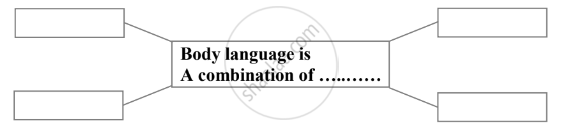
A3. Find the antonyms of: (2)
- verbal × ______
- entertaining × ______
- sender × ______
- comfortable × ______
A4. Do as Directed: (2)
- The eyes convey a range of emotions. (Frame a 'Wh' question in order to get the underlined part as answer).
- Physicians can tell about a patient's wellness. (Rewrite using 'able to')
A5. Personal Response: (2)
Non-verbal communication plays an important role in our daily life. Comment.
Activity: Live English: Packs, packets, pouches, wrappers

Given above is the picture of an imaginary food item’s packet. Let us see how to ‘read’ the matter on the packet as a vigilant consumer.
- Look at the wrapper and complete the sentences.
- The name of the food item is ______.
- It is made by ______.
- It is a ______ food item. (Veg/Non-veg)
- The ______ sign indicates whether it is a Veg or Non-veg food item.
- The ingredients are ______, ______, ______, ______.
- The date of packing is ______ and the expiry date is ______.
- It should be consumed before ______ from the date of manufacturing.
- Try and obtain more information about the various symbols printed on the packet.
- Discuss the following -
- Why the ‘recipe’ is given on the packet.
- Why the packet tells us to visit the website of the company.
- What ideas are used to make the packet attractive?
- How you will verify whether something is good for you to eat.
