हिंदी

Read the following passage - According to some experts, a staggering 93 percent of our daily communication is non-verbal. Facial expressions are easy to decipher. - English (Second/Third Language)

Advertisements
Advertisements

प्रश्न

Read the following passage and do the activities:

A1. Fill in the blanks:  (2)

  1. ______ percent of our daily communication is non-verbal.
  2. Eye contact is another type of ______ communication.
  3. Frequent blinking is a sign of the person feeling ______.
  4. One can readily detect _______.

According to some experts, a staggering 93 percent of our daily communication is non-verbal. Facial expressions are easy to decipher. One can readily detect happiness, sadness, anger. Physicians can tell a patient is doing well (or not) by looking at his/her face.

Eye contact is another type of non-verbal communication, which can tell a lot about the other person. The eyes convey a range of emotions-happiness, sadness, boredom, surprise, confidence .......... even emotional interest. Staring at someone's forehead may intimidate the recipient, staring at the mouth is sometimes interpretated as a sign of emotional interest. In fact, staring into someone's eyes is a sign of lying, and so is looking away. In certain cultures, lack of eye contact is taken as a sign of respect.

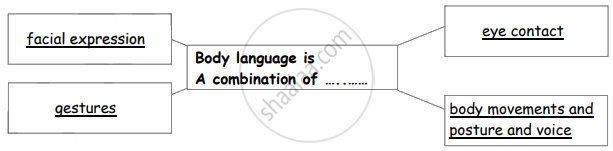
If body language is to be defined, it is a combination of facial expression, gestures, eye contact, body movements and posture and voice.

Frequent blinking is a sign of the person feeling distressed or uncomfortable. If the pupils are dilated, it ofter indicates interest, even emotional interest. The lips also reflect our body language, and lip biting indicates worry and/or anxiety; tightening of the lips may be an indication of disapproval. Slightly turned-up lips indicate happiness and slightly turned-down lips indicate sadness.

A2.

A3. Find the antonyms of:    (2)

  1. verbal × ______
  2. entertaining × ______
  3. sender × ______
  4. comfortable × ______

A4. Do as Directed:   (2)

  1. The eyes convey a range of emotions.   (Frame a 'Wh' question in order to get the underlined part as answer).
  2. Physicians can tell about a patient's wellness.  (Rewrite using 'able to')

A5. Personal Response:   (2)

Non-verbal communication plays an important role in our daily life. Comment.

संक्षेप में उत्तर
सारिणी
रिक्त स्थान भरें
एक पंक्ति में उत्तर
एक शब्द/वाक्यांश उत्तर
Advertisements

उत्तर

A1. 

  1. 93 percent of our daily communication is non-verbal.
  2. Eye contact is another type of non-verbal communication.
  3. Frequent blinking is a sign of the person feeling distressed or uncomfortable.
  4. One can readily detect happiness, sadness, anger.

A2.
A3.

  1. verbal × non-verbal
  2. entertaining × boredom
  3. sender × recipient
  4. comfortable × uncomfortable

A4. 

  1. What do the eyes convey?
  2. Physicians are able to tell about a patient’s wellness.

A5. In our daily interactions, using body language, gestures, eye contact, and facial expressions to communicate a message enhances verbal communication. When we encounter people from other cultures, it helps us communicate. One may comprehend and create stronger connections at home and at business by understanding non-verbal cues and picking up on them.

shaalaa.com
Reading Skills
  क्या इस प्रश्न या उत्तर में कोई त्रुटि है?
2021-2022 (March) Set 1

संबंधित प्रश्न

Attempt a character sketch of Otto Frank, Anne's father.


Attempt a character sketch of Mr Gilman as a teacher.


Answer the following question in 120 – 150 words: 

How do you perceive Dr. Kemp based on his interaction with Griffin ? (The Invisible Man) 


What strategy do chimps use to open hard shells and fruits ? 


Number the points.


What does the phrase 'as if he were on needles' mean? Can you think of another phrase with a similar meaning substituting the word 'needless'?


What was the reason for young Paul's restlessness at the beginning of the story? How did it find expression?


Notice these expressions in the poem and guess their meaning from the context:

rancid breath squelching tar
spectroscopic flight of fancy
rearing on the thunderclap brunette
peroxide blonde clinical assent
raven black

The quill is the central element of the poem – what does it symbolise?


How is the idyllic juxtaposed with the pedestrian in the poem?


Discuss the following in pairs or in small groups.
“Before you begin experimenting you need to perfect the technique with which you experiment.”


Say why the speaker of the poem wishes to be a-

hawker


Find evidence from the lesson and write in your own words.

We Indians are obsessed with foreign things. 


Pick out some sentences from the lesson that convey a general truth.


Who gives medicine/treatment to sick animals and birds?


Expand the idea inherent in the following proverb:

A Bad workman blames his tools.


Play the roles of an interviewer and a Great Indian Bustard and present the interview in the classroom.


Write a short note on the following:

Veterinary Science in Ancient India.


Think of a play/skit which you have seen enacted on the stage and which has impressed you. Write the following details about it.

Name of the play/skit: ______________
Important characters: ______________
Any famous actors/actresses: ______________
Theme: ______________
Climax: ______________
Ending: ______________
Use of lights and special effects if any: ______________
Use of background music and sound effects if any: ______________
Use of sets: ______________
The costumes, make up, etc. of the characters: ______________
How well the actors present the play and behave on the stage: ______________
Your own opinion about the play: ______________

Form a group of 4 or 5. Make a ‘storyboard’ for the story ‘Three Sacks of Rice’.
Arrange the story in the form of a sequence of pictures.
Decide what you will show in each picture; what words/lines you will write with each picture to explain what happens in it.
You can also add ‘speech balloons’ for the people in the pictures.


Write in short how the travellers crossed the first ditch.


Miranda was brought to the island ____________ years ago.


Read the lines and answer the questions.

They are of all forms and shapes

They all have an excellent ending

What do have an excellent ending?


Mother called ______.


Read the questions related to the three sports stars you have read about and tick the appropriate boxes.

 
1. Who won the Olympic 2016 silver medal in badminton?      
2. Who is the role model for her siblings?      
3. Whose mother tongue is Tamil?      
4. Whose attitude is 'never-say-die spirit'?      
5. Which player works in the Police Department?      
6. Which player holds the record for the highest individual score in cricket?      

The blue lights seen through the window were aliens.


Match the following.

cuckoo blows
breeze sings
river swims
fish flows

How should we treat everyone?


Some words sound the same but their spelling and meaning are different. Such words are called homophones. There are many homophones.


Match the rhyming words.

mars crime
bed cars
time head

Why did Robinson name the tribe Friday?


The old man put _____ on the mouth of the gourd.


Read the passage three times and colour a cup for eachtime.

There is a table under a tree. A man with a big hat and a hare with long ears are sitting. A young girl is sitting between them. There are many cups on the table. The girl has a cup in her hand, and the man has a pot in his hand. It seems like they are having tea. Yes, they are having tea at the tea party in Wonderland. The girl is Alice, and she is in Wonderland.


In real, the test is for______.


The child won’t ______ anything, if he closes his ears.


A person who overcomes problems, will get ______ at the end.


Draw the garden of your dreams.


Write the related words as shown in the example:


Based on the poet’s idea of true success, think of four people in your surroundings - your family, neighbours, friends, teachers, classmates, etc. who have achieved true success. Write, in short, what makes them successful.


Share
Notifications

Englishहिंदीमराठी


      Forgot password?
Use app×